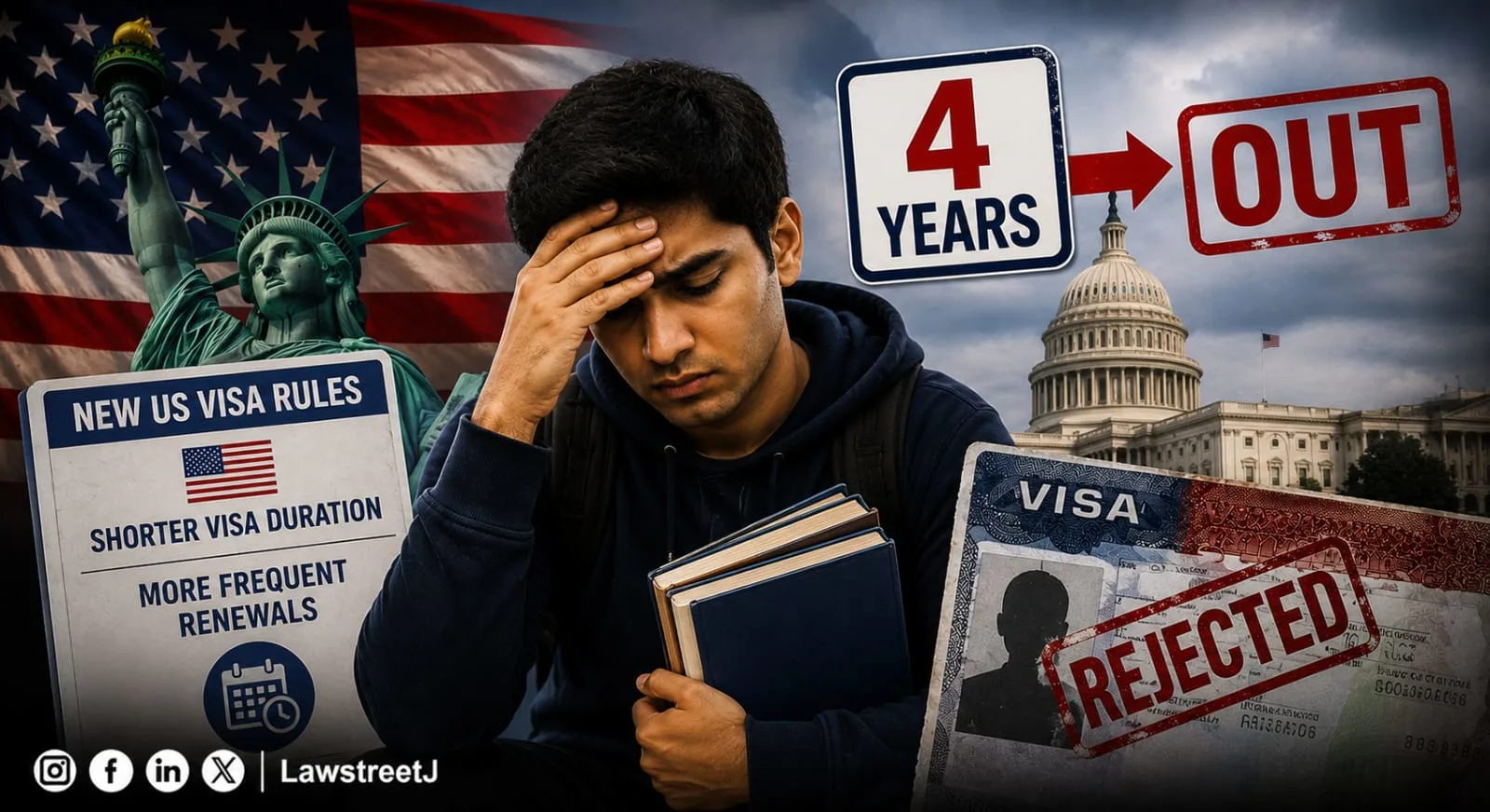
Washington D.C.: In one of the most sweeping changes to these visa categories in decades, the Department of Homeland Security announced a final rule on July 16 establishing fixed periods of admission for F student, J exchange visitor, and I media visa classes. The rule is scheduled to take effect on September 15, 2026, and is expected to touch hundreds of thousands of international students, including India's largest-in-the-world cohort in America.
Under the outgoing system, known as "duration of status," F, J, and most I visa holders were admitted for as long as they remained enrolled in their programme, without a fixed departure date stamped on their paperwork. That framework, in place for decades, is now being replaced with one in which every stay has a fixed end date and every extension requires direct approval from US Citizenship and Immigration Services.
DHS Secretary Markwayne Mullin said the open-ended system had "compromised national security" for nearly half a century and allowed some students to remain in the country indefinitely by repeatedly re-enrolling in courses. The administration argues that the changes will combat visa fraud and strengthen national security, even as legal experts warn they could harm the nation's economy and innovation. DHS said it was eliminating what it called a "duration of status loophole" that allowed these visa classes to "remain in the United States indefinitely without routine government oversight."
What Changes for F Visa Holders: International Students
Rather than being admitted for the duration of their studies, students would receive fixed periods of admission and, in many cases, need to seek approval from USCIS to remain in the country longer.
The student visa period would be no longer than four years, with holders able to apply for extensions. This four-year cap creates an immediate and severe structural problem for doctoral students, whose programmes in science, engineering, medicine, and the social sciences routinely run five to seven years. A PhD scholar admitted in September 2026 under the new rules would need to file a formal USCIS extension application before the end of their fourth year, adding a bureaucratic hurdle, filing fee, and waiting period with uncertain approval outcomes to the already demanding process of completing a doctorate.
About 1.5 million current F and J visa holders will automatically be transferred to the new system. In 2023 alone, more than 1.6 million F-1 students, over 500,000 J exchange visitors, and 32,470 I visa holders were admitted to the United States.
The rule also shortens the post-graduation grace period and imposes mandatory extension reviews for students seeking Optional Practical Training, the post-study work authorisation that allows international graduates to work in the United States for up to three years in STEM fields. OPT has been one of the central reasons Indian students choose American universities over those of other English-speaking countries: it provides a structured pathway into the US technology job market that no other destination replicates at the same scale. A mandatory USCIS review at the OPT extension stage introduces a new layer of uncertainty into that pathway.
The rule also shifts authority away from universities and exchange program administrators, who previously had significant latitude to certify and manage the duration of status of their international students, toward direct federal immigration oversight. Universities that have built their international student programmes on the assumption of duration of status flexibility will need to substantially revise their advising, compliance, and support frameworks before September 15.
What Changes for J Visa Holders: Exchange Visitors and Researchers
J-1 exchange visitors, a category encompassing research scholars, university professors, physicians in training, au pairs, summer work travel participants, and cultural exchange programme visitors, along with their J-2 dependents are subject to the same four-year maximum as F visa holders.
The implications for academic researchers on J-1 visas are particularly disruptive. Multi-year research projects at American universities, the kind that produce the peer-reviewed scientific output that American research institutions depend on for their global rankings and their grant funding, may now be interrupted by mandatory USCIS extension applications mid-project. A researcher working on a five-year laboratory project would need to file for an extension in year four, with no guarantee of timely approval by USCIS, whose processing times have historically varied widely and have been subject to significant backlogs.
The rule also affects J-2 dependent spouses and children, family members who have in many cases built their own professional and educational lives in the United States around the assumption that their J-1 primary holder's status would last as long as the programme required. Under the new framework, their status is co-terminous with the primary holder's admission period and equally subject to the extension requirement.
What Changes for I Visa Holders: Foreign Journalists and Media Professionals
The visa for journalists, which currently can last years, would be up to 240 days or, in the case of Chinese nationals, 90 days.
The 240-day ceiling for most I visa holders represents a fundamental restructuring of how foreign media organisations post correspondents and bureau staff to the United States. A journalist currently based in Washington or New York under an I visa that lasts for the duration of their posting would, from September 15, need to plan their work assignment around a 240-day admitted period and actively file for extension if their posting extends beyond that point.
The singling out of Chinese journalists for a 90-day ceiling,, one-quarter of the general 240-day limit applied to other nationalities is explicitly national security-motivated. The Trump administration has treated Chinese state media organisations as foreign mission entities and has been incrementally restricting the operational conditions under which their personnel work in the United States. The 90-day cap formalises that restriction in immigration law.
For Indian journalists and media professionals holding I visas, the 240-day limit requires practical adaptation to how assignments are structured, renewed, and extended, but does not impose the dramatic restriction that Chinese correspondents face.
India at the Centre of the Story
India is not a peripheral player in this story, it is the central one.
India has for several years been the largest source of international students in the United States, surpassing China in 2023 and maintaining that position since. Indian students hold a disproportionately large share of F-1 visas and an even larger share of OPT extensions in STEM fields, where Indian nationals working in American technology companies after graduation have become a defining feature of the US technology sector's talent pipeline. Indian nationals are also the largest single group of J-1 research scholars at American universities.
Students from India, China and South Korea are expected to be among those most affected by the rule, Bloomberg reported.
The four-year cap is particularly consequential for the most common academic trajectory of Indian nationals in the United States: a two-year master's degree, followed by OPT employment, followed by either further study or independent employment. The combination routinely exceeds four years before the doctoral phase has even begun. Students who have planned five- or six-year academic journeys based on the current duration of status framework will need to restructure those plans before September 15 or face having their admitted period expire mid-programme.
The DHS's explicit citation of national security risks from Indian and Chinese students is also notable and has drawn sharp reactions from Indian university associations and diaspora organisations. The rule's preamble frames the problem in part as one of oversight, of the US government's inability to verify that students are engaging only in authorised activities without routine check-in points. But the specific naming of India and China as countries of concern, in the context of a rule that imposes new restrictions primarily affecting their nationals, has been received as a signal that goes beyond administrative efficiency.
Legal Challenges and What Universities Are Saying
The rule has been classified a "major rule," meaning it is subject to congressional review, though DHS retains the authority to implement it on schedule unless Congress intervenes.
Immigration attorneys and university associations have indicated they are reviewing the final rule for potential legal challenge. The core legal argument likely to be tested is whether DHS has the statutory authority under the Immigration and Nationality Act to replace the duration of status framework with a fixed-period system without explicit congressional authorisation, particularly given that the INA's provisions governing F and J status have historically been interpreted to allow the current system.
American universities have been outspoken in opposing the rule since its proposed version was released in 2025. The Association of International Educators, NAFSA, and the Association of American Universities have described the change as likely to reduce international student enrolment significantly with direct economic consequences for institutions heavily dependent on full-tuition-paying international students, and indirect consequences for American innovation and the technology sector that draws so heavily on international student talent.
The economic dimension is not trivial. International students contribute over $40 billion annually to the US economy through tuition, housing, and living expenses. India alone accounts for over $10 billion of that figure. A rule that adds bureaucratic uncertainty to the process of studying in the United States, at a moment when Canada, the United Kingdom, Germany, and Australia are all actively competing for the same cohort of internationally mobile Indian students, could produce a durable shift in where those students choose to go.
With a September 15 implementation date, universities and students have fewer than two months to adapt to a change that affects every aspect of how international students plan, fund, and execute their American educational journeys. For the hundreds of thousands of Indian students currently enrolled in American institutions or planning to enrol in the coming academic year, the rule's practical implications are immediate, consequential, and as of today, still being litigated in the courts of law and public opinion.


.jpeg)