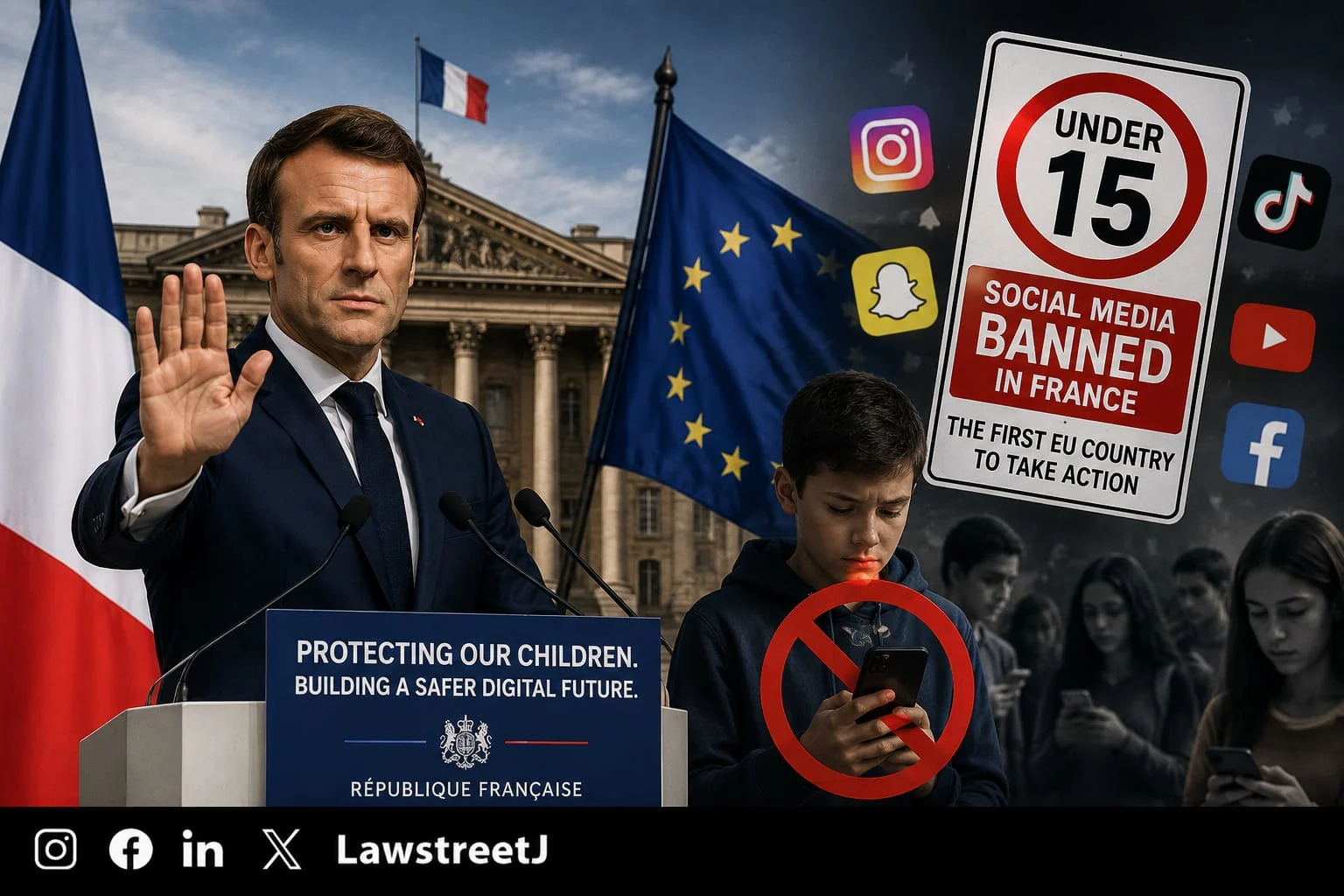
Paris: French lawmakers approved on Tuesday a ban on social media access for children under the age of 15, as concerns grow around the world over the impact social media has on the health and safety of minors. France becomes the first in Europe to follow Australia, where the world's first ban for under-16s on platforms including Facebook, Snapchat, TikTok and YouTube came into force in December.
Both houses of France's parliament voted in favour of the legislation on the same day, the Senate gave its approval in the morning session, and the National Assembly subsequently passed the bill by 279 votes to 81. "France opens the way by being the first country in Europe to adopt a digital majority," Anne Le Hénanff, junior minister for AI, told senators. French President Emmanuel Macron described the outcome as a "major step forward," calling it a flagship reform of his final term in office.
The legislation must still receive clearance from the Constitutional Council before it takes effect, but the government has stated it expects that process to proceed without obstacle in time for the September 1 implementation date.
A Six-Month Legislative Journey
The bill that passed on July 21 has been working its way through France's bicameral legislature since late 2025. The National Assembly first passed its version of the bill in January 2026 by 116 votes to 23. The Senate spent the following months debating it, with the two chambers disagreeing on specific provisions, particularly on whether a two-tier system should apply, distinguishing between platforms blacklisted as harmful to children and those accessible with parental consent, as opposed to a blanket ban across all platforms.
A cross-party joint committee, seven members of the National Assembly paired with seven senators reached a compromise text on Monday July 20, resolving the key disagreement in favour of the National Assembly's blanket ban approach over the Senate's proposed two-tier framework. Under French legislative procedure, the National Assembly has the final word, meaning its preference for a blanket ban without a parental consent exception prevailed.
The bill was submitted to the National Assembly in November 2025 and was proposed by centrist lawmaker Laure Miller, who presented it to the chamber with the words: "Our children are reading less, sleeping less, and comparing themselves to one another more. This is a battle for free minds."
What the Law Does: A Provision-by-Provision Account
The legislation bans children under 15 from accessing social media platforms and social networking functionalities embedded within broader platforms. The ban covers the major platforms including Facebook, Instagram, TikTok, Snapchat, and YouTube, among others.
The implementation is structured in two stages. From September 1, 2026, the start of the new school year, which was Macron's stated deadline for the law to be in place, children under 15 will be blocked from creating new social media accounts. Platforms will be required to use age verification tools approved by France's privacy regulator, the Commission Nationale de l'Informatique et des Libertés. Existing accounts held by under-15s will not be immediately closed, but platforms will have until January 2027 to close those accounts as well. "For four months, all of us in France will have to prove our age," Digital Minister Anne Le Henanff told journalists. "If someone is under 15, the account will be closed."
The onus is on platforms to implement the rule, not on children or parents. The text does not provide for any penalties for children or parents. Digital Minister Le Henanff said the timeline was realistic "because age-verification tools already exist" with others still in development.
Exceptions to the ban are provided for sites such as online encyclopaedias, educational or scientific directories, and platforms for the development and sharing of free software or open-source educational digital projects, meaning Wikipedia, educational databases, and open-source development platforms remain accessible to under-15s.
The legislation also bans students from using mobile phones in schools, a provision that extends and formalises rules that France has been progressively tightening since 2018, when a partial school phone ban was introduced.
Macron's Personal Championing of the Law
President Macron described the bill passing as a "major step forward" and has been personally committed to the ban as a signature policy of his final presidential term. "France is leading the way in Europe," he said following the vote.
Macron had previously pointed to social media as one factor contributing to violence among young people, citing the riots that followed the police shooting of Nahel Merzouk in 2023, which were partly organised through social media platforms, as evidence of the real-world consequences of unregulated social media access for young people.
He has been urging France to follow Australia since December 2025, when Australia's ban for under-16s came into force. The French threshold of 15, one year younger than Australia's, makes France's ban the strictest age-based social media restriction enacted by any democracy. It is also stricter than the 16-year-old benchmark adopted by the United Kingdom, where Prime Minister Andy Burnham announced last week that Britain would implement a similar ban within a year.
The Debate: What Critics Said
The Senate's original two-tier approach, which would have distinguished between platforms blacklisted as harmful and those accessible with parental consent, reflected concerns within the upper house that a blanket ban would be difficult to enforce and might push younger teenagers toward less well-known platforms that are harder to regulate. The joint committee's decision to abandon the Senate's blacklisting system in favour of a uniform ban was not without dissent.
Some lawmakers on the left raised concerns about the age verification process itself, arguing that requiring all French internet users to prove their age to access social media creates a de facto national digital identity system that raises serious privacy concerns. The Commission Nationale de l'Informatique et des Libertés, France's data privacy regulator, will be responsible for approving the verification methods platforms use, and legal advocates have noted that the choice of verification technology will determine whether the law's privacy implications are manageable or significant.
The blacklisting system, which the Senate had preferred, would have taken more time, including fresh consultations with the European Commission on the criteria, and carried what lawmaker Laure Miller described as a "small risk" of non-compliance with EU law, since EU-wide digital market rules govern how member states can regulate online platforms. The blanket ban avoids that specific complication but introduces the age verification privacy question in its place.
France in the Global Context
France's law makes it the first EU member state to enact a blanket social media ban for minors. It joins a rapidly growing list of democracies that have taken legislative action on this issue.
Australia became the first country in the world to implement a nationwide ban, with its under-16 threshold coming into force in December 2025. Indonesia's ban for under-16s took effect on March 28, 2026. Malaysia's under-16 ban came into force on June 1, 2026. The UAE became the first Arab nation to ban social media for under-15s in June 2026. The UK's Starmer government committed to a ban for under-16s before Burnham's administration confirmed it would proceed.
Greece has announced a similar ban for under-15s beginning January 1, 2027. Denmark, Spain, Norway, Poland, and Slovenia are all at various stages of drafting or considering comparable restrictions. Italy has restricted under-14s from social media through a combination of data protection rules and platform guidelines. The European Parliament has called for the EU to set minimum ages for children's social media access at the bloc level, although individual member state legislation has so far moved faster than any EU-wide directive.
France's passage of the bill means that when the new school year begins on September 1, 2026, the same day French children return to classrooms, those under 15 will find that the social media world has changed. Whether platforms successfully implement the required age verification in time, whether under-15s find workarounds, and whether the Constitutional Council clears the law before the September deadline are the three immediate questions the government must now answer.
"The major platforms are, in my view, largely ready," lawmaker Laure Miller said after the vote. Her confidence will be tested in the forty-one days between now and September 1.