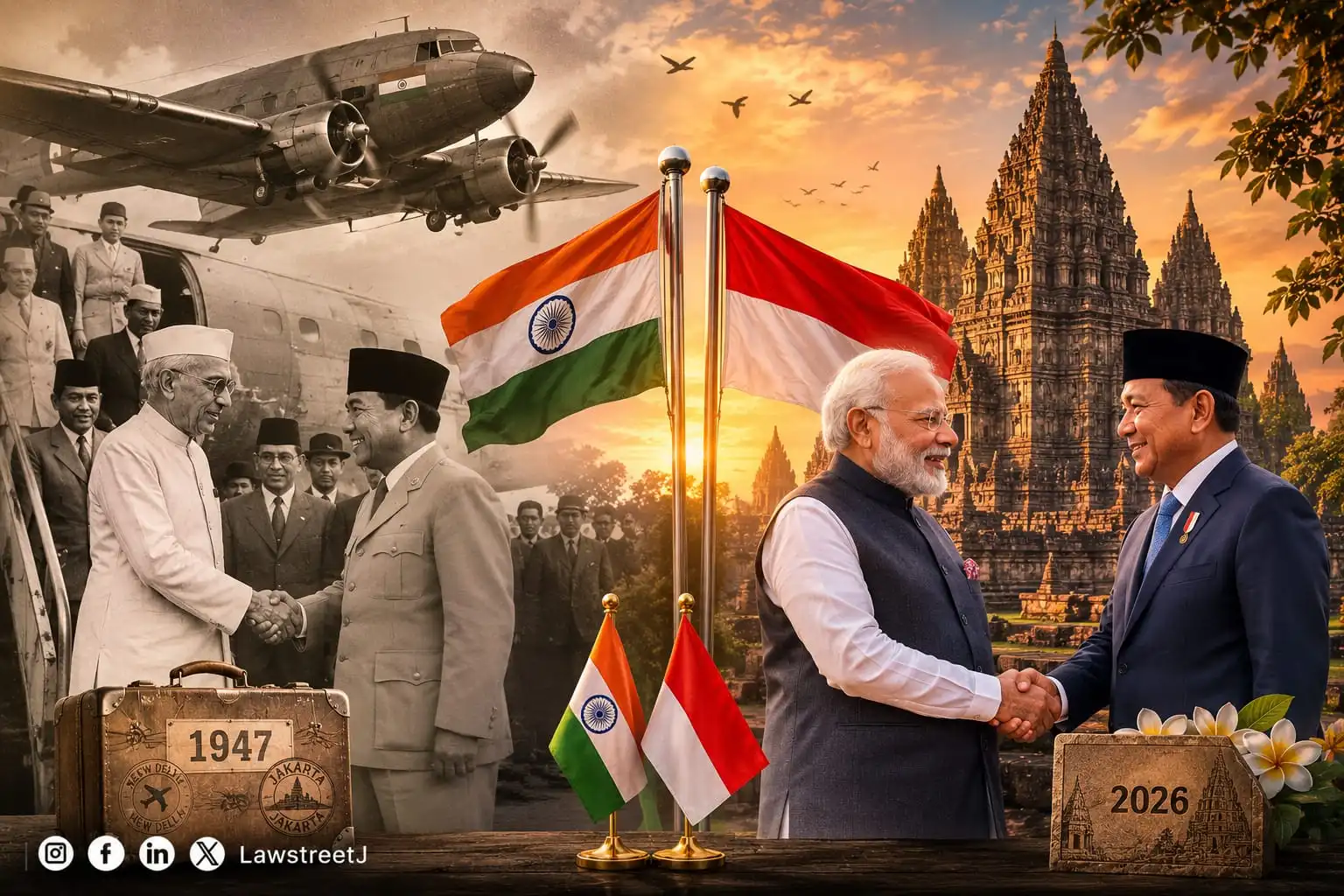
Jakarta / Yogyakarta | When Prime Minister Narendra Modi stood before the Indonesian Parliament on July 7, 2026, the first Indian prime minister ever to address that chamber, he began not with trade figures or strategic frameworks but with a story about a pilot, a Dakota aircraft, and a July night in 1947 when one man's courage changed the course of a nation's history.
"The role played by the respected Biju Patnaik during that period, the way he safely brought Prime Minister Sutan Sjahrir and Vice President Mohammad Hatta to India, brought our two nations closer," Modi told assembled Indonesian lawmakers. The applause that followed was for a chapter of shared history that stretched back eight decades and whose threads, as Modi's three-day visit demonstrated, are still being woven today.
Part One: 1945–1949- When India Stood With Indonesia
Indonesia declared independence on August 17, 1945, two days after Japan's surrender in the Second World War. Its founding President Sukarno proclaimed freedom from over three centuries of Dutch colonial rule. But the Dutch were not prepared to let go. Backed by Allied military support, they launched what they called "police actions", military offensives to reassert colonial authority, that brought them into direct conflict with Indonesian nationalist forces.
Jawaharlal Nehru, who would formally become India's first prime minister on August 15, 1947, though he was already the effective head of the interim government, watched the Dutch offensive with fury. Still fighting for India's own independence, Nehru had made Asian solidarity a cornerstone of his emerging foreign policy vision. He saw the Dutch reassertion of colonial control in Indonesia as precisely the kind of imperialism that the independence movements of Asia must collectively resist.
When the Dutch launched their first major military offensive on July 21, 1947, Indonesian Prime Minister Sutan Sjahrir and Vice President Mohammad Hatta were effectively under house arrest in Jakarta, cut off from international communication, unable to travel, and unable to present Indonesia's case before the international community. Nehru needed them in New Delhi for the first Inter-Asia Relations Conference, a gathering that would allow Indonesia to place its independence cause before the world's press and diplomatic community.
The mission was impossible by conventional means. The Dutch controlled all sea and air routes in and out of Indonesian territory. Nehru turned to Bijayananda Patnaik, known everywhere as Biju Patnaik, a 31-year-old aviator, freedom fighter, entrepreneur, and born risk-taker who had trained at the Delhi Flying Club, flown rescue sorties in the Second World War, and founded Kalinga Airlines after India's independence.
Patnaik, accompanied by his wife and co-pilot Gyanwati Patnaik, flew a Douglas C-47 Dakota aircraft into Dutch-controlled Indonesian airspace on July 24, 1947. Dutch authorities warned him his aircraft would be shot down if he proceeded. He reportedly sent back a message that any attack on his aircraft would be met with retaliation against Dutch aircraft over Indian skies. He landed on an improvised airstrip near Jakarta, refuelled using fuel salvaged from abandoned Japanese military dumps, loaded Sjahrir, Hatta, and other Indonesian leaders aboard the Dakota, and flew them to New Delhi via Singapore.
The rescue worked. Sjahrir and Hatta were able to address the international community and build the diplomatic pressure that ultimately forced the Dutch to negotiate. The Netherlands formally recognised Indonesia's independence on December 27, 1949. Patnaik's mission, in the words of those who documented it, was a defining act of Asian solidarity, one individual's courage translating Nehru's diplomatic vision into physical reality.
Patnaik's bonds with Indonesia ran deeper than one mission. He is credited by multiple accounts with suggesting the name "Megawati", derived from the Sanskrit "meghavatī," meaning "she who has clouds" or "daughter of clouds", for Sukarno's daughter when she was born during a visit, because it was raining at the time. Megawati Sukarnoputri went on to become Indonesia's fifth president and its first and only female head of state. Patnaik was honoured by Indonesia with the title "Bhoomi Putra", Son of the Soil, one of the country's highest honours rarely bestowed on a foreign national. He was also granted honorary citizenship of Indonesia. His Dakota aircraft became a museum exhibit in the country, a tangible symbol of the rescue that had given Indonesian leaders the chance to fight for their nation on the world stage.
Part Two: Nehru, Bandung, and the Architecture of Non-Alignment
India's support for Indonesian independence was not merely bilateral sentiment, it was the foundation stone of a broader Asian diplomatic architecture that both countries would help build.
In 1955, Indonesia hosted the Bandung Conference, a gathering of 29 Asian and African nations that laid the intellectual and diplomatic groundwork for the Non-Aligned Movement. Nehru and Sukarno were its two most prominent figures. The Bandung Declaration, which called for cooperation among newly independent nations, opposition to colonialism and imperialism, and the right of nations to choose their own political systems, was a direct expression of the solidarity that had first found practical form in Patnaik's 1947 rescue mission.
Modi, in his Parliamentary address, paid tribute to this moment. "India follows the path of development, not expansionism," he told Indonesian lawmakers, a phrase that echoed the spirit of Bandung even as it was delivered in the very different geopolitical context of 2026. He also separately praised Nehru's Bandung message, in a notably bipartisan gesture given that Modi and Nehru belong to opposed political traditions within India, a signal of how deeply the Indonesia relationship is treated as a matter of national history rather than party ideology.
The two countries formally established diplomatic relations in 1950, making Indonesia one of the first nations India recognised as a sovereign state. The relationship deepened through the 1950s and early 1960s, shaped by the personal friendship between Nehru and Sukarno, the shared Non-Aligned Movement framework, and the two countries' common experience of having won independence from colonial powers within a few years of each other.
Part Three: From Friendship to Partnership - The Modern Relationship
The post-Cold War era brought significant changes to the India-Indonesia relationship. Both countries moved toward market-oriented economic reforms in the 1990s and became increasingly integrated into regional and global economic frameworks. Indonesia's democratic transition following the fall of Suharto in 1998 aligned the two countries more closely on governance values, and the expansion of the Association of Southeast Asian Nations brought India into a structured regional dialogue with Indonesia through its Look East, later Act East policy.
The relationship was formally elevated to a Strategic Partnership in 2005 and to a Comprehensive Strategic Partnership in 2018, a designation that reflects the breadth of engagement across defence, security, trade, investment, energy, technology, and culture. Modi's July 2026 visit to Jakarta was the first state visit at prime ministerial level since that elevation, making it the most significant bilateral engagement in the relationship's recent history.
Indonesia is today India's second-largest commercial trading partner in the ASEAN bloc. Bilateral trade has expanded significantly over the past decade. Indonesia is the world's largest archipelagic state, straddling the critical sea lanes of the Indian and Pacific Oceans, the same waterways that India's MAHASAGAR framework for Indo-Pacific cooperation has identified as central to regional security and stability.
Part Four: July 2026 - What Modi Discussed, What Was Signed, and What Was Promised
Prime Minister Modi arrived in Jakarta on July 6, 2026, for a three-day visit, the first leg of a three-nation tour. His schedule covered a one-on-one meeting with President Prabowo Subianto at Istana Merdeka, the Palace of Freedom, followed by delegation-level talks, a Parliamentary address, a diaspora community event, and a concluding visit to the Prambanan Temple complex in Yogyakarta.
At the joint press briefing following the bilateral talks, Modi was conferred Indonesia's highest civilian honour, the Bintang Republik Indonesia Adipurna, which he dedicated to "the crores of Indians," describing it as a reflection of the sentiments of the Indonesian people and the deep-rooted bonds between the two nations.
The bilateral talks produced 20 Memoranda of Understanding, the most comprehensive set of agreements in the history of the bilateral relationship. Their scope is broad enough to warrant setting out in full.
On defence, the two countries signed an MoU on cooperation on the BrahMos missile system, marking a significant milestone in India's defence export programme and in the Make in India for the World initiative. They also signed an Air-to-Air Missile Cooperation Agreement, deepening technology collaboration in India's indigenous missile development ecosystem. An extension of the MoU on Maritime Safety and Security Cooperation strengthens coordination between the two countries' Coast Guards in maritime domain awareness, search and rescue operations, and capacity building in the Indo-Pacific. Indonesia will deploy a Liaison Officer to the Information Fusion Centre for the Indian Ocean Regio, IFC-IOR, based in Gurugram, enhancing real-time maritime information sharing between the two navies.
On connectivity, the two sides agreed to jointly develop the Sabang Port in Indonesia's Aceh province, a port that overlooks the Strait of Malacca and sits approximately 100 miles from India's Great Nicobar Port project. The joint development of these two port facilities, on either side of one of the world's most strategically critical maritime chokepoints, is a significant Indo-Pacific strategic signal. Both sides also agreed to improve maritime and air connectivity between the two countries and welcomed progress on cross-border QR payment linkage.
On critical minerals and industry, India will invest in the manufacturing of steel, nickel, and rare earth permanent magnets in Indonesia, a strategic move to strengthen India's access to critical mineral supply chains essential for its clean energy and defence technology ambitions. An MoU was signed between India's Non-Ferrous Materials Technology Development Centre, Midwest Limited, and PT PERMINAS for the development of rare earth magnets. A strategic joint venture between the Steel Authority of India Limited and PT Krakatau Steel was initiated to establish a stainless-steel slab manufacturing facility in Indonesia.
On education, an Indian Institute of Management Bangalore branch campus will be established at the Singhasari Special Economic Zone in Indonesia, a historic first and a direct expression of India's expanding educational diplomacy in Southeast Asia.
On telecommunications and technology, an MoU was signed on cooperation in telecommunications technologies and services, covering wireless, quantum, and advanced systems. A separate MoU on Research, Technology, and Innovation Cooperation strengthens knowledge exchange and the Startup India ecosystem.
On energy, both countries agreed to strengthen collaboration in renewable energy, green hydrogen, LNG, bioenergy, and energy efficiency. On healthcare, both sides welcomed agreements on professional health workforce development and medical products regulation. On digital infrastructure, Indonesia welcomed India's ONDC, Open Network for Digital Commerce, architecture, with Jakarta planning an equivalent Open Network initiative based on the Indian framework.
President Prabowo, in a moment that captured the warmth of the bilateral tone throughout the visit, directly addressed Modi and said: "I follow your career and I copied many of your programmes. I don't mind admitting, because if it succeeds for hundreds of millions of people with the same background as Indonesia, it succeeds for Indonesia as well. It's proving to be successful for us. So, thank you very much. I'm very happy there's no copyright to all your programmes."
Part Five: Prambanan - Civilisation as Diplomacy
The final day of the visit, July 8, brought Modi and Prabowo together at the most symbolically resonant location of the entire state visit: the Prambanan Temple complex in Yogyakarta, a UNESCO World Heritage Site built in the ninth century and dedicated to the Hindu trinity of Shiva, Vishnu, and Brahma.
Prambanan is the largest Hindu temple complex in Indonesia. Its 47-metre central Shiva temple is the tallest structure at the site, which originally comprised 240 temples. Its stone reliefs depict scenes from the Ramayana and the Mahabharata, the two great Indian epics that have been central to the cultural and spiritual life of Java and Bali for over a millennium. The temple stands as one of the most tangible proofs of the civilisational connections between the Indian subcontinent and the Indonesian archipelago that predate both nations' existence as modern states by a thousand years.
The day before, India and Indonesia had exchanged a Letter of Intent for an India-backed conservation and restoration initiative at Prambanan, under which the Archaeological Survey of India will work alongside Indonesian heritage authorities to restore the temple complex. The project carries a target deadline of 2029. It follows ASI's successful heritage restoration work at the My Son Sanctuary in Vietnam, the Ananda Temple in Myanmar's Bagan Archaeological Zone, and the Thiruketheeswaram Temple in Sri Lanka.
Modi offered prayers at the temple, was moved by chants of the Mahamrityunjay Mantra and Om Namah Shivaya that echoed through the complex, and told the gathered crowd that he had always felt a special connection with Lord Shiva throughout his life. He recalled being born in Vadnagar, home to the Hatkeshwar Mahadev temple; representing Varanasi, home to Kashi Vishwanath; and having contributed to the redevelopment of Kedarnath and the Ujjain Mahakal corridor. He thanked the people of Indonesia for having preserved the temple for 1,200 years and said he was confident the restoration project would bring more Indian tourists to Prambanan in the years ahead.
He also announced the commemoration of the Tagore-Dewantara Year of Cultural and Educational Diplomacy, celebrating the parallel educational visions of Rabindranath Tagore and Indonesia's Ki Hajar Dewantara, who knew each other and whose educational philosophies shared a common emphasis on child-centred, culturally rooted learning.
"India and Indonesia do not just share the sea; we also share our history," Modi said at the temple. "Our relationship is rooted in the legacy of the Ramayana and the Mahabharata. We are linked through magnificent monuments such as Borobudur and Prambanan. We are connected through Garuda, Indonesia's national emblem."
Before departing, he made a personal promise: "I promise to come back here."
Conclusion: Eight Decades, One Thread
The thread running through eight decades of India-Indonesia relations, from Biju Patnaik's Dakota to a Prambanan Temple restoration promise, from Nehru's Bandung Declaration to a BrahMos missile MoU, from Sukarno's independence struggle to President Prabowo's admission that he has copied India's development programmes is one of genuine solidarity, cultural depth, and strategic convergence that has outlasted the Cold War, survived periods of diplomatic distance, and arrived in 2026 as one of the most substantive bilateral partnerships in the Indo-Pacific.
When Modi concluded his three-day visit on July 8, he said: "This visit has opened new avenues for cooperation in defence and security, maritime collaboration, critical and emerging technologies, artificial intelligence, digital public infrastructure, and culture. The India-Indonesia friendship will keep scaling new heights."
He then flew to his next destination, Australia, carrying with him Indonesia's highest civilian honour, twenty signed agreements, and the Prambanan promise.
Biju Patnaik, one imagines, would have approved.