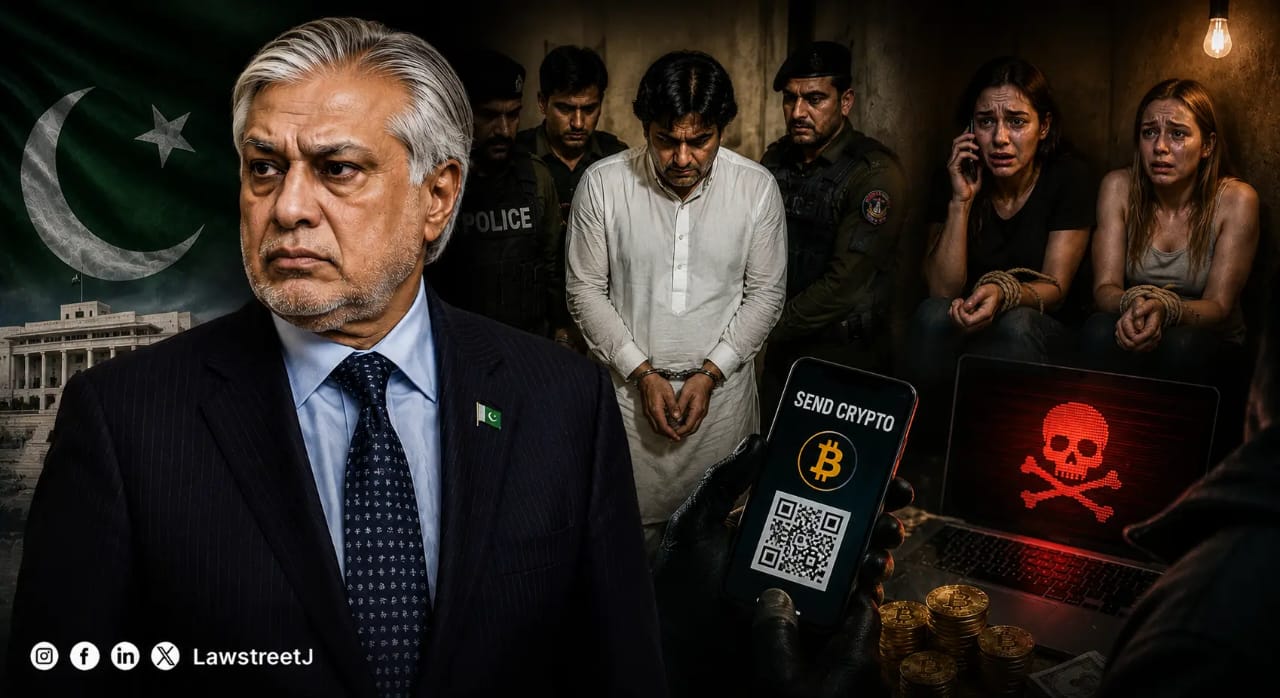
New and deeply disturbing details have emerged in the Lahore kidnapping and gang rape case involving Muhammad Raza Dar, identified by police as a grandson of Pakistan's Deputy Prime Minister and Foreign Minister Ishaq Dar, after one of the two foreign survivors recorded her formal statement before a judicial magistrate. The testimony, a copy of which was obtained by Pakistan's ARY News, shifts the investigation into new territory, with Pakistani police now examining whether a multi-million dollar cryptocurrency dispute was the primary motive behind what the FIR describes as an abduction, sexual assault, and extortion carried out over several hours in a locked room in Lahore.
Investigators are analysing digital evidence, cryptocurrency transactions, and communication records to determine whether the women were specifically targeted for their crypto assets rather than, or in addition to being victims of opportunistic violence.
The Survivor's Statement
The testimony was recorded under Section 164 of Pakistan's Code of Criminal Procedure, a provision that allows magistrates to record statements from witnesses and victims during an investigation, giving those statements formal evidentiary weight in subsequent court proceedings. The statement was recorded by Astrid Gabriela Robinson Bracho, one of the two victims, who is a Venezuelan national.
According to her testimony, Astrid and her friend Stephani Adriana had just arrived in Lahore when a group of armed men stormed the house where they were staying. The women were restrained and locked inside a room. She alleged that Muhammad Raza Dar then repeatedly demanded access to a computer containing cryptocurrency assets.
"They asked where the computer with the money was, and I told them it was in the green bag," she told the magistrate, adding that Dar continued demanding money and passwords even after the computer was handed over.
She alleged that she was struck on the head while being held captive. One of the armed men, she said, made the stakes explicit: "He told me if we gave them the money, we would live. If we didn't, they would kill us."
Astrid also alleged that during captivity she was sexually assaulted by two of the accused while a third stood guard outside the room.
The Ransom: $100,000 Paid, $19,000 Transferred to Digital Wallets
When no immediate response came to Dar's initial attempts to contact people in the victims' networks, Astrid said Dar used her own mobile phone to reach out to individuals known to her, an attempt to pressure their contacts into paying. Eventually, Stephani Adriana's mother arranged a payment of $100,000, which was received by Dar before he told the women they were free to leave.
The suspects also forced the women to transfer $19,000 to their digital wallets. The total amount received by the accused in cryptocurrency and cash therefore stands at approximately $119,000, a figure investigators are using as a starting point in their forensic examination of digital transaction records.
Pakistani investigators are now probing whether a broader cryptocurrency dispute, reportedly worth approximately $1.5 million, between Raza Dar and the two women was the underlying motive for the entire operation. According to police, the two women met Raza Dar in Singapore in October 2025 while working on a cryptocurrency-related venture. Investigators allege that Dar later invited them to Pakistan on business visas.
The distress signal that ultimately led to the rescue is also notable in its detail. Astrid said she managed to send a prearranged code word, "CARLITOS" to her family in Europe, a signal her relatives understood to mean she was in danger. Her family then contacted both international and local law enforcement agencies. Pakistani police launched a rescue operation following that alert. After the money was received, Dar told them they were free to leave, returned their passports and drove them to the airport. However, the vehicle being driven by the main accused met with an accident while en route, at which point the women were eventually rescued.
Also read: https://lawstreet.co/international/relative-of-pakistans-deputy-pm-ishaq-dar-arrested-in-lahore
Victims May Have Left Pakistan
A significant procedural development has emerged alongside the new testimony. Local media reports citing judicial sources indicate that the two foreign women may have left Pakistan after recording their statements before the magistrate. Their statements have reportedly been sealed, with copies retained by the court and investigating authorities.
If confirmed, this means the evidentiary foundation of the prosecution will rest heavily on the sealed magistrate statements, which carry legal weight under Section 164 of the Criminal Procedure Code and can be used during trial even if the witnesses are not physically present in Pakistan, alongside forensic evidence, digital transaction records, and the testimony of police officers involved in the rescue operation.
The four accused, Muhammad Raza Dar, Hassan Raza, Sikandar Khan, and Sajid Ali are scheduled to appear before a Lahore court again on July 8, when police will be required to present an investigation report and either seek an extension of custody or present the accused for further judicial proceedings. A fifth accused remains absconding, with police continuing raids to locate him.
The Cryptocurrency Dimension: A $1.5 Million Dispute Under the Microscope
The emerging cryptocurrency motive adds a layer to the case that distinguishes it from a conventional kidnapping and extortion. Investigators are working to establish whether Raza Dar's relationship with the two women, which began in the context of a shared cryptocurrency business venture in Singapore was already the subject of a financial dispute before the women arrived in Pakistan, and whether their invitation to Lahore was arranged with the express purpose of coercing them into surrendering control of their digital assets.
Cryptocurrency extortion, the use of threats, coercion, or violence to compel individuals to hand over access credentials to digital wallets has emerged as a category of crime in multiple jurisdictions over the past five years, particularly as the value of crypto assets has increased and their relative anonymity compared to conventional banking has made them attractive to criminal actors. Pakistan does not have a dedicated legislative framework for cryptocurrency crime at the national level, though the Securities and Exchange Commission of Pakistan has been developing regulatory guidelines for digital assets. Prosecutors in this case are expected to rely on existing provisions of the Pakistan Penal Code including those covering criminal extortion, robbery, and criminal intimidation, to address the cryptocurrency-related elements of the alleged offences.
Political Pressure and the July 8 Deadline
The case continues to generate intense political attention inside Pakistan. The combination of a senior government official's family member being the prime accused, two foreign nationals as victims, and a potential multi-million dollar cryptocurrency motive has made it one of the most closely watched criminal cases in the country in recent months.
Opposition PTI leaders have continued to use the case as a focal point for their critique of elite impunity under the current PML-N administration. Civil society organisations have called for the investigation to proceed without political interference. The Pakistani government has not issued any public statement on the case, and the Deputy Prime Minister's office has not commented on the relationship between Ishaq Dar and Muhammad Raza Dar, nor on the ongoing proceedings.
The next court date on July 8 will be a critical marker. If police seek an extension of custody beyond the initial five-day remand, they will need to demonstrate to the court that the investigation is actively progressing and that additional custody is necessary to complete forensic work and locate the remaining absconding accused. The court will also be watching whether the prosecution can establish a coherent and evidence-based theory of the case, one that accounts for the cryptocurrency motive, the ransom payments, and the sexual violence alleged by both survivors.