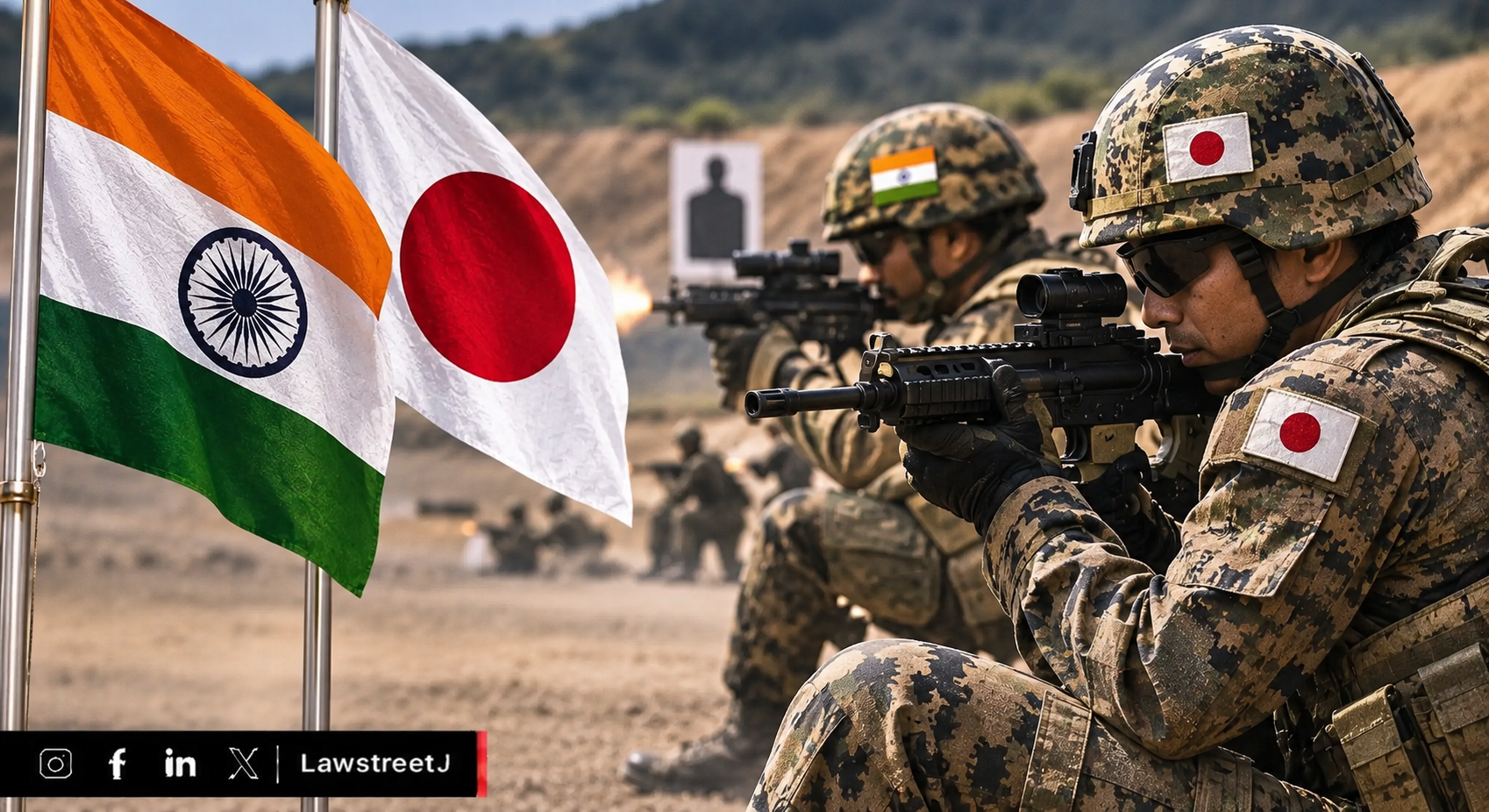
NEW DELHI: India and Japan have taken a significant step towards expanding military cooperation, with Japanese Self-Defence Forces set to conduct live-fire training at Indian firing ranges for the first time. The proposed arrangement, which includes training involving surface-to-ship missiles, was announced following the fourth India-Japan Foreign and Defence Ministers' 2+2 Dialogue in Tokyo on November 19.
The two countries signed a Letter of Intent (LOI) towards the utilisation of Indian firing ranges by Japan's Self-Defence Forces. Defence Minister Rajnath Singh and his Japanese counterpart Shinjiro Koizumi agreed to accelerate coordination between their respective defence authorities to implement the arrangement.
External Affairs Minister S. Jaishankar and Japanese Foreign Minister Toshimitsu Motegi also participated in the high-level dialogue.
The agreement marks an important development in bilateral defence cooperation, moving the partnership towards greater operational coordination and military interoperability in the Indo-Pacific region. According to the joint statement issued after the meeting, the arrangement would allow Japanese forces to conduct live-fire training in India, including exercises involving surface-to-ship missiles. However, the signing of the LOI is a step towards implementation, and the actual training has not yet been announced.
Fourth India-Japan 2+2 Dialogue Strengthens Strategic Partnership
The fourth India-Japan 2+2 Ministerial Dialogue brought together the foreign and defence ministers of both countries in Tokyo. The ministers reviewed the progress of bilateral security cooperation and reaffirmed their commitment to maintaining a free, open and rules-based international order.
Both sides highlighted the growing strategic convergence between India and Japan amid an increasingly uncertain global security environment. They also agreed to expand the complexity of bilateral military exercises, integrate unmanned systems into future drills and explore conducting bilateral and multilateral exercises at short notice.
The joint statement highlighted the first-ever visit of Japan Air Self-Defence Force fighter aircraft to India for the bilateral air exercise Veer Guardian 26. The visit was accompanied by the participation of Japan's Air Self-Defence Force Chief of Staff. The ministers welcomed the expansion of military cooperation across different services and agreed to strengthen exchanges between their respective special operations forces.
UNICORN Naval Radar System: India and Japan Move Towards Cooperation
Another important development involved progress towards the transfer of Japan's UNICORN naval antenna system to India. UNICORN, short for Unified Complex Radio Antenna, is a stealth-oriented integrated naval antenna system designed to consolidate multiple communication antennas into a single structure, reducing the radar signature of naval vessels.
The system is intended to improve communication capabilities while supporting the stealth characteristics of naval platforms. The two countries expressed expectations for an early formulation of the arrangements related to UNICORN, with India expected to take an Acceptance of Necessity (AoN) decision by February 2027.
The joint statement also reaffirmed cooperation under the framework of Design with Japan, Make in India, indicating an emphasis on defence industrial collaboration rather than simply purchasing foreign equipment. The statement does not confirm that India has already received or deployed the UNICORN system. The next major milestone will be the formulation of the necessary arrangements and India's proposed AoN decision.
Maritime Security and Naval Shipbuilding Cooperation
India and Japan also agreed to strengthen maritime security cooperation between the Indian Navy and Japan Maritime Self-Defence Force. The discussions covered Maritime Domain Awareness, Air Domain Awareness, search and rescue, information sharing and humanitarian assistance during disasters.
Both countries expressed their commitment to improving mine-countermeasure capabilities and exploring the possibility of joint development in naval shipbuilding and design. The cooperation builds on the Memorandum of Arrangement on Maritime Security Cooperation signed earlier in August 2026.
The two sides also welcomed expanding coast guard cooperation, with the fifth Coast Guard Global Summit scheduled to take place in India in February 2027.
China and Indo-Pacific Security Remain Important Strategic Factors
The growing defence partnership comes amid increasing strategic competition in the Indo-Pacific, where maritime security, military preparedness and supply-chain resilience have become major concerns. Although the joint statement did not explicitly identify China as the target of the cooperation, both countries expressed serious concerns about economic coercion, arbitrary export restrictions and non-market practices that disrupt critical global supply chains.
India and Japan also reaffirmed their commitment to strengthening cooperation through the Quad, alongside the United States and Australia. The ministers condemned terrorism and violent extremism, including cross-border terrorism, and called for coordinated action against internationally designated terrorist organisations.
Both countries additionally reiterated mutual support for each other's candidatures for permanent membership of a reformed United Nations Security Council.
The next India-Japan 2+2 Ministerial Dialogue will be held in India at a mutually convenient date. With the 75th anniversary of diplomatic relations approaching in 2027, the two governments have also agreed to celebrate the year as the India-Japan Year of Shared Horizons.
The latest agreements indicate that the partnership is expanding beyond traditional diplomatic engagement into military training, defence manufacturing, maritime security, advanced technology and regional strategic coordination.