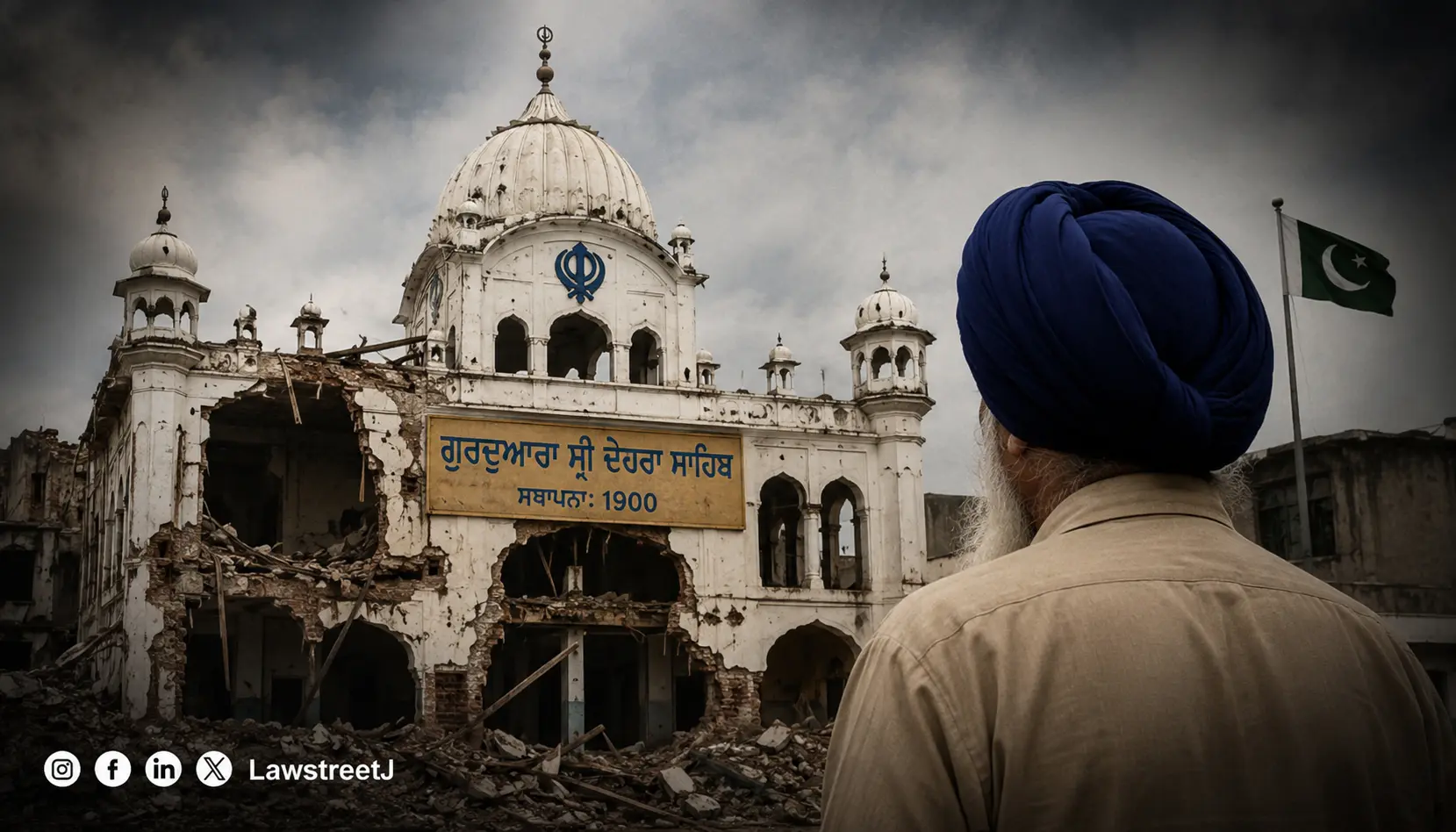

India's Ministry of External Affairs on Wednesday issued a formal condemnation of the reported demolition of the historic Gurdwara Sri Guru Singh Sabha Sahib in Farooqabad, Punjab province, Pakistan, a 125-year-old Sikh shrine that has been described as a monument of significant religious and historical importance to the Sikh community. The statement, delivered by MEA spokesperson Randhir Jaiswal, called the incident "highly deplorable and a targeted act of vandalism against a revered Sikh shrine" and demanded that Pakistan investigate the matter, prosecute those responsible, and restore the demolished portions at the earliest.
"We have seen the deeply distressing reports regarding the demolition of the historic 125-year-old sacred Gurdwara Sri Guru Singh Sabha Sahib in Farooqabad, Pakistan. We strongly condemn this highly deplorable and targeted act of vandalism against a revered Sikh shrine. Its destruction, along with reports of no meaningful action being taken by local authorities or the Evacuee Trust Property Board (ETPB), is a matter of grave concern," Jaiswal said in his official statement issued on July 1, 2026.
The MEA added: "This is unfortunately not an isolated incident, as we have also seen similar reports earlier. The systemic targeting of religious minorities and their places of worship in Pakistan continues unabated."
What Happened in Farooqabad
Gurdwara Sri Guru Singh Sabha Sahib is located in Farooqabad, also known as Mandi Chuharkana, in the Sheikhupura district of Pakistan's Punjab province, approximately 70 kilometres from Lahore. The shrine is historically linked to the Singh Sabha Movement, a late nineteenth century reformist movement that sought to revive Sikh religious identity and literacy, and carries deep significance for Sikhs across the region.
Reports indicate that portions of the 125-year-old structure were demolished during the night of June 24 to 25, 2026. Sikh groups in the area alleged that unidentified persons razed parts of the century-old structure, prompting immediate protests and demands for action from the local Sikh community. The local Sikh community staged protests after the government failed to take any meaningful action following the demolition.
According to a Pakistani official quoted by PTI, the historic gurdwara was demolished by a local businessman who had done so without obtaining the required No Objection Certificate from the department concerned. The same official acknowledged that the department had not taken notice of it until the Sikhs of the area protested, an admission that drew sharp criticism from India and from Sikh organisations.
Punjab BJP President Kewal Singh Dhillon, condemning the incident from Chandigarh, pointed out that the building had itself been declared a historic monument by the Pakistan government, and that there is a complete legal ban on its demolition. "Despite this, the damage caused to Sikh historical heritage is deeply unfortunate," he said, adding that incidents of attacks and atrocities against Sikhs in Pakistan's Punjab had been repeatedly coming to light. He also referenced a recent incident in which a sevadar, a caretaker of a gurdwara and his wife were brutally murdered in Pakistan's Punjab.
The ETPB: A Body Under Scrutiny
A central element of the MEA's condemnation is directed at the Evacuee Trust Property Board, the Pakistani government body specifically mandated to maintain and protect the religious properties left behind by Hindus and Sikhs who migrated to India at the time of Partition in 1947. The ETPB was established precisely to serve as the custodian of these properties and to ensure they are preserved, maintained, and accessible to pilgrims.
India's statement specifically called out the ETPB by name, citing "reports of no meaningful action being taken by local authorities or the Evacuee Trust Property Board" as a matter of grave concern. The inclusion of the ETPB in the condemnation is significant, it signals that New Delhi holds not merely the individual perpetrators but the institutional framework responsible for Sikh heritage sites in Pakistan to account for the failure that allowed this demolition to proceed without intervention.
Pakistan's minister for minority affairs in the Punjab, Ramesh Singh Arora, has since acknowledged that part of the gurdwara was demolished and said it would be reconstructed and restored, according to The Wire's reporting. However, reports have differed on the circumstances surrounding the demolition, with investigations said to be continuing.
India's Demands and the Diplomatic Context
New Delhi's formal demands are threefold and unambiguous. The MEA called upon the Government of Pakistan to expeditiously investigate the matter and bring the perpetrators to justice, to restore and reconstruct the demolished portions of the gurdwara at the earliest, and to discharge its obligations to ensure the safety, security, and well-being of its minority communities and their places of worship, putting a decisive end to the prevailing environment of sectarian violence and religious intolerance.
The incident arrives at a diplomatically complicated moment for India-Pakistan relations. The two countries have not returned to normal bilateral engagement following Operation Sindoor, India's military operation against terror infrastructure in Pakistan launched in May 2025. At the same time, Pakistan has sought to project an image of diplomatic engagement internationally, including through its mediating role in the US-Iran negotiations at Bürgenstock in Switzerland earlier this month.
The latest exchange also comes less than two weeks after New Delhi formally rejected comments by Pakistani President Asif Ali Zardari over the proposed demolition of the Ganj Shahida mosque in Varanasi, a sequence of events that illustrates the continuing pattern of mutual accusations over the treatment of religious minorities on both sides of the border.
A Pattern of Targeted Incidents Against Sikhs in Pakistan
India's MEA was explicit that the Farooqabad demolition is part of a broader, documented pattern rather than an isolated incident. The Singh Sabha Movement shrine in Farooqabad joins a list of Sikh heritage sites in Pakistan that have been damaged, encroached upon, or left to deteriorate in recent years despite the ETPB's mandate to protect them.
The Sikh community in Pakistan, concentrated largely in Khyber Pakhtunkhwa and Punjab provinces, has faced persistent challenges including attacks on individuals, threats against gurdwaras, and forced conversions. Human rights organisations including the United States Commission on International Religious Freedom have repeatedly documented the vulnerability of religious minorities, including Sikhs, Hindus, and Christians in Pakistan, and have called on Islamabad to strengthen legal protections and enforcement mechanisms.
Pakistan's government has at various points acknowledged these concerns and announced measures to address them, including through the ETPB's restoration programmes for Sikh heritage sites. The acknowledgment by Minority Affairs Minister Ramesh Singh Arora that the gurdwara would be restored is a step in that direction, but India's condemnation makes clear that acknowledgment after the fact is not considered an adequate response to what the MEA described as an act of targeted vandalism against a revered shrine that the Pakistani government itself had recognised as a protected historic monument.