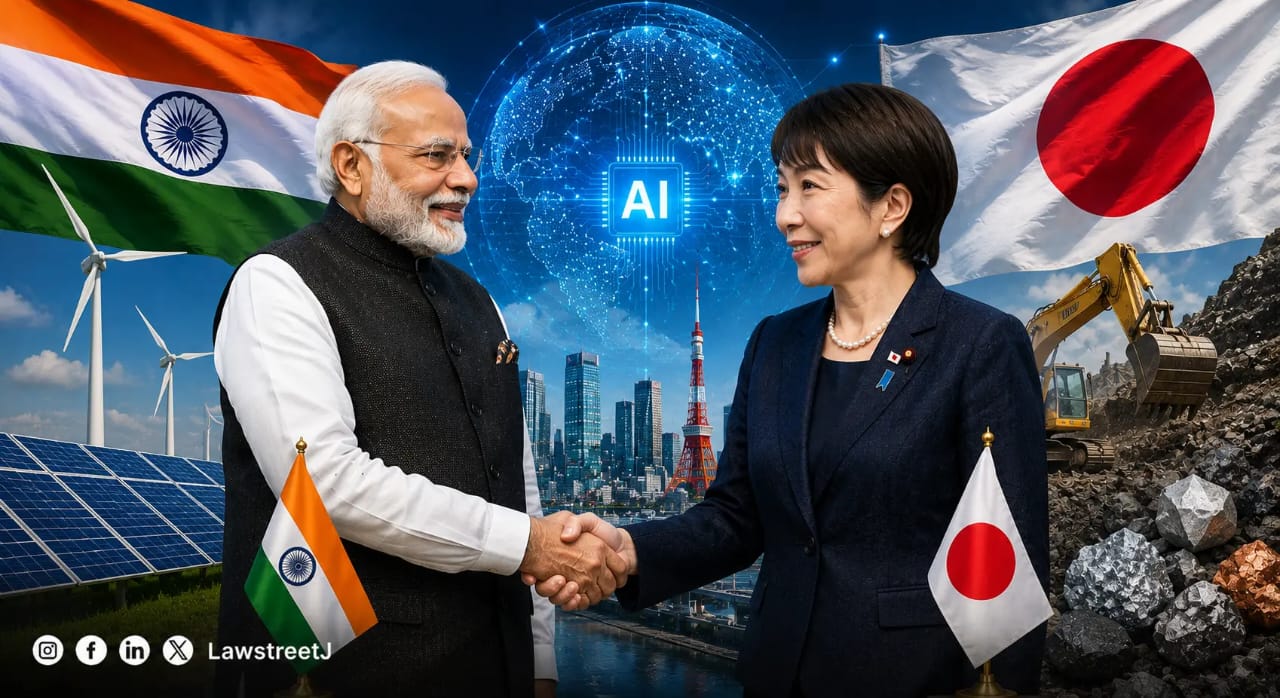
New Delhi hosted a defining moment in India-Japan relations this week. On July 2, 2026, Prime Minister Narendra Modi and Japanese Prime Minister Sanae Takaichi sat down at Hyderabad House and walked out with three major policy documents and a 16-point roadmap touching everything from artificial intelligence to defence hardware.
It was Takaichi's first visit to India as prime minister, part of a three-day trip from July 1 to July 3. The timing mattered. Bilateral trade between the two countries had just touched 27.5 billion dollars in the 2025-26 financial year, and Japan remains one of India's largest sources of foreign investment. Against that backdrop, the summit produced the India-Japan Joint Declaration on Economic Security, the Joint Statement on Cooperation in the Field of Artificial Intelligence, and the Joint Statement on Energy Resilience, three documents both governments say elevate their existing Special Strategic and Global Partnership.
AI Cooperation Now Covers the Entire Technology Stack
The AI statement is the summit's centrepiece, and it goes far beyond symbolism. India and Japan have agreed to work together across the full AI stack, secure digital infrastructure, semiconductors, GPUs, compute resources, multilingual and open-source AI models, governance frameworks, cybersecurity, and public-good applications. Both sides committed, in writing, to building what the statement calls a safe, secure, trustworthy, inclusive and human-centric AI ecosystem.
This isn't only government-to-government. Indian AI institutions have already begun formalising partnerships with Japanese counterparts, IIT Bombay's BharatGen Tech initiative is one confirmed collaboration. The two countries also agreed to coordinate on international AI governance standards and are preparing jointly for a major international AI gathering later this year.
Semiconductors got their own commitment: both governments agreed to diversify chip supply chains and deepen cooperation in manufacturing, design, research and skill-building, with Japanese companies encouraged to participate more actively in India's Semiconductor Mission 2.0. On top of that, the two sides agreed to work together on 5G Advanced networks, Open RAN systems, data centres, submarine cables, and the standards that will eventually govern 6G.
Minerals, Energy and a 16-Point Economic Security Roadmap
Critical minerals were treated as a security issue, not just a trade one. India and Japan signed an agreement on geology and mineral exploration, linking the Geological Survey of India with Japan's state-run JOGMEC to deepen upstream exploration. Both sides also agreed to build out e-waste recycling infrastructure to recover critical minerals, the kind used in electronics, EVs and clean energy tech, reducing reliance on any single country for these supply chains.
On energy, the Joint Statement on Energy Resilience covers renewables, strategic stockpiling and upstream oil and gas development. Japanese assistance for the Green Ammonia Project in Odisha was also part of the pre-summit discussions. Beyond these two anchor areas, the countries struck deals on batteries, pharmaceuticals, biotechnology, financial regulation, mobility and internet governance. India's Centre for Cellular and Molecular Platforms will now work with Japan's RIKEN institute on deep-tech and life sciences; the National Centre for Biological Sciences will run joint neuroscience research with RIKEN as well. A new Next Generation Mobility Partnership targets railways, aviation, shipbuilding, ports and logistics, positioning India as a manufacturing base for global exports.
On the financial side, India's International Financial Services Centres Authority and Japan's Financial Services Agency agreed to strengthen cooperation on fintech and regulatory technology. India's National Internet Exchange and Japan's Network Information Center separately signed a deal on internet registry operations and IPv6 adoption. To keep all of this from becoming paperwork that goes nowhere, both governments also agreed to set up a Track 1.5 Economic Security Dialogue, a standing forum bringing together officials, industry and independent experts to actually monitor progress.
A First-Ever Defence Pact and What Comes Next
Perhaps the most closely watched outcome was defence. The summit produced the first formal defence hardware co-development agreement between India and Japan, a genuine first, after a decade of joint exercises, maritime cooperation and technology exchanges that never quite crossed into co-development. Both countries are Quad members alongside the United States and Australia, and officials on both sides pointed to shared concerns over stability in the Indo-Pacific as the backdrop for this step.
None of this is meant to sit on paper. Both governments have committed to ministerial and working-group reviews to track implementation, with early AI pilot programmes and mineral supply diversification efforts expected to roll out over the next 12 to 18 months. Longer-term, both sides flagged ambitions in quantum technology and sustainable aviation fuel, though nothing concrete has been signed there yet.
The diplomacy extended past government offices. Takaichi addressed the India-Japan Business Forum alongside Modi, speaking to more than 100 Japanese business leaders, with additional commercial deals reported on the sidelines. The two countries also announced a year-long cultural and academic exchange programme, festivals, youth exchanges, business roadshows, and science partnerships that include work tied to the LUPEX lunar exploration mission, alongside expanded ties between Indian states and Japanese prefectures.
Neither government has disclosed the total financial value of everything signed this week. Ministries on both sides are now expected to begin working out the operational details sector by sector.