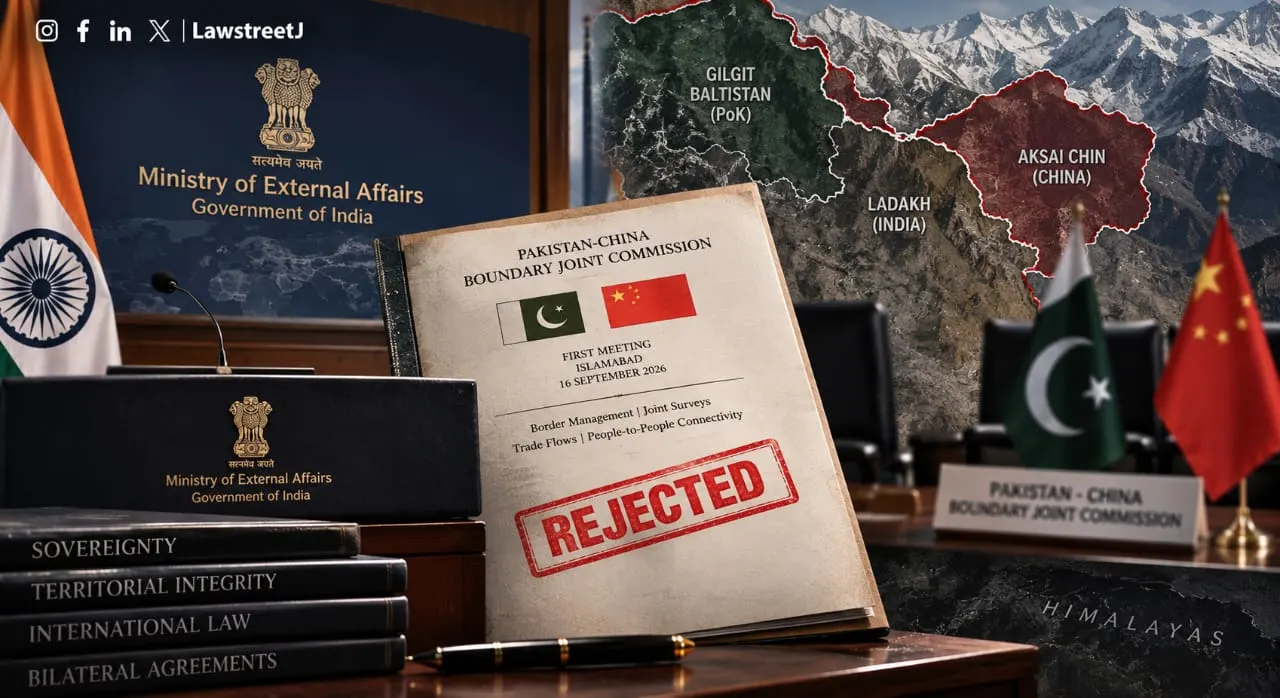
NEW DELHI — India on Wednesday, September 16, 2026, firmly rejected the newly operationalised Pakistan-China Boundary Joint Commission, asserting that no recognised boundary exists between Pakistan and China and describing the commission itself as carrying no legal standing. The response came from the Ministry of External Affairs within hours of Pakistan's own foreign ministry publicly hailing the commission's launch as a "significant milestone" in Pakistan-China relations.
Responding to media queries on the matter, MEA Official Spokesperson Randhir Jaiswal delivered India's position in unambiguous terms. "We have seen reports in this regard. Our position on this matter is clear and consistent. There is no boundary between Pakistan and China. We reject the so-called Joint Commission, which is without any legal basis," Jaiswal said, according to multiple outlets that carried the briefing, including The Statesman and The Tribune.
What Pakistan and China Actually Announced
The commission's first meeting was co-chaired by Chinese Foreign Ministry official Li Ya and Pakistan's Director General for China, Bilal Mahmood Chaudhary. According to Pakistan's Ministry of Foreign Affairs, the two sides used the meeting to set the stage for what they described as enhanced cooperation across several areas, including border management, joint border surveys, trade flows, and people-to-people connectivity between the two countries.
Islamabad framed the development in celebratory terms, with its foreign ministry publicly terming the commission's "operationalisation" a milestone moment for the broader China-Pakistan relationship. That framing is precisely what drew New Delhi's swift and pointed rebuttal, given that any formal boundary arrangement between the two countries inherently touches on territory India considers its own sovereign land under illegal occupation.
India's Core Legal Objection: There Is No Boundary to Manage

At the heart of India's rejection lies a foundational legal argument rather than a mere diplomatic protest. New Delhi's position is that Pakistan and China do not share a legitimate international boundary in the first place, because the territory along which any such "boundary" would run belongs to India. As Jaiswal put it in his briefing, the entire premise of a bilateral boundary commission between Islamabad and Beijing collapses once that underlying territorial claim is rejected.
This objection is not new. It rests on India's decades-old refusal to recognise the China-Pakistan Boundary Agreement of 1963, under which Pakistan ceded a portion of territory in the former princely state of Jammu and Kashmir to China. Jaiswal reiterated this history directly in Wednesday's briefing, stating plainly that India has "never recognised the so-called 'China-Pakistan Boundary Agreement' of 1963" and has "consistently maintained that it is illegal and invalid." That 1963 agreement has remained a persistent irritant in India's relations with both countries for more than six decades, and Wednesday's statement effectively folds this week's commission into that same long-running dispute.
Beyond rejecting the commission's legal basis, the MEA used the occasion to reassert India's broader territorial position in the clearest possible language. Jaiswal stated that "the entire Union Territories of Jammu and Kashmir and Ladakh have been, are and will always remain integral and inalienable parts of India," and went further to argue that Pakistan has no standing whatsoever to enter into arrangements concerning that territory. "Pakistan has no locus standi to enter into arrangements concerning Indian territory under its illegal and forcible occupation," he said.
The spokesperson framed any Pakistan-China cooperation touching these territories as fundamentally illegitimate, regardless of how it is packaged diplomatically. "We resolutely oppose and reject any attempts to alter the status of these occupied territories or legitimise illegal occupation, impinging on India's sovereignty and territorial integrity," Jaiswal said. He added that "any so-called boundary cooperation between China and Pakistan concerning Indian territories would be completely unacceptable and would have no bearing whatsoever on India's sovereignty over these territories", the specific line that produced the "completely unacceptable" framing used in headlines covering the story.
A Pointed Message Back to Islamabad
Rather than limiting its response to a legal rebuttal, the MEA also used the briefing to turn the diplomatic pressure back onto Pakistan directly. Jaiswal characterised the commission's launch dismissively as "theatrics," and called on Islamabad to redirect its energy toward addressing India's actual, longstanding demand. "Instead of engaging in such theatrics, we call on Pakistan to immediately vacate from areas under its illegal and forcible occupation," he said.
That line reflects a consistent posture India has maintained across successive governments, any bilateral or multilateral arrangement, agreement, or joint statement that references Pakistan-occupied territory, or treats it as settled ground for diplomatic or infrastructure cooperation, will be met with a rejection grounded in the same core demand for Pakistan's withdrawal from those areas.
Wednesday's rejection is not an isolated incident but fits into a recurring pattern in India's responses to China-Pakistan engagement over the years. India has previously objected on similar grounds to other joint China-Pakistan statements that referenced Jammu and Kashmir, including a June 2024 instance in which then-MEA spokesperson had rejected references to Jammu and Kashmir and the China-Pakistan Economic Corridor in a joint statement issued by the two countries, asserting that "no other country has the locus standi to comment on the issue."
That earlier episode, along with this week's rejection, illustrates that India treats any China-Pakistan cooperation touching contested or occupied territory as a matter requiring an immediate, on-record diplomatic response, rather than something to be addressed quietly through backchannel communication. The consistency of the language used across these episodes, invoking sovereignty, "integral and inalienable" territory, and the absence of legal standing, points to India maintaining a deliberately standardised messaging position on this issue regardless of which specific bilateral initiative between China and Pakistan triggers it.
India's Stance on Pakistan-Occupied Territory Terminology
This week's statement also arrives against the backdrop of a related push by India last month, when New Delhi urged its international partners and other stakeholders to use what it considers the correct terminology when referring to the region, specifically pressing foreign governments and institutions to refer to it as Pakistan-occupied Jammu and Kashmir rather than more neutral or ambiguous phrasing. Jaiswal, addressing questions on foreign media coverage of the region at that time, stated that India's position remains that "the entire region of Jammu and Kashmir, the Union Territories of Jammu, Kashmir and Ladakh, are integral and inalienable parts of India."
Taken together, the rejection of the Pakistan-China Boundary Joint Commission and last month's terminology push reflect a coordinated diplomatic effort by India to firmly contest any external framing, whether from Pakistan, China, or international commentary, that treats the disputed territory's status as settled or open to third-party negotiation. With the commission now formally rejected by New Delhi on legal grounds, attention will likely turn to whether Islamabad and Beijing proceed with their stated border-management and survey cooperation regardless of India's objection, and how that might affect the broader trajectory of India's relations with both countries going forward.