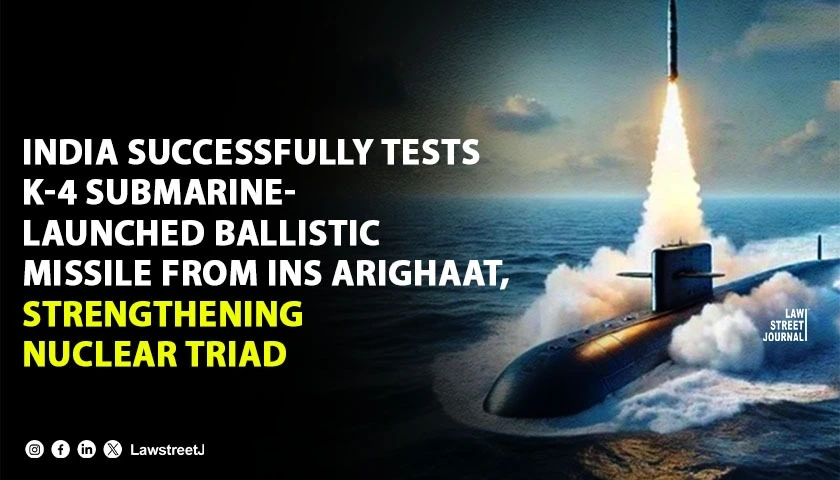
New Delhi: In a significant advancement for India’s strategic defence capabilities, the Defence Research and Development Organisation (DRDO) successfully conducted a test of the K-4 submarine-launched ballistic missile (SLBM) from the indigenous nuclear-powered submarine INS Arighaat on December 23, 2025. The test took place in the Bay of Bengal, off the coast of Visakhapatnam, and marks a pivotal milestone in operationalising the sea-based leg of India’s nuclear triad.
Strategic Significance and Technical Specifications
The K-4 missile, developed by DRDO under the Integrated Guided Missile Development Programme (IGMDP), is an intermediate-range SLBM with a strike capability of approximately 3,500 kilometres. This range significantly surpasses its predecessor, the K-15 ‘Sagarika’, which has a reach of 750 kilometres. The K-4 is designed to deliver a 2.5-ton nuclear warhead, and its deployment enhances India’s second-strike capability, a cornerstone of its nuclear doctrine.
The missile is launched from a submerged submarine silo, ascends through the water column, and activates its rocket motor upon surfacing. This launch mechanism ensures stealth and survivability, allowing India’s Arihant-class submarines to conduct deterrence patrols in undisclosed oceanic regions. The K-4 is derived from the Agni-III land-based missile and adapted for underwater deployment, incorporating modifications for hydrodynamic stability and launch sequencing.
INS Arighaat, commissioned into the Indian Navy on August 29, 2024, is the second nuclear-powered ballistic missile submarine (SSBN) in the Arihant-class fleet. The vessel is equipped to carry multiple K-4 missiles and is designed for extended underwater endurance, enabling strategic patrols across the Indian Ocean Region (IOR).
Legal and Policy Framework
India’s nuclear posture is governed by its No First Use (NFU) policy and commitment to credible minimum deterrence, as outlined in the Nuclear Doctrine adopted in 2003. The successful test of the K-4 missile aligns with India’s stated objective of maintaining a secure and reliable deterrent without engaging in an arms race.
The development and testing of the K-4 missile are in compliance with international legal frameworks, including the Missile Technology Control Regime (MTCR), of which India became a member in 2016. The MTCR does not prohibit the development or testing of missile systems but seeks to prevent the proliferation of unmanned delivery systems capable of carrying weapons of mass destruction.
India is not a signatory to the Treaty on the Non-Proliferation of Nuclear Weapons (NPT) but has consistently upheld its non-proliferation commitments through export control regimes and bilateral agreements. The K-4 test was conducted in a designated maritime zone with prior notification to relevant maritime authorities, ensuring adherence to safety and legal protocols.
The operationalisation of the K-4 missile from INS Arighaat significantly enhances India’s maritime strategic deterrence. With the ability to launch nuclear weapons from land, air, and sea, India joins a select group of nations—namely the United States, Russia, China, France, and the United Kingdom—that possess a fully functional nuclear triad.
This development is particularly relevant in the context of evolving regional security dynamics in the Indo-Pacific. The presence of SSBNs equipped with long-range SLBMs provides India with a survivable second-strike capability, crucial for maintaining strategic stability in the face of potential adversarial threats.
The K-series of missiles, named in honour of Dr. A.P.J. Abdul Kalam, reflects India’s indigenous technological advancement in strategic weapon systems. The successful test of the K-4 is expected to be followed by further trials and eventual integration into active deployment schedules.
According to defence officials, the test met all mission objectives and validated key performance parameters, including trajectory, range, and payload delivery accuracy. The Ministry of Defence has not disclosed specific details regarding the number of missiles deployed or future testing timelines, citing operational confidentiality.
The December 2025 test of the K-4 missile from INS Arighaat marks a critical step in India’s strategic defence roadmap. By reinforcing the sea-based leg of its nuclear triad, India has demonstrated its commitment to maintaining a robust and credible deterrent posture. The test was conducted in accordance with international legal norms and national policy frameworks, underscoring India’s responsible approach to nuclear capability development.