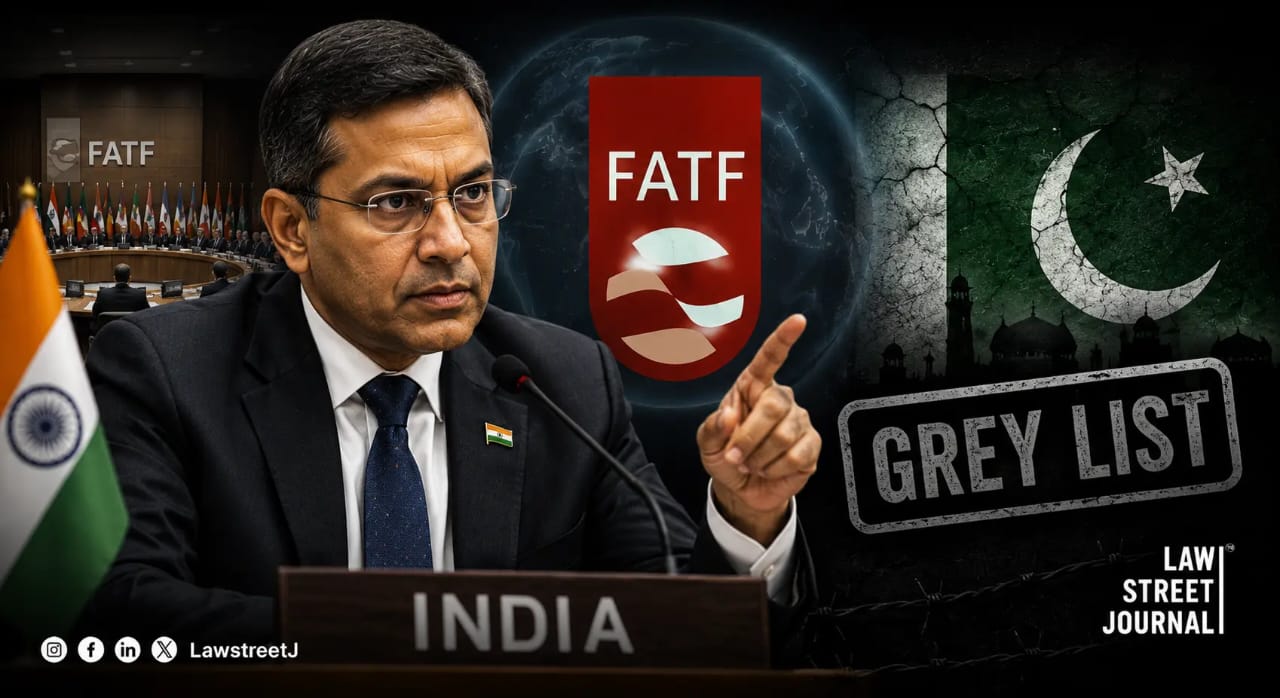
India is expected to urge the Financial Action Task Force to place Pakistan back on its grey list at the watchdog's October 2026 plenary meeting in Paris, according to media reports citing government sources. The move would seek to place Islamabad once again under enhanced monitoring by the Paris-based anti-money laundering and counter-terrorist financing body, just four years after Pakistan successfully exited the grey list in October 2022 following the completion of a demanding 34-point action plan.
India's expected push comes at a diplomatically delicate moment, Pakistan is simultaneously attempting to reinvent itself internationally as a stabilising actor in the region and has been strengthening ties with the administration of US President Donald Trump, having played a key brokering role in the US-Iran peace negotiations at Bürgenstock, Switzerland. New Delhi's FATF effort will therefore need to build sufficient support among the 39-member body, where geopolitical calculations frequently influence what are formally presented as technical determinations.
What India Plans to Present as Evidence
India plans to present material linked to Operation Sindoor, including videos circulated on social media that allegedly show senior Pakistani military and intelligence officials attending funerals of militants killed during the operation. Indian officials are expected to argue that such material, along with other evidence, indicates continued interaction between state actors and militant networks and warrants renewed enhanced monitoring of Pakistan under FATF mechanisms.
Following India's Operation Sindoor, many senior Pakistan army and intelligence officials were seen in videos circulating on social media attending funerals of terrorists killed in the operation. These videos, along with other material showing state actors participating in gatherings of terror outfits, could be presented at the next FATF plenary to argue for placing Islamabad back under enhanced monitoring.
New Delhi's efforts may also gain visibility following the appointment of Vivek Agarwal, secretary in India's culture ministry, as vice-president of FATF. That appointment places an Indian official in a senior institutional role within the body at precisely the moment India intends to make its most consequential push against Pakistan in the organisation's history.
Pakistan's Grey List History: Three Times In, Once Out
Pakistan's relationship with the FATF grey list is long and economically painful. Pakistan was first on the FATF grey list from 2012 to 2015. It was included again in June 2018 as deficiencies in its anti-money laundering and counter-terrorist financing framework were considered a serious threat to the global financial system. Deficiencies covered many areas: legal, financial, regulatory, investigations, prosecutions, judicial, and the non-governmental sector.
Pakistan was removed from the grey list in October 2022 after satisfying FATF members on the implementation of a 34-point action plan. The plan included legislative and operational reforms, such as anti-money laundering and counter-terrorist financing mechanisms, and enhanced monitoring of suspicious transactions and politically exposed persons.
The groups whose financing Pakistan was specifically required to address as part of its action plans included, according to the Basel Governance Institute's detailed assessment, the Afghan Taliban, Jamaat-ud-Dawa, the Haqqani Network, Jaish-e-Mohammed, Lashkar-e-Taiba, Falah-e-Insaniyat Foundation, al-Qaeda, and Islamic State. India's current argument is that despite formally satisfying the 34-point plan, Pakistan's state actors have continued to engage with militant networks and that Operation Sindoor produced documented evidence of exactly that.
What Grey-Listing Costs: The Economic Consequences
The financial stakes of a return to the grey list for Pakistan are severe and well documented.
Being on the FATF grey list made it difficult for Pakistan to get assistance from the IMF, World Bank, Asian Development Bank, and EU. The IMF had included exiting the grey list as part of its conditions for receiving a six billion dollar bailout.
Research by Islamabad-based think tank Tabadlab found that Pakistan sustained a total of 38 billion dollars in economic losses due to FATF's decision to thrice place the country on its grey list since 2008. The research paper titled "Bearing the cost of global politics, the impact of FATF grey-listing on Pakistan's economy" examined grey-listing events from 2008 to 2019 and found those periods may have resulted in total GDP losses worth 38 billion dollars.
For a country already under an IMF Extended Fund Facility and facing chronic balance-of-payments pressures, a return to the grey list would arrive at the worst possible time. Pakistan's sovereign credit rating has been downgraded repeatedly in recent years, and renewed FATF monitoring would add another layer of risk perception that deters foreign investment and complicates access to international capital markets.
How FATF Grey-Listing Works: The Legal and Procedural Framework
The FATF formally the Financial Action Task Force, is a Paris-based intergovernmental body established in 1989 to set global standards for combating money laundering, terrorist financing, and proliferation financing. When the FATF places a jurisdiction under increased monitoring, it means the country has committed to resolve swiftly the identified strategic deficiencies within agreed timeframes and is subject to increased monitoring. This list is often externally referred to as the grey list.
The FATF Plenary, the decision-making body, meets three times a year, around February, June, and October. India's intended push is therefore targeted at the October plenary, the last meeting of the year, which historically has been a session at which significant listing and delisting decisions are made.
Grey-listing is formally a technical determination, not a political one. A country is placed under increased monitoring when its anti-money laundering and counter-terrorist financing frameworks are assessed to have strategic deficiencies that pose risks to the international financial system. However, the process of identifying those deficiencies, marshalling evidence, and building support among the 39-member body involves a substantial diplomatic dimension. Countries that wish to see a jurisdiction grey-listed must convince a sufficient number of FATF members that the technical threshold has been met.
For all countries identified as high-risk, the FATF calls on all members and urges all jurisdictions to apply enhanced due diligence. In the most serious cases, countries are called upon to apply counter-measures to protect the international financial system from the ongoing money laundering, terrorist financing, and proliferation financing risks emanating from the country.
The distinction between grey-listing and black-listing is significant. As of February 2026, only three countries were on the FATF blacklist: North Korea, Iran, and Myanmar. India is not seeking Pakistan's blacklisting, the far more severe designation but rather a return to enhanced monitoring, which is itself a serious designation with measurable economic consequences.
The Diplomatic Challenge India Faces
India's push will not be straightforward. Pakistan's role as a mediator in the US-Iran peace process has earned it significant goodwill in Washington and Doha. The Trump administration has publicly praised Pakistan Army Chief Field Marshal Asim Munir for his role in the Bürgenstock negotiations, with Vice President JD Vance describing him as a great diplomat whose leadership made the Iran talks possible. That diplomatic capital will not disappear overnight, and it complicates India's effort to build the coalition of support within FATF that a successful grey-listing campaign requires.
Pakistan is also likely to push back vigorously. Islamabad has previously characterised India's FATF efforts as politically motivated attempts to weaponise a technical body for bilateral strategic purposes, an argument that carries some resonance among FATF members who are wary of the body being used as an instrument of geopolitical pressure rather than a neutral enforcer of financial standards.
What India has in its favour this time is the specificity of the Operation Sindoor evidence and its own elevated institutional standing within FATF, with the appointment of Vivek Agarwal as vice-president providing an important platform. Whether that is sufficient to secure the votes needed remains to be seen.
The October FATF plenary will take place against the backdrop of a broader regional situation that remains fluid, with US-Iran negotiations continuing in Switzerland, the India-Pakistan relationship in a post-Operation Sindoor holding pattern, and Pakistan's economic fragility making the prospect of grey-listing unusually consequential for Islamabad's ability to service its external obligations.