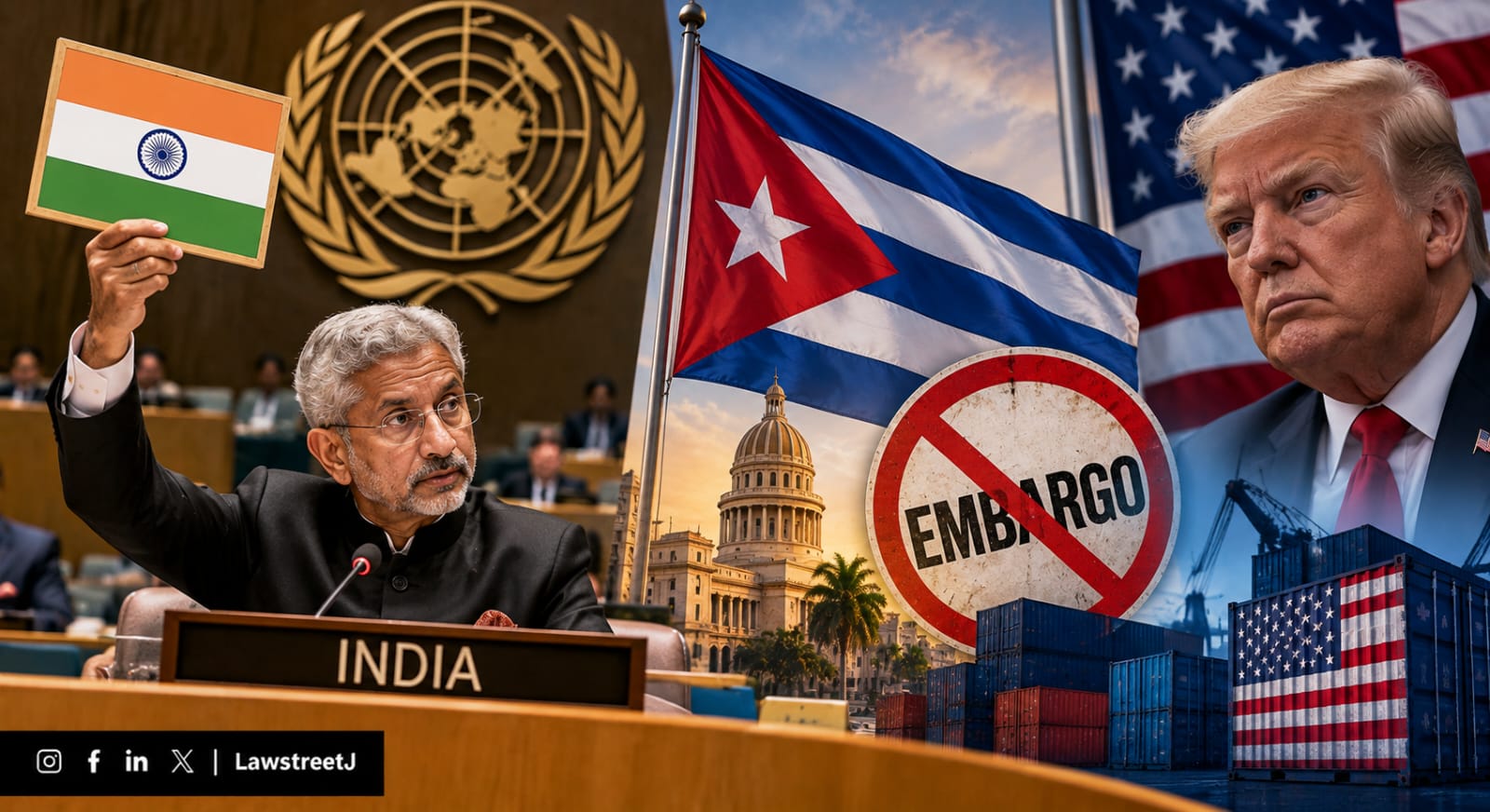
United Nations — India voted in favour of a United Nations General Assembly resolution calling for an end to the United States' decades-long economic, commercial and financial embargo on Cuba, in a vote on October 28, 2026, that saw support drop sharply from previous years amid an active US lobbying campaign, and during which a verbal confrontation between American and Cuban diplomats forced the session to be suspended.
The Vote
The 193-member General Assembly adopted the resolution, titled "Necessity of ending the economic, commercial and financial embargo imposed by the United States of America against Cuba," with 130 countries voting in favour, 17 against, and 25 abstaining. The result marked the 34th consecutive year the resolution has been brought before the Assembly and adopted, though the margin was notably narrower than in many previous years, when support had often exceeded 180 votes, with only the United States and Israel typically voting against.
India's Statement
Delivering India's explanation of vote, Counsellor at India's Permanent Mission to the UN, Soumya Nair, said the General Assembly has repeatedly called for an end to the embargo and rejected laws and regulations with extraterritorial effects that adversely affect the sovereignty of other states and the progress and prosperity of their peoples. Nair said Cuba's health system faces shortages of over 60 percent of essential medicines, while food production has declined by more than 50 percent over the past five years. She added that restrictions on fuel exports to Cuba had aggravated the country's ongoing energy crisis, with shortages disrupting essential services including healthcare, education, water supplies, food distribution and transportation.
Nair said India reiterates the Assembly's call to all states to refrain from promulgating and applying, and to repeal and invalidate, such laws and measures, in conformity with their obligations under the UN Charter and international law. She stated that India's commitment to multilateralism is rooted in the belief that international challenges are best addressed through dialogue and diplomacy, in accordance with the UN Charter.
The Confrontation Between US and Cuban Diplomats
The session was marked by a dramatic disruption. While US envoy Mike Waltz was addressing the General Assembly on the Cuba resolution, Cuban Foreign Minister Bruno Rodríguez Parrilla and other Cuban diplomats rose from their assigned seats and walked toward the podium to confront the American envoy, triggering a verbal exchange between the two delegations. UN General Assembly President Khalilur Rahman, who was presiding over the meeting, was compelled to suspend the session as a result of the confrontation.
This year's vote reflected a notably different outcome from the pattern of previous years. In 2024, for comparison, the same resolution had passed with 187 votes in favour and only the United States and Israel voting against. The sharp decline to 130 votes in favour in 2026, alongside a rise to 17 votes against and 25 abstentions, has been attributed in reporting to an active lobbying campaign by the Trump administration aimed at persuading other countries to vote against or abstain on the resolution, consistent with the administration's broader tightening of Cuba policy since returning to office.
The US Embargo and the Annual Resolution
The United States first imposed its trade embargo on Cuba in 1960, following the Cuban Revolution led by Fidel Castro, and the embargo has since been expanded in scope through subsequent legislation, including the 1992 Cuban Democracy Act and the 1996 Cuba Liberty and Democratic Solidarity Act, commonly known as the Helms-Burton Act, which codified the embargo into US federal law and gave it extraterritorial reach by allowing US nationals to sue foreign companies that use property in Cuba confiscated from them after the revolution.
The General Assembly has voted annually since 1992 on a Cuban-sponsored resolution calling for the embargo's termination, a vote that has become one of the most closely watched annual demonstrations of international opinion on the issue at the UN, notwithstanding its non-binding character.
US policy toward Cuba has fluctuated across successive administrations, the Obama administration moved toward normalising relations with Havana starting in 2014 and abstained, rather than opposed, the UN resolution in 2016, the first such US abstention in 25 years, the first Trump administration reversed this opening and intensified sanctions, the Biden administration largely maintained the tightened restrictions, and the current Trump administration has continued and further tightened the embargo since returning to office in 2025.
General Assembly resolutions of this nature, including the annual Cuba embargo resolution, are not legally binding on UN member states. Unlike resolutions passed by the UN Security Council under Chapter VII of the UN Charter, which can carry binding obligations and enforcement mechanisms, General Assembly resolutions under Article 10 and Article 14 of the Charter serve a recommendatory function, reflecting the collective political position of the international community without imposing direct legal obligations on the United States or any other member state to alter its domestic or foreign policy.
The practical effect of the annual vote has, over more than three decades, been understood primarily as a measure of diplomatic isolation and international pressure on US Cuba policy rather than as an instrument with direct legal consequences.