Costa Rica's bilateral agreement with Washington now puts the Central American nation at the centre of a widening and legally contested deportation network spanning multiple continents
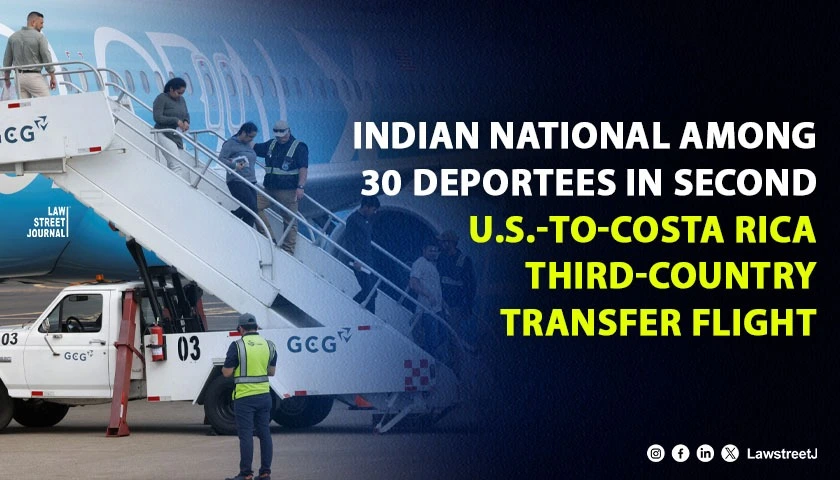
Costa Rica on Friday received a second group of migrants deported from the United States, as part of an ongoing bilateral agreement designed to support the Trump administration's policy of removing immigrants to third countries. Among those on board was one Indian national, part of a flight that carried people from ten different countries, none of whom hold citizenship in Costa Rica.
The second group comprised 30 individuals in total, including eight Costa Ricans, eight Brazilians, three Romanians, two Chinese nationals, three from Uzbekistan, two from Azerbaijan, one from Ireland, one from India, and one from Vietnam. Their arrival at San José's Juan Santamaría International Airport marks a significant escalation in the practical implementation of what has become one of the most disputed immigration enforcement mechanisms of the current U.S. administration.
This is the second such transfer in as many weeks. The first group included 25 people from Albania, Cameroon, China, Guatemala, Honduras, India, Kenya, and Morocco. An Indian national was present in that first group as well, making this the second consecutive flight to Costa Rica carrying citizens from India, individuals who were not being returned to their home country, but instead deposited in a nation with which they have no legal, cultural, or familial connection.
The Agreement: What It Says and What It Allows
Under a bilateral agreement signed in March by Costa Rican President Rodrigo Chaves and U.S. Special Envoy Kristi Noem, Costa Rica agreed to accept up to 25 third-country nationals expelled from the United States each week. That cap was exceeded in the second transfer, with 30 individuals arriving on Friday. Under the arrangement, the United States provides financial support, while the International Organization for Migration covers food and accommodation during the first seven days of the migrants' stay in Costa Rica. After those seven days, the migrants must determine their own next steps, a timeline that many legal experts and oversight bodies have described as inadequate for the complexity of the situations involved.
Costa Rica's Immigration Chief Omer Badilla stated that the migrants are not being held in detention and are in full freedom, staying in a hotel, with their exact location withheld on grounds of privacy. However, Costa Rica's Ombudsman's Office gave immigration authorities 24 hours to disclose where the first group of migrants was being housed, after it was unable to carry out an on-site inspection more than 48 hours after their arrival.
If any deportee chooses to leave Costa Rica, they must inform local migration authorities and clarify whether they will need humanitarian support to leave, or will pay for the trip themselves. For individuals without financial resources, travel documents, or ties to any country willing to receive them, this provision carries a weight that is difficult to overstate.
The Broader Network: How Many Countries Are Now Involved
Costa Rica is not operating in isolation. It is one of a growing number of countries across Africa and the Americas that have signed contentious, often secretive agreements with the United States to accept deportees from other countries. The Trump administration has entered into agreements with at least 27 countries to receive non-nationals deported from the United States, though some of those agreements have not been made public. Countries confirmed to have accepted third-country deportees include South Sudan, Honduras, Rwanda, Guyana, and several Caribbean islands including Dominica and St. Kitts and Nevis.
The financial dimension of these agreements has drawn considerable scrutiny. El Salvador received nearly six million dollars to imprison deportees, Equatorial Guinea received 7.5 million dollars, and Eswatini received 5.1 million dollars. Senate Democrats in the United States have estimated that at least 40 million dollars in funding has been provided as incentives for countries to accept deportations, with most funds disbursed in lump sums before any deportees arrived.
A February 2026 report from Democrats on the Senate Foreign Relations Committee found that these deportation agreements cost American taxpayers millions of dollars, at times more than one million dollars per person removed from the country. The report cited the example of a Jamaican man who was sent to Eswatini at a cost exceeding 181,000 dollars, despite a U.S. court ruling that he should have been returned to Jamaica and who was subsequently flown back to Jamaica, also at U.S. expense.
Migrant arrests in the United States increased elevenfold during the first year of President Trump's second term, driving a fivefold increase in deportations. Third-country transfers have become a central instrument in managing the sheer volume of removals, particularly in cases where a migrant's home country has declined or delayed accepting them back.
Legal Challenges: Courts, Due Process, and International Law
The legal framework surrounding these deportations is the subject of active litigation across multiple jurisdictions. U.S. law requires the government not to deport anyone to a country in which they will be persecuted or tortured, or to a country that will then send them into harm's way. These protections are grounded in the 1951 Refugee Convention and the United Nations Convention Against Torture, both of which have been codified into U.S. domestic law.
U.S. District Court Judge Brian E. Murphy barred the federal government from sending migrants to third countries without first assessing potential claims under the UN Convention Against Torture, ruling that failing to give migrants a meaningful opportunity to raise fears of deportation violated their constitutional due process rights. In a subsequent ruling, Judge Murphy found that the Trump administration's third-country removal policy violated federal immigration law and migrants' right to due process, stating that the policy failed to satisfy due process for multiple reasons, not least because the scope and reliability of assurances provided by receiving countries remained unclear.
Multiple federal judges have now ruled that before deporting a person to a third country, the Department of Homeland Security must provide them meaningful notice and a meaningful opportunity to raise country-specific claims against removal. Despite these rulings, enforcement of the policy has continued. Reports indicate that many individuals first learn they are being deported to a third country while already aboard the flight overseas, and that even when a country has not credibly promised to refrain from torture or persecution, the Department of Homeland Security generally gives individuals only 24 hours' notice, with no guaranteed opportunity to speak with an attorney.
Costa Rica itself has a recent precedent that bears directly on this situation. In 2025, Costa Rica's Constitutional Chamber ruled that authorities violated fundamental rights of migrants by failing to provide timely information on migration status, access to legal advice, contact with the outside world, and early notice of the option to seek refuge. The court ordered that each person's status be individually defined and that they be released from the facility near the Panama border where they were being held.
What Happens Next
For the Indian national on this latest flight and for the hundreds of others caught in this system across dozens of countries, the immediate future remains uncertain. In many cases, migrants who had previously hoped to seek asylum in the United States are left in a legal black hole in foreign countries where they do not speak the language. Forced third-country transfers have separated parents from children, spouses from one another, and cut people off from their communities in the United States. In many cases, they have resulted in enforced disappearances, arbitrary detention, and unlawful refoulement.
Some experts note that the United States stands out as one of the first democracies to operationalize third-country removals at scale as part of a broader mass deportation strategy. The United Kingdom pursued a similar agreement with Rwanda in 2022, but it never went into effect due to legal challenges. Australia has used offshore processing extensively, though under different legal and political circumstances.
As of today, the flights continue. The legal challenges continue. And for individuals like the Indian national who landed in San José on Friday, a person with no ties to Costa Rica, no guarantee of return to India, and no clarity on what comes next, the situation remains one of profound legal and human uncertainty.

![India reacts to US accusing Indian in foiled plot to kill Khalistan separatist [Read Unsealed Indictment]](/secure/uploads/2023/11/lj_1593_Khalistan_Row.jpg)