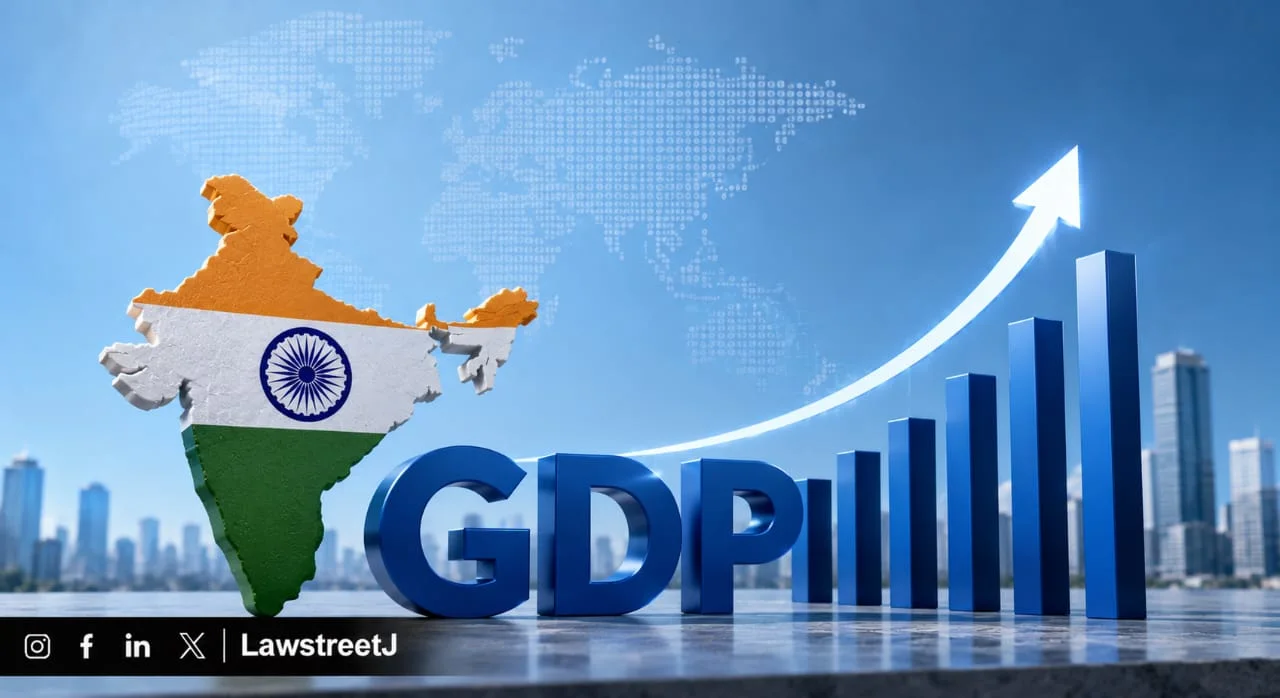

NEW DELHI - India's economy grew at 7.8 per cent in the April-June quarter of 2026-27, the fastest rate among major global economies and significantly ahead of every major forecast as strong domestic consumption, government capital expenditure, private investment, and a resilient services sector absorbed the headwinds from the ongoing West Asia conflict, elevated crude oil prices, and global supply chain disruptions. The data, released on Monday by the Ministry of Statistics and Programme Implementation, confirms India's position as the world's fastest-growing major economy and marks a sharp acceleration from the 6.9 per cent growth recorded in the same quarter of the previous fiscal year.
Real GDP at constant prices in Q1 of FY2026-27 is estimated at Rs 81.36 lakh crore, against Rs 75.46 lakh crore in Q1 of 2025-26, showing a growth rate of 7.8 per cent. Nominal GDP at current prices in Q1 of FY2026-27 is estimated at Rs 88.27 lakh crore, against Rs 80 lakh crore in Q1 of 2025-26, showing a growth rate of 10.3 per cent.
The MoSPI stated: "Indian economy has sustained growth momentum despite global headwinds."
Beating Every Estimate, By a Significant Margin

The 7.8 per cent growth figure was not just better than the previous year's comparable quarter, it beat every major forecast by a substantial margin. A Reuters survey of 58 economists had projected Q1 FY27 GDP growth of around 7.1 per cent, while the Reserve Bank of India had projected 7 per cent for the quarter when it released its monetary policy assessment earlier in August.
Several economists had specifically warned that the West Asia conflict, which erupted with the US-Israel Operation Epic Fury against Iran in February 2026, would weigh on India's economic activity through elevated energy prices, increased import costs, and supply chain disruptions. India imports a large share of its energy requirements from the Gulf region, and the disruption of the Strait of Hormuz has compounded both the cost and uncertainty of those imports.
The economy's ability to deliver 7.8 per cent growth against that backdrop, rather than the 7 to 7.1 per cent economists expected, reflects the depth and breadth of the domestic demand and investment cycle that is now sustaining India's growth story independently of external conditions.
Sector by Sector: What Drove the Number

The sectoral breakdown of Q1 FY27 GDP shows that the growth was broad-based but with important nuances within that broad picture.
The tertiary sector, which encompasses financial services, real estate, professional services, trade, hospitality, transport, and communication registered 10 per cent growth at constant prices, making it the single most significant contributor to the headline number. Financial, real estate and professional services expanded by approximately 12 per cent, reflecting both a deepening domestic financial system and India's growing role as a services export hub.
The secondary sector grew 8.6 per cent. Manufacturing and electricity and gas-related activity grew close to 9 per cent, a figure that surprised many economists who had expected the manufacturing sector to face pressure from elevated input costs linked to the oil price spike. The performance of the metals, power and infrastructure sub-sectors within manufacturing was particularly strong, supported by both domestic demand and government capex.
The primary sector grew only 2.9 per cent overall significantly slower than the secondary and tertiary sectors and this figure conceals an important internal divergence. Agricultural and allied activities grew 3.6 per cent in Q1 FY27, compared to 4.4 per cent in the same quarter last year, reflecting the impact of a delayed monsoon start. The mining sector contracted by 2.4 per cent, a sharp reversal from the 12.4 per cent growth it had posted in Q1 FY26.
Gross Value Added (GVA), which measures economic output before accounting for taxes and subsidies on products, was estimated at Rs 73.82 lakh crore in Q1 FY27 against Rs 68.21 lakh crore in Q1 FY26, a growth rate of 8.2 per cent.
Investment: The Quarter's Most Important Story
Investment emerged as one of the most significant drivers of the Q1 FY27 performance, and its composition matters as much as its scale.
Economists pointed to stronger capital expenditure by both the government and the private sector, including specific investments in data centres, power infrastructure, and metals. The government's sustained push on infrastructure capital expenditure, roads, railways, ports, and urban infrastructure continued to create multiplier effects across the construction sector and its supply chains.
Private sector investment in data centres is a relatively new addition to India's capital expenditure story. The explosion of artificial intelligence workloads, cloud computing demand, and digital services has created a significant pipeline of data centre investment across Hyderabad, Pune, Chennai, and the Mumbai Metropolitan Region, investment that generates both construction activity in the short term and high-skilled employment in the medium term.
The power sector's contribution to investment reflects the ongoing build-out of renewable energy capacity, grid modernisation, and the transmission infrastructure required to connect India's rapidly growing solar and wind generation to demand centres.
Consumption also remained resilient despite elevated prices. The combination of strong consumption and rising investment, two complementary demand drivers in an environment where many economists had expected at least one to weaken under inflationary pressure, is the most encouraging feature of the Q1 FY27 data.
PM Modi and Nirmala Sitharaman Respond
The government welcomed the data with public statements from its most senior figures.

Prime Minister Narendra Modi called India's Q1 FY27 GDP growth a "herculean feat." Writing on X, Modi said: "The collective strength of our people ensured India delivered such growth despite oil price shocks and supply chain issues in the midst of global uncertainties. Doomsayers were doomed and India bloomed…yet again!"
Finance Minister Nirmala Sitharaman also welcomed the figures, saying the performance reflected the resilience of India's domestic economic fundamentals and the effectiveness of the government's reform agenda across manufacturing, financial inclusion, and infrastructure.
The MoSPI has been explicit that Q1 FY27 estimates are provisional and subject to revision. Improved data coverage and revisions in input data by source agencies will have a bearing on subsequent revisions, and users should take this into consideration while interpreting the figures. The next quarterly GDP estimates, covering the July-September 2026 quarter, are scheduled for release on November 30, 2026.
The Q1 FY27 figures are also the first to use the new GDP series introduced by MoSPI on February 27, 2026, with 2022-23 as the base year, replacing the earlier 2011-12 base year series. The new series uses a Double Deflation approach for manufacturing GVA, separately deflating output and intermediate consumption using granular Producer Price Indices. providing what MoSPI describes as a more robust measure of real value added.
For the full financial year FY2026-27, the Reserve Bank of India has projected growth of 6.7 per cent. If Q1 came in at 7.8 per cent, the subsequent quarters, which will face the continued impact of the West Asia conflict, the monsoon's effect on agricultural output, and the lagged pass-through of elevated energy prices, will need to deliver closer to 6.3 to 6.5 per cent on average to land at the RBI's full-year forecast. Whether India can maintain the momentum, particularly if the Strait of Hormuz situation remains unresolved, is the central question hanging over the economy as it moves into the second quarter of FY27.
For now, the 7.8 per cent makes India, by a wide margin, the fastest-growing large economy in the world for Q1 of 2026-27.