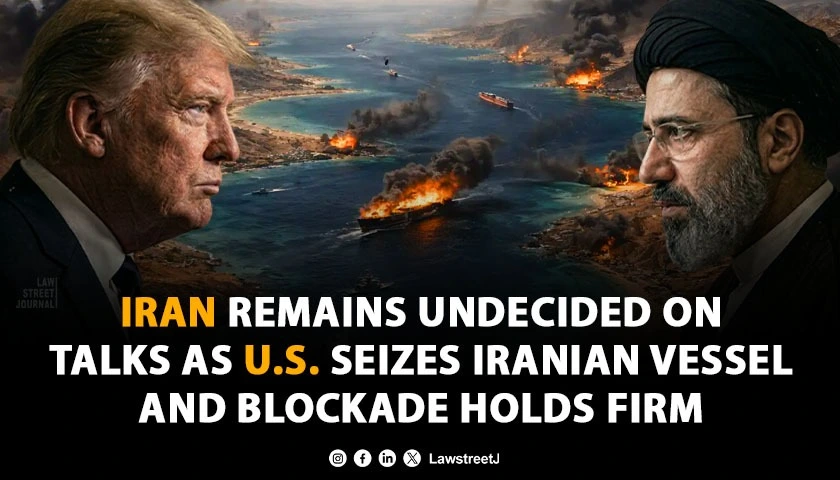
The fragile diplomatic thread connecting Washington and Tehran came under severe strain over the past 48 hours after the United States Navy fired upon and seized an Iranian-flagged cargo ship in the Gulf of Oman, drawing sharp condemnation from Iran and throwing the already uncertain peace process into further disarray. With a two-week ceasefire between the two nations set to expire on April 22, the question of whether a second round of negotiations will take place and whether any deal is possible before the window closes, remains deeply uncertain.
The U.S. Navy fired on and seized an Iranian-flagged cargo ship that tried to bypass the U.S. naval blockade in the Gulf of Oman, according to President Donald Trump. Trump stated on Truth Social that the U.S. Navy Guided Missile Destroyer USS Spruance intercepted the vessel, identified as the Touska, adding that the Navy "gave them fair warning to stop" and that the Iranian crew refused to comply, leading to the ship being disabled by a strike to its engine room. He confirmed that U.S. Marines had taken custody of the vessel. U.S. Central Command confirmed that the Touska was headed to the Iranian port of Bandar Abbas and had ignored multiple U.S. warnings over a six-hour period to evacuate the engine room. The vessel, a nearly 900-foot cargo ship, had been traveling from China to Iran and was listed under U.S. Treasury sanctions due to what American officials described as a prior history of illegal activity.
Iran's response was swift and forceful. Iran's top joint military command said the U.S. had violated the ceasefire by firing at a commercial ship and warned that "the armed forces of the Islamic Republic of Iran will soon respond and retaliate against this armed piracy by the U.S. military."
The Strait of Hormuz: A Chokepoint in Crisis
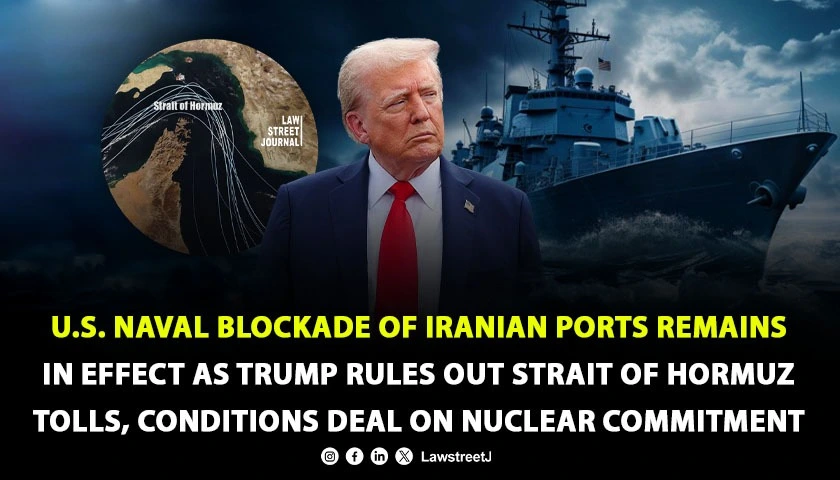
At the center of this escalating confrontation lies the Strait of Hormuz, one of the most strategically critical waterways on the planet. One-fifth of the world's oil and liquefied natural gas supplies pass through the strait in peacetime. Since the U.S. and Israel launched strikes on Iran at the end of February, shipping through the passage has fallen by 95 percent as Iran has threatened to target tankers.
The situation in the strait has deteriorated sharply in recent days. On Sunday, no tankers passed through the Strait of Hormuz, making it one of the quietest days in the channel since the conflict began. India's foreign ministry summoned Iran's ambassador in New Delhi after what it described as a shooting incident involving two Indian-flagged vessels in the Strait of Hormuz. India has urged Iran to allow Indian ships to resume safe passage across the strait as soon as possible. Meanwhile, more than 20,000 seafarers have been stuck on hundreds of ships in the Gulf since the war began in late February. The U.K.'s Maritime Trade Operations Centre also received a report that two Iranian Revolutionary Guard gunboats fired on a tanker. French shipping company CMA CGM confirmed that one of its vessels was the target of warning shots.
The economic consequences are already being felt. West Texas Intermediate futures jumped more than 6 percent to $89 per barrel shortly after midnight Monday, while the international benchmark Brent climbed 5.6 percent to $95.50 a barrel. U.S. gas prices reached a national average of $4.05 a gallon on Sunday, with the U.S. Energy Secretary noting prices may not return below $3 a gallon until next year.
Iran's position on the strait has been unambiguous. Iran's chief negotiator, parliamentary speaker Mohammed Bagher Qalibaf, stated on Iranian state television: "It is impossible for others to pass through the Strait of Hormuz while we cannot."
The Diplomacy: Where Things Stand
The backdrop to this maritime standoff is a deeply troubled diplomatic process that began when Iran and the United States announced a temporary two-week ceasefire on April 7, 2026. That truce created a narrow opening for negotiations, but the first round of talks has already failed to produce any agreement. The first round of high-level talks took place in Islamabad on April 11 and 12, mediated by Pakistan, and lasted more than 20 hours. The discussions included both indirect and direct exchanges between delegations led by U.S. Vice President JD Vance and senior Iranian officials. They focused on several core issues, including Iran's nuclear programme, sanctions relief, Iran's frozen assets, and control of the Strait of Hormuz.
The talks concluded without a resolution or memorandum of understanding, with Vance claiming Iran chose "not to accept our terms" and that the U.S. needed to see a "fundamental commitment" from Tehran not to develop nuclear weapons. On the nuclear enrichment question, arguably the most contentious issue, the two sides remain far apart. Trump officials proposed a 20-year suspension in Iranian uranium enrichment, which Iranian negotiators countered with a proposal for a five-year suspension that the U.S. rejected. American negotiators also reportedly want Iran to dismantle its major nuclear enrichment facilities and hand over more than 400 kilograms of highly enriched uranium.
Iran's legal position on this matter has been articulated clearly by international law experts. Maryam Jamshidi, a law professor at the University of Colorado, told Al Jazeera that Iran's position on enrichment is based on Article IV of the Nuclear Non-Proliferation Treaty, which recognizes that all state parties have the inalienable right to research, develop, and use nuclear energy for peaceful purposes, and that in demanding Iran have no enrichment, the United States is denying Iran its rights under international law. It is also worth noting that in March 2025, Tulsi Gabbard, the U.S. Director of National Intelligence, testified to Congress that the U.S. "continues to assess that Iran is not building a nuclear weapon." Iran is a signatory to the 1970 Treaty on the Non-Proliferation of Nuclear Weapons.
Iranian Foreign Ministry spokesperson Esmaeil Baqaei said there is "no plan for a second round of negotiations with the U.S." under current conditions, citing excessive U.S. demands, shifting positions, and the continued naval blockade, which Iran views as a violation of the ceasefire.
Trump, for his part, has escalated his public warnings. He stated the U.S. would obtain Iran's stockpile of highly enriched uranium "one way or another," warning it could come "in a much more unfriendly form" if negotiations fail, and has threatened to strike Iranian power plants and bridges if Tehran refuses a deal. Legal experts have raised serious questions about whether strikes on civilian infrastructure such as bridges and power plants would constitute violations of international humanitarian law.
The Ceasefire on the Edge
The two-week truce expires on April 22 and has created a small window for negotiations to end the war, which has killed more than 4,000 people across the Middle East, overwhelmingly in Iran and Lebanon.
With the ceasefire set to end in days and a fresh round of U.S.-Iran peace talks in jeopardy, hopes for a quick end to the war are fading. Former negotiators who worked on the 2015 Joint Comprehensive Plan of Action have been candid about the difficulty of reaching any swift agreement. The JCPOA itself required more than 18 months of sustained diplomacy, and the mutual mistrust between Tehran and Washington has only deepened in the years since Trump withdrew the U.S. from that agreement in 2018, despite the International Atomic Energy Agency's confirmation at the time that Iran had been in full compliance.
Vance told Fox News that Iranian negotiators "moved in our direction, but they didn't move far enough," and said Iranian negotiators had to return to Tehran from Islamabad to seek approval for any deal. A Pakistani military delegation has since traveled to Tehran in an effort to revive talks, but no second round has been officially confirmed by either side.
As of April 21, 2026, the ceasefire remains technically in effect but is visibly fraying. The seizure of the Touska, continued closures in the Strait of Hormuz, and Iran's refusal to confirm participation in a second round of talks have left the diplomatic situation in an extremely precarious position. The next 24 hours, before the truce formally expires, may prove decisive in determining whether the conflict resumes or whether diplomacy finds a way forward.

![India reacts to US accusing Indian in foiled plot to kill Khalistan separatist [Read Unsealed Indictment]](/secure/uploads/2023/11/lj_1593_Khalistan_Row.jpg)