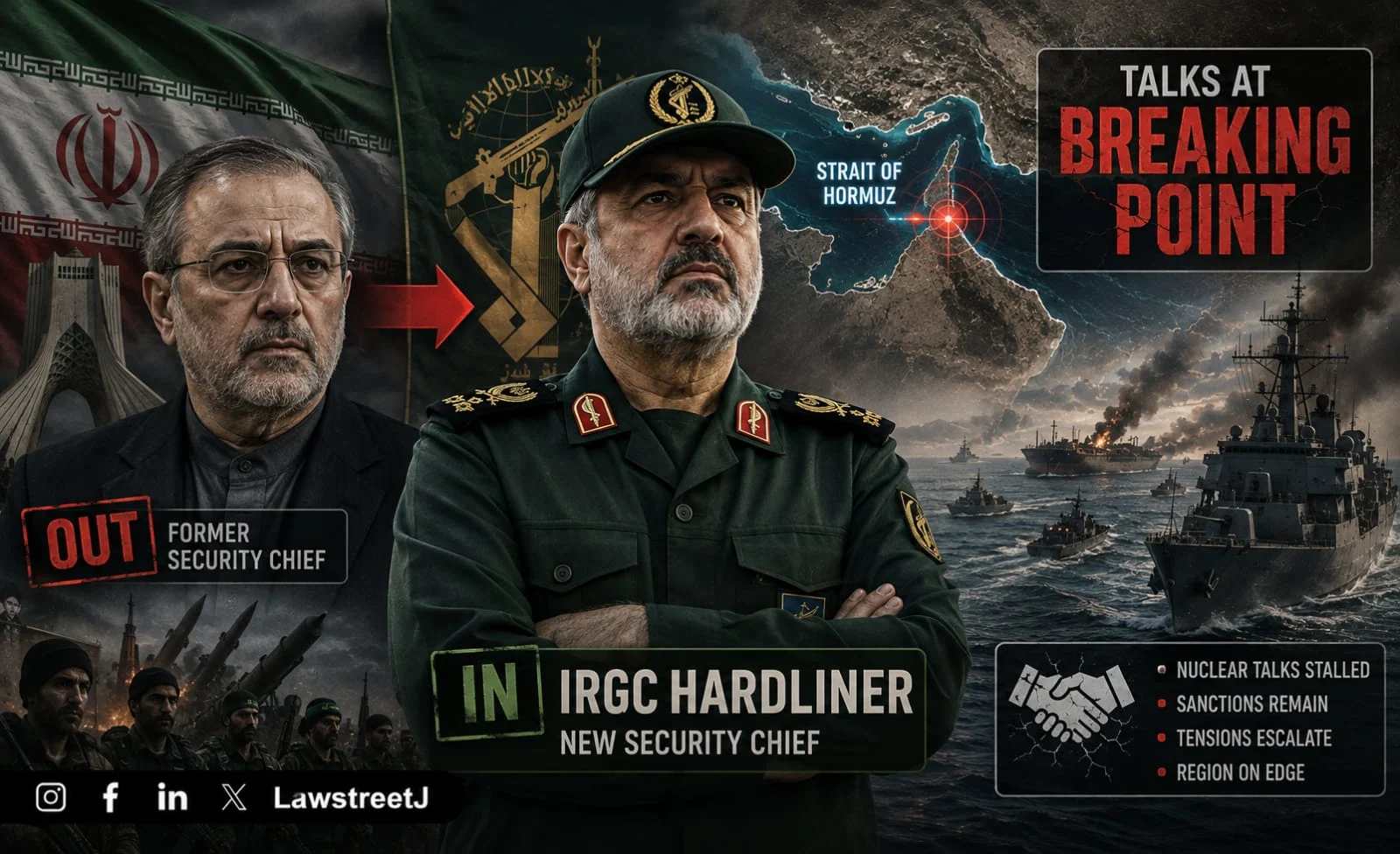
TEHRAN — Iran reshuffled the leadership of its most powerful security body on Sunday, replacing Supreme National Security Council secretary Mohammad Bagher Zolghadr with Mohsen Rezaei, a veteran Islamic Revolutionary Guards Corps commander and close adviser to Supreme Leader Ayatollah Mojtaba Khamenei, at one of the most delicate moments in the ongoing US-Iran conflict. The change comes days after Zolghadr's council issued a list of sweeping and, by most diplomatic assessments, highly unlikely demands as preconditions for reopening the Strait of Hormuz to commercial shipping.
Mohsen Rezaei, who had been an adviser to Supreme Leader Ayatollah Mojtaba Khamenei, will be the new secretary of the Supreme National Security Council. He replaced Mohammad Bagher Zolghadr, who resigned. Zolghadr had been in the post since his predecessor, Ali Larijani, was killed in an Israeli air strike in March. He will serve as political adviser to Khamenei.
Iranian President Masoud Pezeshkian appointed Rezaei as the new secretary of the SNSC in a decree on Sunday. Mehdi Tabatabaei, a spokesperson for the Iranian president's office, announced the appointment, saying that Zolghadr had stepped down from the position to assume a new responsibility.
The reshuffle places an IRGC veteran at the helm of an institution that coordinates Iran's security and foreign policy at the precise moment when both are under maximum strain from US military pressure, an economic blockade, internal leadership losses from the war, and the sustained diplomatic effort to negotiate some form of resolution over the Strait of Hormuz, through which an average of 20 million barrels of oil a day moved before the conflict began in February 2026.
Who Rezaei Is and What His Appointment Signals
Mohsen Rezaei is not a new face in Iranian power politics. He is one of the most recognisable figures in the Islamic Republic's security establishment, having served as commander-in-chief of the IRGC from 1981 to 1997, a 16-year tenure that covered the entire Iran-Iraq War and the formative years of the Revolutionary Guards as a military and political institution. He later served as Secretary-General of the Expediency Discernment Council.
Earlier Sunday, the office of Supreme Leader Mojtaba Khamenei announced that Rezaei would serve as his representative on the Supreme National Security Council, while Zolghadr would become his political adviser.
Citrinowicz, a security analyst, said that Rezaei's background in the Revolutionary Guards is expected to preserve the strong connection between the IRGC and the council. He noted that Rezaei had also served as an adviser to Ali Khamenei and had, in his words, "in a sense mentored Mojtaba." As for the official claim that Zolghadr resigned, he said the circumstances remain unclear. "We cannot know what happened behind the scenes. There are several possibilities. It could even be that Iran's current policy is not hard-line enough for him because he really is very extreme. There could also be personal disagreements that we do not know about. Ultimately, the system is taking shape and there are internal tensions."
He added: "I would not exaggerate and say that the system is out of control. It is under control, and we can see that they are managing to establish a consensus regarding their policy on the Strait of Hormuz."
Both Rezaei and Zolghadr are considered hardliners. The replacement of one IRGC-affiliated hardliner with another, at a moment when Iran is nominally engaged in indirect negotiations over the Strait, leaves the fundamental question unanswered: does this reshuffle represent a shift in Iran's negotiating posture, toward more flexibility or more rigidity or is it purely an internal personnel adjustment within a leadership structure that is still adapting to the losses it has sustained since February?
It was the latest shuffle at the top for the politburo-like body, which has a range of political opinions and rivalries and is adapting to the loss of several senior officials in the war.
The Demands on the Table and the State of Negotiations
The leadership change arrives in the immediate aftermath of the SNSC issuing what observers described as a maximalist set of preconditions for reopening the Strait of Hormuz.
The Supreme National Security Council of Iran issued a list of highly unlikely demands from the US in order to fully reopen the Strait of Hormuz, saying the US must never threaten Iran again, end the blockade, withdraw all military assets from the region, lift sanctions, unfreeze assets and compensate Iran for war damages.
These demands, issued in the days before Zolghadr's resignation, set a ceiling on what Iran says it needs before a resolution is possible, a ceiling that, on its face, encompasses virtually the entire US security and economic posture in the Middle East. The demands include not just the lifting of sanctions and the compensation of Iran for war damages, but the permanent withdrawal of all US military assets from the region and a binding commitment that the US will never threaten Iran again.
The shakeup came as Foreign Minister Abbas Araghchi said Iran is not talking directly with the US to end the war with Tehran and open the Strait of Hormuz, despite claims by US officials that the sides are near a deal. Araghchi was quoted by the Mehr news agency as saying that "messages are being exchanged through intermediaries" and Iran isn't talking directly with Washington.
The use of intermediaries, most significantly Oman, which has long served as a back-channel between Tehran and Washington keeps the door open without constituting the kind of direct engagement that Iran's leadership has publicly ruled out. Iran and Oman appear close to a deal on managing the key waterway. Whether that deal survives the leadership reshuffle and the maximalist demands now on the formal record is the central question facing diplomats working the channel.
Oil futures rose 1.2% on Sunday after Tehran said it was not engaging in negotiations with the United States and submitted a list of demands for reopening. The market's reaction to Iran's statement, a rise in oil prices reflecting the reduced expectation of a quick Strait reopening, illustrates the direct and immediate economic consequence of every shift in the diplomatic temperature around this waterway.
Trump's Posture: "Low-Keying" the Negotiations
The United States has its own internal calibration to manage, and President Trump addressed it directly in an interview published Sunday.
President Trump said on Sunday that the US is "low-keying" negotiations with Iran and signalled a willingness to allow economic pressure to mount on the Islamic Republic. "We are only semi-negotiating with them. We are just watching Iran with its huge inflation and the fact they have no money," Trump told Axios during a phone interview. He said Iran is in "very bad shape" and that the US blockade on the Strait of Hormuz has exacerbated the country's economy. "It will work out. It always works out. It's like a chess game," Trump said.
Trump's chess metaphor captures the dynamic with some precision. Both sides are making moves, Iran with its maximalist demands and its leadership reshuffle, the US with its maintained blockade and its "low-keying" of talks and neither side is yet willing to make the concession that would move the game toward a conclusion.
The "chess game" is not, however, a cost-free one. The Strait of Hormuz has been effectively closed to normal commercial shipping since February. Countries dependent on Gulf oil, including India, which has been engaged in three rounds of talks between EAM Jaishankar and Iran's foreign minister specifically about the safety of Indian-flagged vessels are bearing the economic consequences of every day the standoff continues.
Houthis Strike Saudi Aramco's Jazan Refinery as Proxy Conflict Widens
The leadership change in Tehran on Sunday coincided with fresh evidence of the expanding proxy dimension of the Iran-US conflict.
The Houthi militant group claimed new strikes targeting Saudi Arabian forces in Yemen and a major oil refinery. Yemen's military said it thwarted a new attack by Iranian-backed Houthi rebels, hours after the militant group claimed strikes against Saudi Arabian forces in the country. Recent Houthi attacks underline the risk of Iranian proxy groups escalating the Middle East conflict.
The Houthis claimed strikes against Saudi Aramco's Jazan refinery, a facility that, if successfully hit, would represent one of the most significant strikes on Saudi oil infrastructure since the September 2019 Abqaiq-Khurais attacks. Saudi Arabia confirmed an attempted attack on the refinery. The Houthi operation, whether or not it succeeded in causing damage, signals that Iran's proxy network remains active and capable of escalatory action even as Tehran's own leadership is being reshuffled and its nuclear security council issues demands for a ceasefire.
For Saudi Arabia, which signed the Mecca Joint Defence Agreement with Pakistan and Turkiye just two days before Sunday's events, the Houthi strike attempt is a reminder of the immediate and concrete nature of the security threat it faces, a threat that the new trilateral pact is explicitly designed to deter.
What the Reshuffle Means
The replacement of Zolghadr with Rezaei at the Supreme National Security Council is a development with multiple possible readings, none of which can be confirmed with certainty from outside Tehran's decision-making circles.
It could represent Mojtaba Khamenei tightening personal control over the council by appointing a figure he has closely mentored and with whom he has a documented personal relationship. It could reflect dissatisfaction with the pace or direction of Iran's indirect negotiations over the Strait, either too soft or too hard a line, depending on which faction drove the change. It could be a routine personnel adjustment in a leadership structure that has lost multiple senior figures to Israeli and US strikes since February and is still rebuilding institutional capacity.
"In light of the resignation of Mohammad Bagher Zolghadr from his position as secretary of the Supreme National Security Council and his appointment to new functions, President Masoud Pezeshkian has named Mohsen Rezaei as the head of this body," the Times of Israel quoted Iranian official communications as stating.
What is confirmed is that Iran's most powerful security body now has its third secretary in five months, Larijani killed in March, Zolghadr appointed in March and resigned in August, Rezaei appointed on August 9. That rate of turnover in a body responsible for coordinating Iran's security and foreign policy at the height of a war with the United States and Israel is itself a measure of the institutional stress the Islamic Republic is operating under.