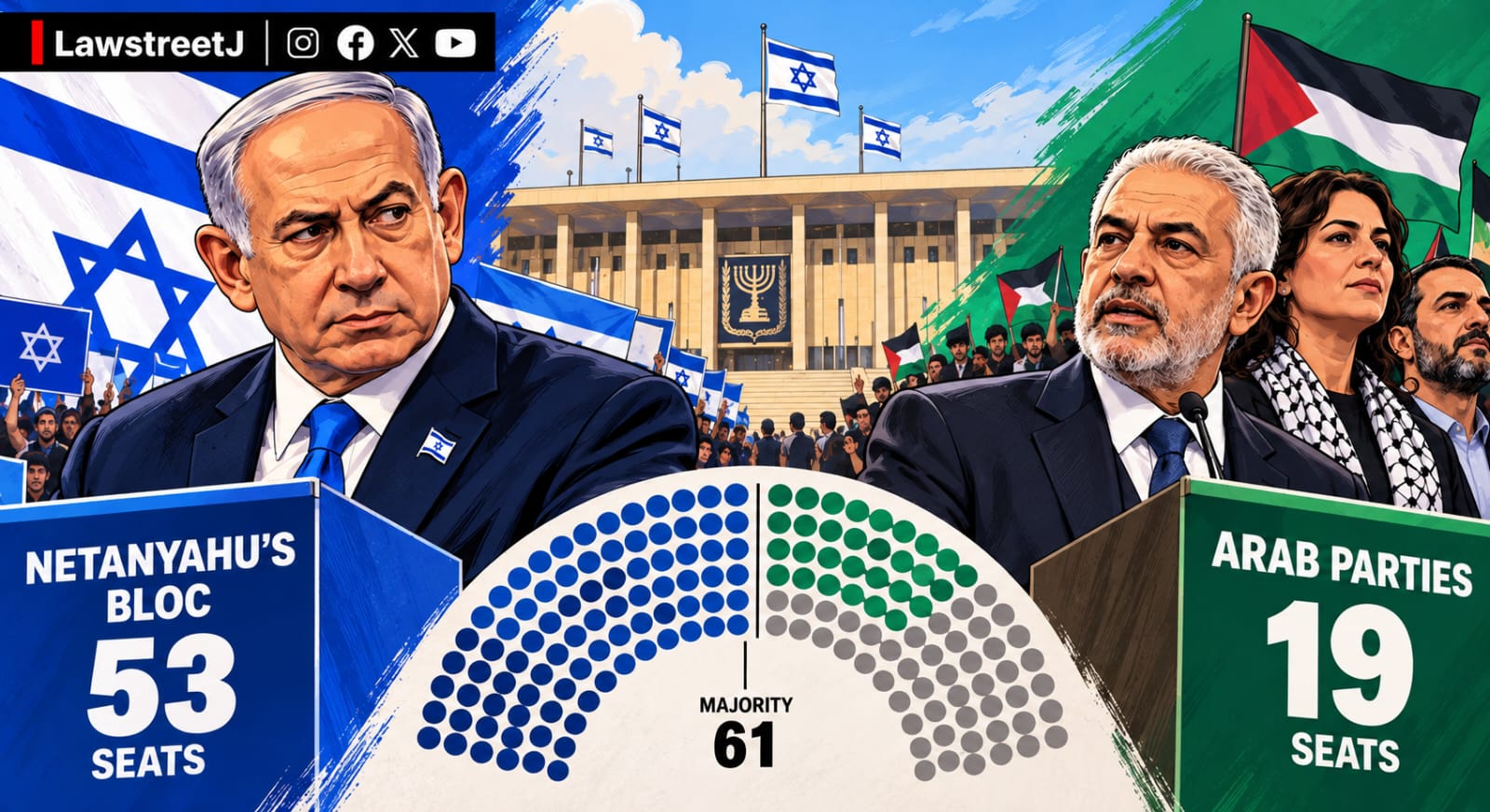
Jerusalem — Israel's Central Elections Committee is expected to publish the final results of the 26th Knesset election around noon on Thursday, October 29, 2026, with the count, as of its most recent update, showing Prime Minister Benjamin Netanyahu's right-wing and religious bloc at 53 seats, seven short of the 61 needed for a parliamentary majority, while a historic surge in support for Arab-led parties has reshaped the arithmetic of what comes next.
The Latest Numbers
With roughly 91 percent of votes counted, Netanyahu's bloc stood at 53 projected seats in the 120-seat Knesset, down from an earlier count of 54 as additional ballots were tallied through Wednesday. Gadi Eisenkot's opposition bloc, led by his Yashar party, held 48 seats, while the Joint List and Ra'am, the two Arab-led parties, together reached a combined 19 seats, nearly double their 10-seat presence in the outgoing Knesset and described by multiple Israeli outlets as a historic high. Combined, Eisenkot's bloc and the Arab parties totalled 67 seats, six more than the 61-seat majority threshold, though translating that combined number into an actual governing coalition remains politically unresolved.
Likud remained the single largest individual party, followed by Eisenkot's Yashar. Yair Golan's Democrats were projected at eight seats and Avigdor Liberman's Yisrael Beytenu at seven. These figures remain provisional, the Central Elections Committee, chaired by Justice Yitzhak Amit, has said double-sealed ballots, including votes from soldiers and overseas diplomatic staff, were still being counted overnight into Thursday, and final, certified results were expected around midday Thursday, October 29, with the committee's statutory deadline to publish official results falling the following Wednesday, November 4.
President Isaac Herzog is due to formally receive the certified results from the Committee once published.
Competing Claims
Both camps have claimed a form of vindication from the results so far. Eisenkot said the outcome reflected "the people's will, having expressed no confidence in the October 7 government," and vowed to press ahead with forming what he called a "Zionist government of enlistment." Democrats leader Yair Golan went further, declaring "Netanyahu lost" and calling on the opposition to form a government with the backing of Arab parties, arguing that while Likud remained the largest single party, a clear majority of votes cast were for parties opposed to Netanyahu's continued leadership.
Netanyahu, meanwhile, spent the final hours of counting shoring up his existing alliance, publicly assuring far-right partners Itamar Ben-Gvir and Bezalel Smotrich that he would not abandon them in coalition talks, and said Israel must form a "strong, national, right-wing government" to confront what he described as the continuing "existential threat from Iran."
Likud separately accused Arab parties of "stealing" the election without presenting evidence, a claim that drew criticism given the absence of any supporting proof, independent monitors, including the Central Elections Committee itself, have reported no evidence of widespread fraud.
Former Prime Minister Ehud Olmert publicly backed Eisenkot's camp, saying Netanyahu was "on the wrong side of history."
Arab Parties as Potential Kingmakers
The near-doubling of the Arab parties' seat count has placed them in an unusually consequential position. Ahmad Tibi, a senior Arab political leader, said he was willing to help Eisenkot's bloc form a government in order to remove Netanyahu from office, while acknowledging this would require Eisenkot to withstand fierce criticism from Netanyahu's camp over any arrangement resting on Arab-party support, a form of coalition that has historically been treated as politically fraught by mainstream Israeli blocs, including elements within Eisenkot's own alliance. Whether Eisenkot is ultimately willing to govern on this basis remained unresolved as of Thursday.
Once the Central Elections Committee publishes final, certified results, Israel's constitutional process under the Basic Law.
The Government requires President Herzog to consult with the leaders of every party that won Knesset seats before formally tasking one candidate, typically the leader of the largest bloc, with attempting to form a government commanding the confidence of at least 61 Knesset members. Herzog has said he intends to do everything possible "to establish a stable government" and avoid pushing Israel toward yet another election, a scenario the country has faced repeatedly in recent election cycles.
The candidate tasked with forming a government is given a defined, extendable period under the Basic Law to complete negotiations and bring a coalition before the Knesset for a confidence vote; failure to do so can see the mandate reassigned or, ultimately, trigger fresh elections.