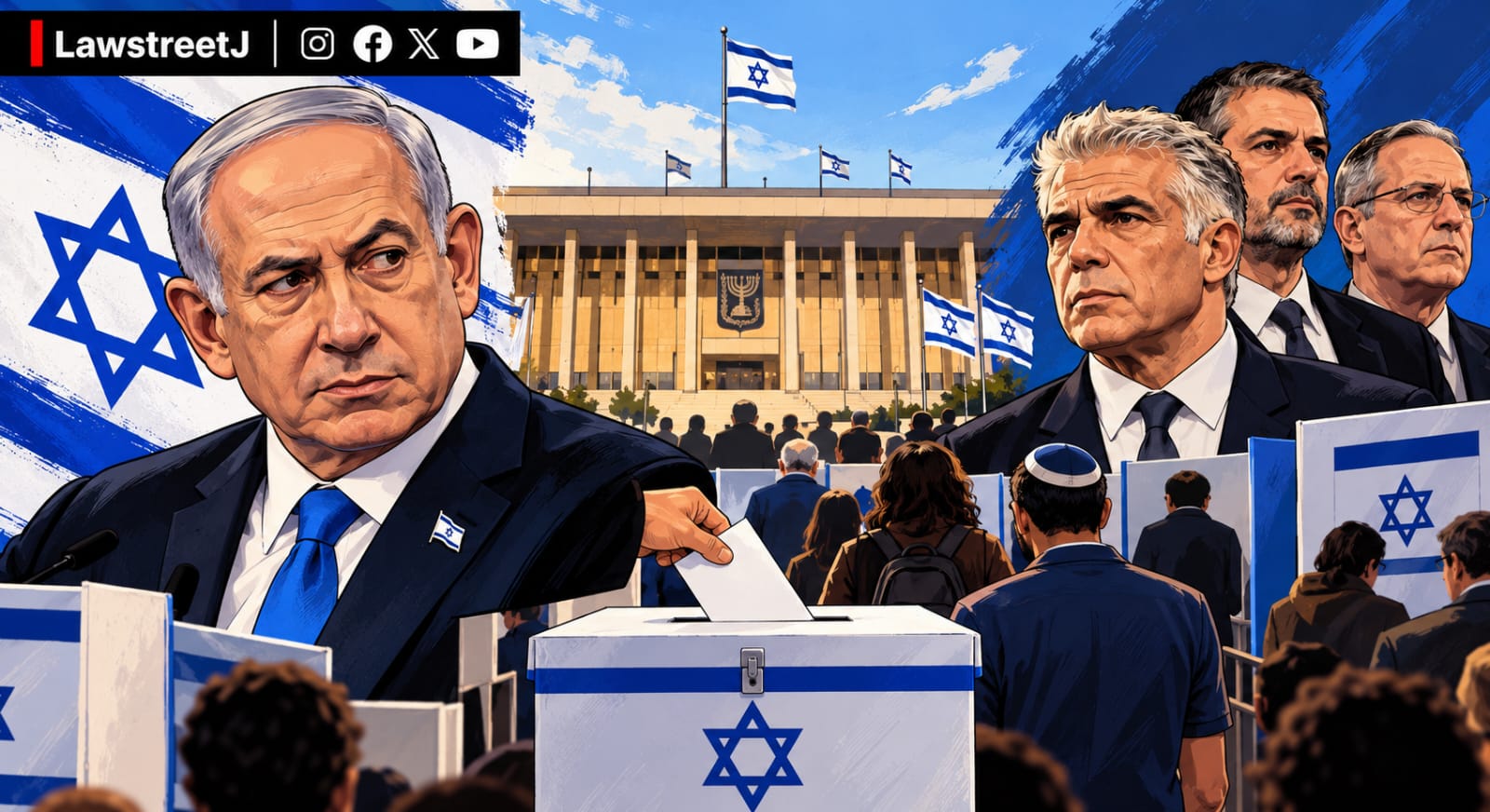
Jerusalem — Israelis went to the polls on Tuesday, October 27, 2026, to elect all 120 members of the 26th Knesset, in the country's first general election since the October 7, 2023 Hamas attacks and since the US-Israel war with Iran began in February 2026. Final pre-election polls showed neither the bloc aligned with Prime Minister Benjamin Netanyahu nor the main opposition bloc assured of the 61 seats needed to form a governing majority.
The Knesset formally dissolved on July 17, 2026, triggering the election process. Netanyahu, who leads the right-wing Likud party, returned to power in late 2022 with a coalition that included far-right and ultra-Orthodox parties, an alliance that has since come under significant strain over disputes concerning a Gaza ceasefire, the conduct of the war, and other contentious domestic issues.
Following the October 7 attacks, the opposition party National Unity had joined Netanyahu's government to form an emergency, national unity war cabinet, with its leaders Benny Gantz and Gadi Eisenkot joining the newly formed body at the time. That arrangement has since ended, with both Gantz and Eisenkot now leading separate opposition forces contesting this election from outside the governing coalition.
The Key Contenders
The election features a crowded field, with the two principal blocs led by Netanyahu on one side and former military chief Gadi Eisenkot, running under his new party "Yashar," on the other. A significant third force is Naftali Bennett, Israel's former prime minister, who has returned to frontline politics with a new party referred to in reporting as "Bennett 2026." Final polling from Israel's major broadcasters, Channels 11, 12 and 13, showed Eisenkot's bloc retaining a lead over Netanyahu's incumbent coalition, but falling short of the 61-seat majority threshold in most scenarios.
Other parties in contention include Yisrael Beiteinu, led by Avigdor Liberman, the Democrats, led by Yair Golan, Yesh Atid, led by Yair Lapid, the ultra-Orthodox parties Shas, led by Aryeh Deri, and United Torah Judaism, the far-right Religious Zionism and Otzma Yehudit, led respectively by Bezalel Smotrich and Itamar Ben-Gvir, and the Arab parties Ra'am and Hadash-Ta'al.
A central feature of this election has been the persistent possibility of post-election deadlock. According to analysis of the final pre-election polls, even if Eisenkot's opposition bloc were to reach the 61-seat threshold on paper, doing so in several scenarios would require the support of Avigdor Liberman's Yisrael Beiteinu party, whose leader has stated he refuses to serve in any coalition that relies on the support of Arab parties.
Eisenkot has separately and publicly ruled out forming a government dependent on Liberman under those terms, a combination of constraints that has led analysts to project that the Knesset may fall into coalition deadlock following Tuesday's vote, potentially necessitating prolonged negotiations or even a further election, a pattern Israel has experienced repeatedly in recent election cycles since 2019.
Key Issues Shaping the Vote
Security considerations have dominated the campaign, given the election's position as the first since the October 7, 2023 attacks and since the outbreak of the US-Israel war with Iran in February 2026. Other central issues shaping voter choices include the ongoing situation in Gaza, the contentious question of mandatory military conscription for ultra-Orthodox Israelis, who have traditionally been exempted from Israel's compulsory military service, and the mounting economic cost of prolonged conflict on Israeli households and the broader economy.
Israel elects all 120 members of the Knesset through a single nationwide constituency using a proportional representation system, under which parties must clear an electoral threshold, currently set at 3.25 percent of the national vote, to win any seats. Because this system makes an outright single-party majority exceptionally rare, Israeli governments are formed through multi-party coalitions.
Under Israel's Basic Law: The Government, following an election, Israel's President consults with the leaders of parties represented in the new Knesset and formally tasks the Knesset member judged best placed to assemble a 61-seat governing majority, typically though not always the leader of the largest party or bloc, with forming a government, that individual then has a defined period under the Basic Law to negotiate a coalition agreement and present it to the Knesset for a formal vote of confidence.
If no government can secure Knesset confidence within the prescribed process, Israel's Basic Law provides for the dissolution of the Knesset and the calling of a fresh election, a scenario Israel has encountered multiple times in its recent political history, including five elections held between 2019 and 2022 alone.