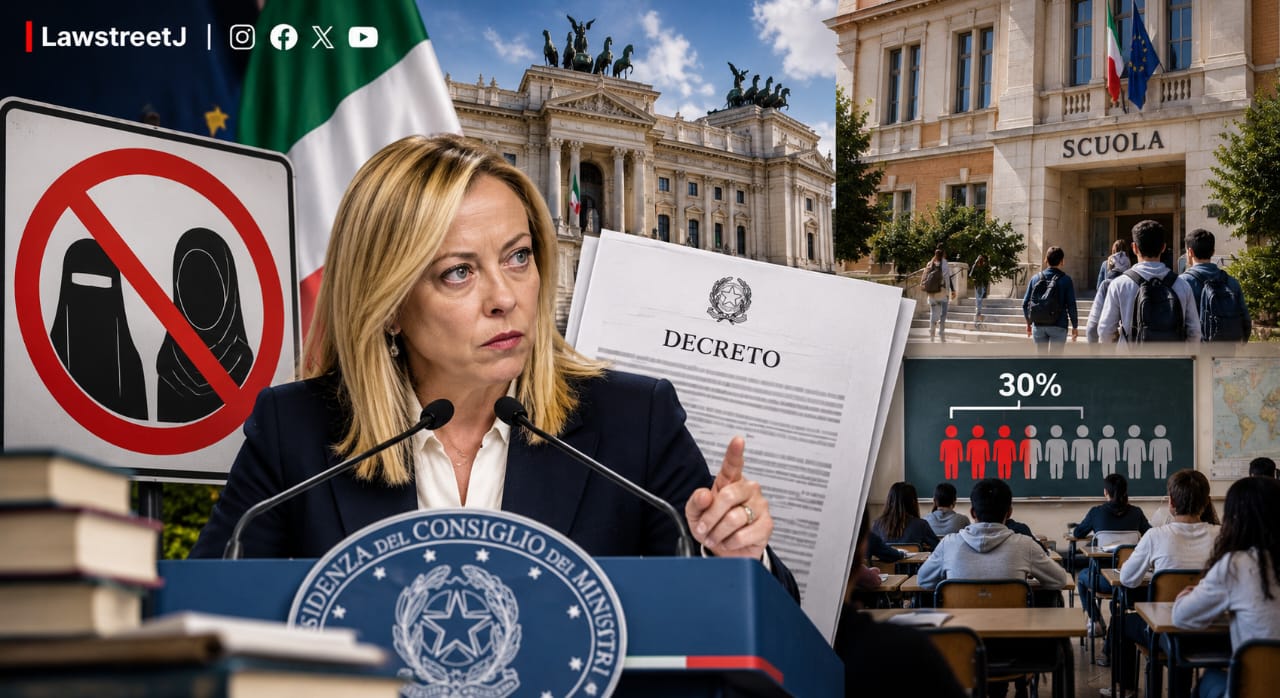
Rome - Italy's Council of Ministers has approved a new decree-law banning full-face coverings such as the burqa and niqab in schools and introducing a 30 percent ceiling on certain foreign students in individual classrooms, in a move that Prime Minister Giorgia Meloni's government has framed as an integration measure and which opposition parties have characterised as politically motivated ahead of national elections.
Details of the Decree
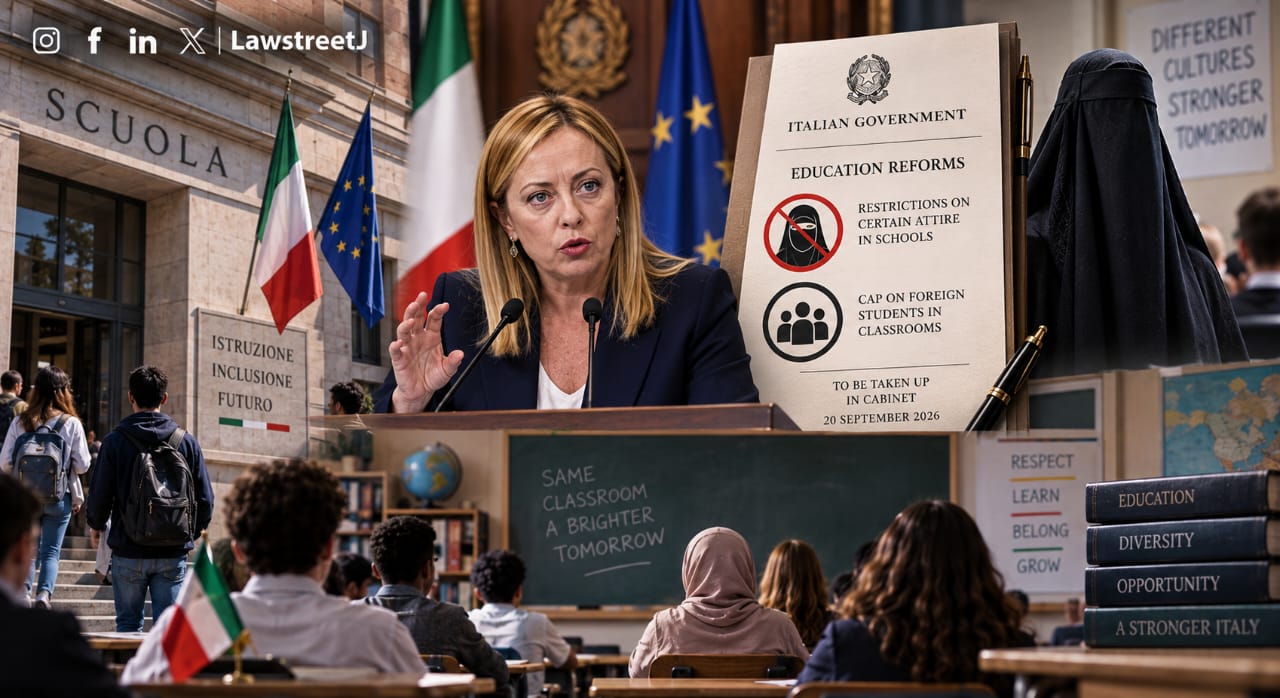
The decree was adopted by Meloni's cabinet on Thursday, September 24, 2026, as part of a broader package addressing school integration policy. The measure limits enrollment of certain foreign students with limited Italian-language skills to 30 percent of pupils in first-year classes, and the government has introduced this ceiling starting from the 2027-28 school year. The cap specifically applies to non-Italian speakers in classrooms and is set to take effect starting next year.
The face-covering ban applies during school activities in which the face cannot be identified, with exceptions permitted for specific health or educational reasons. The prohibition covers the burqa and niqab but does not extend to the hijab, which leaves the face visible. Prime Minister Meloni described the measure on social media as introducing a 30 percent cap on students in a class lacking adequate command of Italian, additional tools for language learning, and a ban on the burqa and niqab in schools.
Violations of the face-covering prohibition can result in financial penalties. Fines range between 200 and 1,000 euros, and parents may be held liable for penalties if the student involved is a minor. Separately, the decree requires parents of children facing serious difficulties integrating into school to participate in free Italian-language courses, with non-compliance punishable by a fine of up to 1,000 euros, equivalent to approximately $1,140.
Legislative Process and Presidential Role
The measure takes the legal form of a decree-law, which allows it to take effect immediately, though it must be ratified by the Italian parliament within 60 days to remain in force. Italian President Sergio Mattarella, whose signature is required for the decree, had reportedly expressed reservations earlier in the week about the imposition of barriers on education, according to Italian media reports. It remains to be seen how these reservations will affect the decree's passage through parliament, where Meloni's coalition currently holds a majority.
Education Minister Giuseppe Valditara has outlined how the classroom cap would be implemented in practice. Local school authorities will coordinate student placements to avoid concentrations of non-Italian-speaking pupils in individual classrooms, while schools unable to comply with the cap would be eligible for exemptions and additional funding to support language instruction.
The government has stated that the classroom cap is not a blanket restriction on all non-Italian citizens. The threshold specifically targets students who do not have an adequate command of the Italian language, rather than foreign nationality status as such. Exemptions apply to students born in Italy or those who have spent sufficient time within the Italian education system to have acquired adequate language proficiency.
Meloni has publicly defended the measures as intended to prevent the formation of concentrated, under-integrated classrooms, often described in Italian media discourse using the term "ghetto classes," and to promote both integration and equal educational opportunity. She has described the steps as common-sense measures intended to promote integration while maintaining rules within the school system.
Political Context
The decree arrives amid an intensifying political debate over immigration ahead of Italy's 2027 general election. Immigration has remained a central issue in Italian politics as Meloni faces a growing challenge from the National Future party, a further-right rival that has risen sharply in opinion polls since its launch in February. A campaign specifically calling for a prohibition on burqas in schools was launched in July by the National Future party, which sits outside the governing coalition and is positioned further to the right than Meloni's Brothers of Italy party.
Meloni first outlined the proposed changes publicly at a rally for the youth wing of her Brothers of Italy party, telling attendees that anyone settling in Italy must learn the Italian language, understand its culture, and respect its rules. The timing of the decree has led some Italian commentators to suggest that Meloni is seeking to preempt criticism from her right flank ahead of the upcoming campaign.
The decree has drawn criticism from opposition politicians, teachers' unions, and school administrators. Elly Schlein, leader of the centre-left Democratic Party, described the decree as an attempt to conceal the government's inability to address the substantive problems of the public school system behind what she characterised as a new ideological framing. Other opposition politicians have accused Meloni of prioritising culture-war politics over the practical interests of students and schools.
Concerns have also been raised regarding the practical implementation of the classroom cap. Antonello Giannelli, president of Italy's National Association of School Principals, has raised concerns about how the policy will function in practice, particularly in regions where the concentration of foreign-background students substantially exceeds the proposed threshold.
Existing Legal Framework and Historical Context
Italy's move builds upon an existing, though non-binding, administrative guideline rather than introducing an entirely new concept. A 30 percent ceiling on foreign students in individual classes has existed in Italy since a 2010 ministerial memorandum, although education authorities have retained discretion to adjust the threshold, allowing classes to exceed the limit where foreign students possessed sufficient Italian-language skills, or lowering the threshold where students faced greater difficulty. The new decree places a version of this administrative limit into binding law while altering the criteria used to determine which students count toward the cap.
Separately, restrictions on face-covering garments are not entirely new to Italian law. Neither burqas nor niqabs are currently banned outright at a national level in Italy, though a 1975 law enacted amid domestic terrorism concerns prohibits garments that prevent personal identification in public places. The new schools decree represents a more specific, sector-targeted prohibition applicable to educational settings.
Italy's action follows a broader pattern of face-covering restrictions adopted elsewhere in Europe over the past decade and a half. France became the first European country to prohibit burqas and niqabs in public spaces in 2010, approving the measure through a parliamentary vote of 335 to 1. Belgium's parliament began a similar legislative process the same year. Denmark enacted a ban covering face-concealing garments, including the niqab and burqa, in 2018, and Swiss voters narrowly approved a public face-covering ban in a 2021 referendum.
According to figures cited in reporting on the decree, foreign citizens currently account for approximately 11.6 percent of Italy's overall school population, according to data from the Fondazione ISMU research institute, although the distribution of foreign-background students varies considerably between individual schools and regions. This uneven geographic distribution has been cited by critics as a key practical challenge in applying a uniform national classroom threshold.
As of this report, the decree has been approved by Italy's Council of Ministers and, as a decree-law, is capable of taking immediate legal effect. However, its continued validity depends on ratification by the Italian parliament within 60 days. President Mattarella's required signature, along with his previously reported reservations regarding barriers to education, adds a further institutional checkpoint before the measure's long-term legal status is settled. The classroom enrollment cap is scheduled to take effect from the 2027-28 school year, while the face-covering prohibition and related parental language-course requirements are structured to apply immediately upon the decree's promulgation, subject to parliamentary ratification.