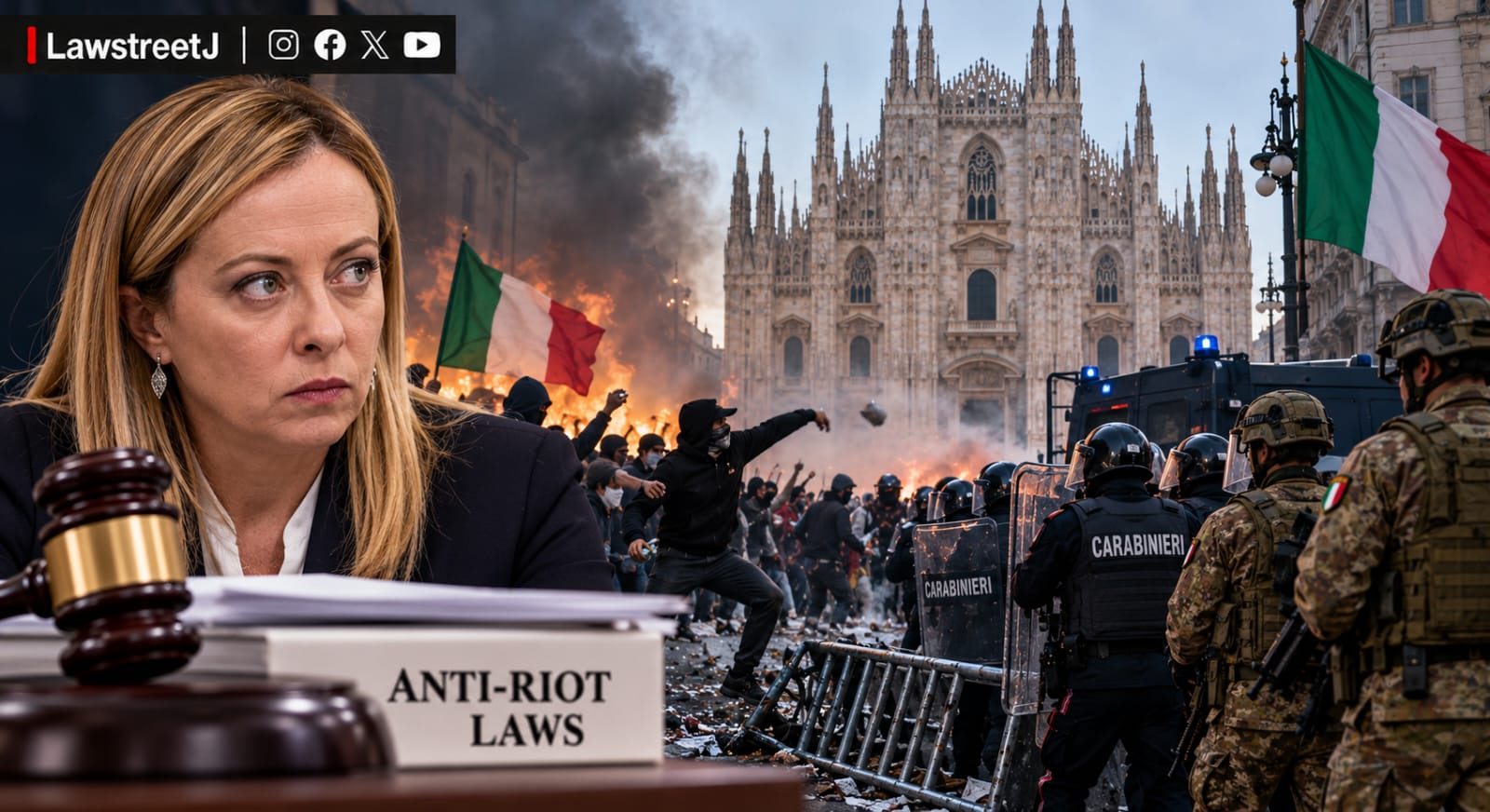
Rome — Italy's government, led by Prime Minister Giorgia Meloni, has approved a package of tougher security measures following a weekend of violent unrest in Milan and other northern Italian cities, introducing prison terms of up to five years and fines of up to €20,000 for people who endanger public safety during demonstrations, alongside the deployment of 500 additional army troops to Milan.
Violent clashes broke out in Milan and other northern Italian cities over the weekend of October 17-18, 2026, with groups smashing shop windows, looting stores and attacking police. According to Confcommercio, Italy's national business association, damage in Milan alone reached approximately €1 million. More than 100 police officers were reported injured in the unrest.
Public security forces detained and arrested 330 people in connection with the violence, of whom half were reported to be of foreign origin, either born abroad or born in Italy to foreign-born families. The disturbances in northern Italy were reported alongside, and in the same period as, large-scale riots in neighbouring France, where hundreds of thousands of people took to the streets that same weekend in some of the country's most violent unrest in years.
The New Measures
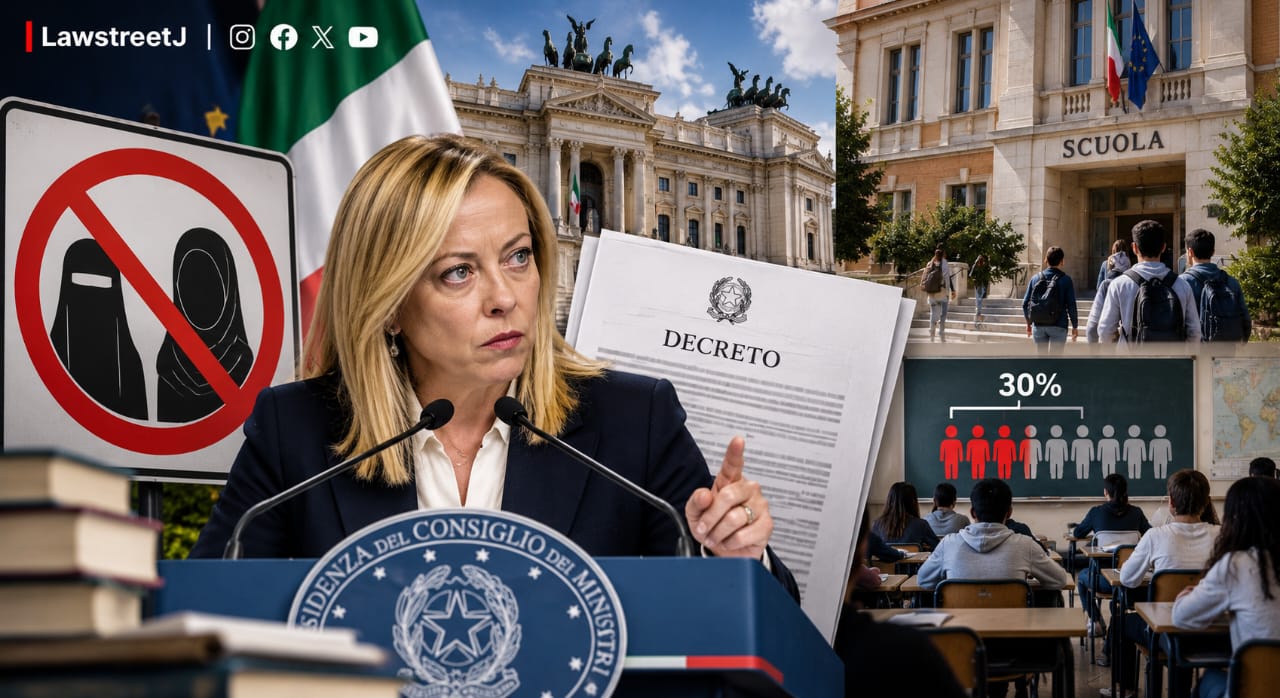
The Italian cabinet approved the security decree on Tuesday, October 20, 2026, with the measures taking immediate effect. Prime Minister Meloni announced the package on social media, stating that vandalism and theft constitute criminality rather than legitimate protest. Under the decree, anyone who takes part in a group of at least five people and endangers public safety during a demonstration faces up to five years in prison and a fine of up to €20,000. According to the Italian news agency ANSA, the offence can carry prison sentences ranging from four to 12 years depending on the specific circumstances. Penalties increase where participants conceal their faces or where people are injured as a result of the actions covered by the offence.
The decree additionally introduces financial liability for parents whose minor children cause damage through vandalism or looting during such incidents, and expands police powers to detain teenage suspects aged 14 to 17 who are assessed as dangerous, even where they have not committed a specific crime. Separately, the decree orders the deployment of 500 additional army troops to reinforce police and Carabinieri operations in Milan through the end of 2026, alongside stepped-up surveillance of sensitive locations and enhanced monitoring across the affected areas, according to a statement from Italy's defence ministry.
Meloni described the involvement of young people in the Milan riots as "painful and frightening," and called for action to prevent the violence from being imitated elsewhere in the country.
Legal and Constitutional Framework
The security package was issued as a decree-law (decreto-legge), a legal instrument under Article 77 of the Italian Constitution that allows the government to adopt measures with the immediate force of law in cases of necessity and urgency, without prior parliamentary approval. Under the same constitutional provision, a decree-law automatically lapses and loses legal effect unless it is converted into ordinary legislation by Parliament within 60 days of its publication, Italy's current decree must therefore be debated and formally approved by both houses of Parliament by mid-December 2026 to remain permanently in force.
Freedom of assembly in Italy is protected under Article 17 of the Italian Constitution, which guarantees citizens the right to assemble peaceably and without arms, while permitting the law to require prior notice to authorities for meetings held in public places, and allowing such gatherings to be prohibited only for proven reasons of public safety and security. This specific constitutional formulation, requiring that any restriction be grounded in "proven reasons" of safety and security rather than broader public-order concerns, has previously been cited by Italian legal scholars and former constitutional-court officials as a significant limiting factor on the scope of security decrees targeting public demonstrations, a debate that resurfaced following an earlier, comparable 2022 decree targeting unauthorised rave parties, which was criticised at the time by a University of Bologna criminal law expert as "extremely generic and therefore slippery."
Criticism and Context
The measures have drawn criticism from rights advocates concerned about the expansion of criminal penalties and their potential impact on civil liberties, a criticism consistent with responses to earlier Meloni-government security decrees, including the 2022 anti-rave decree and a separate 2026 decree permitting police to detain individuals for up to 12 hours where there are reasonable grounds to believe they may act as agitators disrupting peaceful protests, introduced around the time of the Milan-Cortina Winter Olympics.
Critics of the government's broader law-and-order approach have argued that criminal enforcement alone does not address underlying social and economic grievances, including those related to employment, education and the cost of living, that have been cited as contributing factors behind the recent unrest in both Italy and France. Government data cited in reporting on the decree shows Italy's prison population has risen by more than 17 percent over the preceding four years, an increase of nearly 10,000 people, a trend critics have linked to the cumulative effect of the government's successive security-focused legislative measures since Meloni took office in 2022.