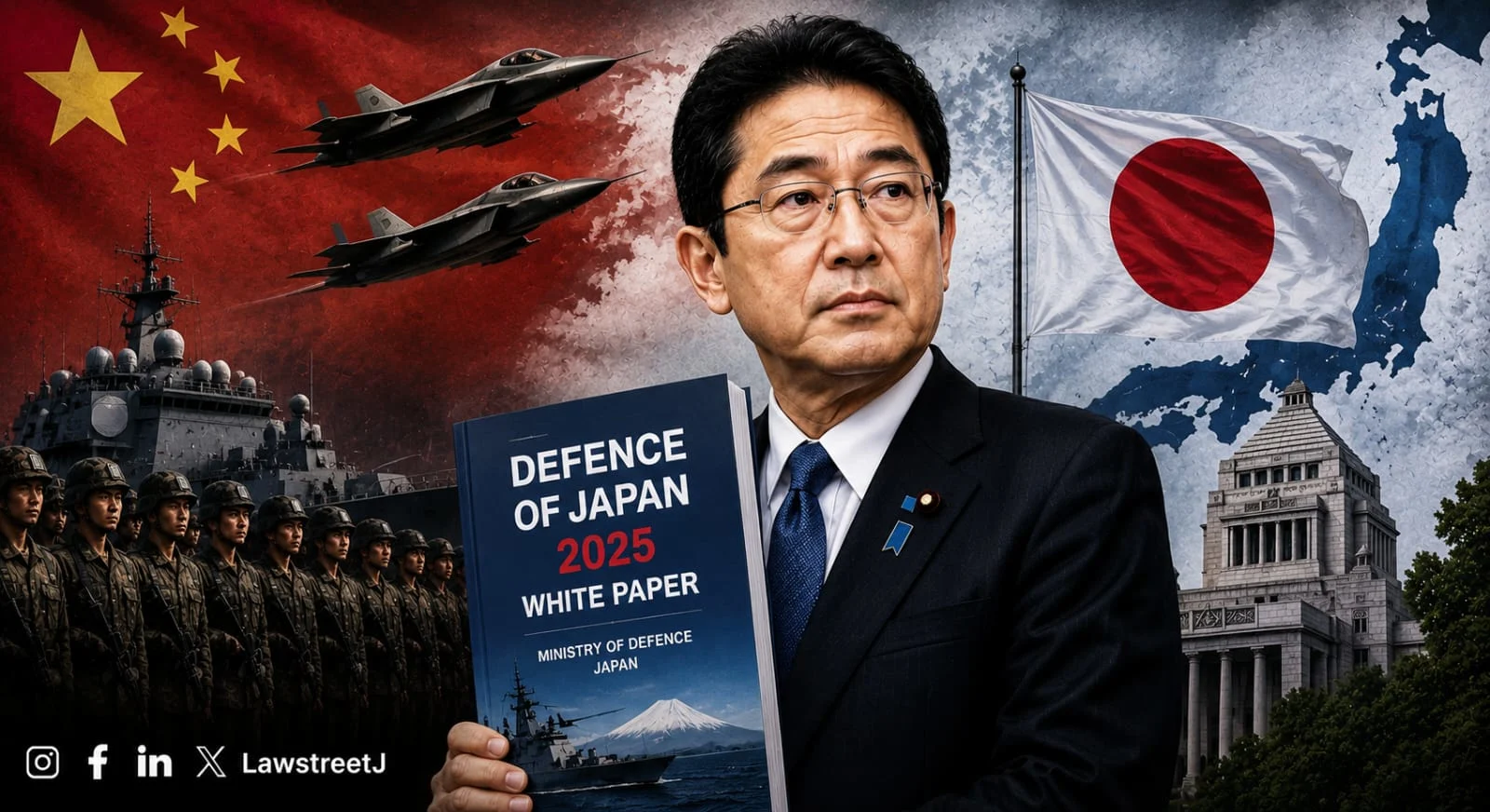
TOKYO / BEIJING : Japan's Cabinet approved the most detailed defence assessment in the country's postwar history on Tuesday, August 4, a 598-page document that formally labels China Japan's "greatest strategic challenge," warns that Beijing's military reach is now extending deep into the Pacific beyond the First Island Chain, and explicitly frames Japan's accelerating military buildup as not just a security necessity but as a driver of economic growth. China responded swiftly and sharply, accusing Tokyo of deliberate exaggeration and using the white paper to lay the groundwork for military expansion that violates the spirit of Japan's postwar constitution.
Japan's Cabinet approved the 2026 edition of its annual defence white paper, warning that China is steadily expanding its military reach into the Pacific beyond the First Island Chain, the strategic arc linking Japan's southwestern islands, Taiwan, and the Philippines. The report, titled Defence of Japan 2026, again described China as "an unprecedented and the greatest strategic challenge" to Japan's peace and security, repeating language first adopted in Japan's revised National Security Strategy in 2022.
The glossy defence white paper, which received cabinet approval on August 4, is packed with a record 598 pages of assessments detailing the increasingly volatile regional security environment. For the first time, it also includes links to short movies offering explanations about defence policy, as the Defence Ministry looks to reach a broader audience ahead of a planned revision of the nation's three key security documents this year.
Defence Minister Shinjiro Koizumi writes in a preface to the report: "The security environment surrounding our country today is the most severe and complex since the end of the war."
What the White Paper Says: China, Taiwan, Russia, and North Korea
The 2026 white paper is not merely a restatement of existing concerns. It marks a significant escalation in the tone and specificity with which Japan describes the threats it faces, and introduces a new economic dimension to the argument for military expansion that represents a departure from the purely security-based framing of previous years.
This year's white paper placed particular emphasis on China's expanding military activities in the Pacific, highlighting what Tokyo views as Beijing's growing ability to project military power beyond the so-called First Island Chain and increasingly deeper into the Pacific. The report argued that these challenges should be addressed by strengthening Japan's "comprehensive national power," together with closer cooperation with allies and like-minded partners.
The 2026 Defence White Paper not only calls China Japan's "greatest strategic challenge" but also frames the security of the Taiwan Strait as existential to the Japanese economy. Japan is heavily dependent on sea lanes that pass through or near the Taiwan Strait for its energy imports and trade, making the stability of that waterway a matter of direct economic consequence rather than a purely geopolitical concern.
Japan has warned that a deepening military alliance between Beijing and Moscow now poses a direct threat to the country's economic survival. The deepening of China-Russia defence cooperation, which has accelerated since Russia's full-scale invasion of Ukraine in 2022, is presented in the white paper as a compound threat that combines the geographic proximity of China's military activities with Russia's demonstrated willingness to use force against a neighbouring state.
On North Korea, the white paper continues to flag Pyongyang's ongoing missile and nuclear development programme as a distinct and active threat to Japan's security, noting continued ballistic missile tests and the advancement of North Korea's nuclear capabilities.
A New Argument: Defence as Economic Policy
Perhaps the most analytically significant element of the 2026 white paper is its articulation of a new political argument that military spending is not simply a cost that Japan must bear for security reasons, but an investment that will generate economic returns.
The white paper's most revealing message is not only its continued labelling of China as Japan's "greatest strategic challenge," but also Tokyo's new narrative that a stronger defence industry can drive innovation, create jobs and stimulate national prosperity. In other words, military spending is being sold as an investment that will enrich Japan.
Japan's government is portraying its accelerating military buildup not only as a way to protect the country but as a route to greater prosperity, arguing in its latest defence white paper that arms production can support economic growth. The annual assessment calls for Japan to harness technology, to fund startups and use more commercial components in weapons production. The white paper stresses that "investment in defence benefits the wider economy and people's lives."
That message aligns with Prime Minister Sanae Takaichi's broader use of strategic state spending in an effort to drive economic growth.
Her government secured a record 122.3 trillion yen budget for the year to March 2027 and later added a 3.1 trillion yen supplementary package to cushion households and businesses from high costs. She has yet to explain clearly how she would pay for further expansion without adding pressure on Japan's already stretched public finances.
The economic argument for military spending is politically significant in Japan. Japanese society remains divided over the country's rapid rearmament, particularly as inflation erodes household purchasing power and public debt remains among the highest in the industrialised world. By framing missile production and defence investment as job-creating, innovation-driving economic activity, the Takaichi government is attempting to broaden domestic support for a programme that goes well beyond what Japan's postwar security consensus has historically allowed.
The white paper advocates expanded long-range strike capabilities, closer integration between civilian technology and military production, and a broader strategic role for the Self-Defence Forces.
This year's white paper portrayed China's expanding military reach into the Pacific as the defining feature of Japan's security environment. Japan must respond, the report argued, not only through higher defence spending, but also by strengthening alliances, its defence industrial base, and preparations for a new era of warfare.
Japan's defence-related spending has now been pushed to 2 per cent of gross domestic product, a threshold that was once the exclusive domain of NATO members debating burden-sharing and has now become Japan's operating benchmark.
China's Response: Rejection and Counter-Accusation
Beijing did not wait long to respond. Within hours of the white paper's release, China's state media machinery issued a comprehensive rejection of its findings and framing.
China's state news agency Xinhua said Japan's white paper continued to label China as Japan's "greatest strategic challenge ever," making what it described as unwarranted criticisms and deliberately hyping up China's routine military activities and legitimate national defence development, while wantonly distorting the Chinese military's necessary actions to safeguard national sovereignty and territorial integrity.
China swiftly rejected the white paper's assessment. In a commentary published by state news agency Xinhua, Beijing accused Japan of exaggerating the regional security threat.
The Chinese government's position is that its military activities in the South China Sea, the Taiwan Strait, and the broader Pacific are lawful exercises of sovereignty and routine defence posture, not the escalatory, Pacific-reaching expansion that Tokyo's white paper describes. Beijing rejects the First Island Chain framework as a construct designed to contain China's legitimate strategic interests in its own maritime neighbourhood.
The exchange of positions reflects a structural incompatibility that goes beyond any specific incident or deployment. Japan's white paper, in describing China's military expansion as "unprecedented," is documenting a shift in the regional balance of power that China views as the natural consequence of its economic and military development. Japan and its allies, most notably the United States and Australia, view the same shift as a destabilising threat to a rules-based regional order.
The Taiwan dimension sharpens that incompatibility further. Prime Minister Takaichi has stated that Japan could deploy its Self-Defence Forces if a Chinese attack on Taiwan also threatened Japan's survival. Beijing reacted furiously when Takaichi said Japan could deploy its Self-Defence Forces if a Chinese attack on Taiwan also threatened Japan's survival, demanding that she retract what it called an "egregious" remark. That retraction has not come. The 2026 white paper's treatment of Taiwan Strait security as existential to Japan's economy effectively reinforces her earlier position within the formal framework of Japan's published defence policy.
Japan's Postwar Security Posture: How Far It Has Come
The 2026 white paper is the product of a trajectory that began with Japan's revised National Security Strategy, approved in December 2022, when the language of China as Japan's "greatest strategic challenge" was adopted for the first time. That document marked a watershed in Japan's postwar security posture, the most significant departure from the constitutional pacifism that had defined Japan's defence policy since 1947.
Since then, Japan has steadily implemented the policy changes that the 2022 strategy outlined. Defence budgets have grown every year. The legal framework for "counterstrike capability", the ability to strike enemy missile bases has been developed. Alliance coordination with the United States, Australia, the United Kingdom, and other partners has been deepened. And the white paper's new economic framing suggests that this trajectory is not a temporary response to a temporary threat, but a structural transformation of how Japan thinks about the relationship between national security and national prosperity.
The white paper, presented to the cabinet by Defence Minister Shinjiro Koizumi, retained the wording of the 2025 edition, claiming that the international community is facing its greatest challenge since World War II and has entered a "new era of crisis."
Whether the 2026 defence white paper represents a stabilising signal, a demonstration of resolve that deters potential adversaries or an escalatory one that intensifies regional tensions, is a question on which Tokyo and Beijing hold irreconcilable positions. What is beyond dispute is that Japan's annual defence document has, in 2026, grown to its longest length ever, introduced arguments it has never made before, and placed two of Asia's largest economies on a trajectory of strategic competition whose consequences for the entire Indo-Pacific region are yet to be fully measured.