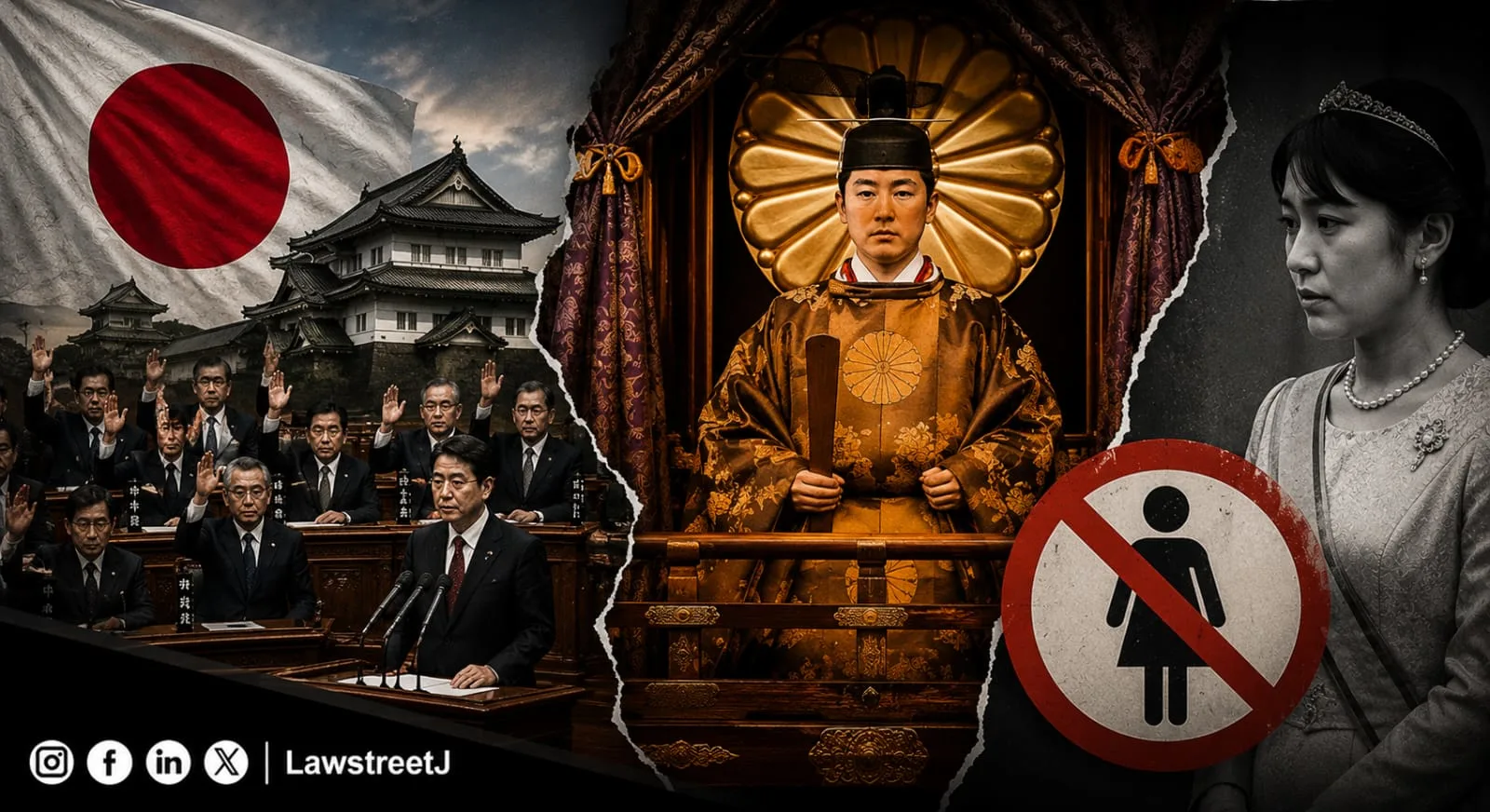
Tokyo | Japan's parliament enacted revisions to the Imperial House Law on Friday, formally cementing the country's male-only succession rule for the Chrysanthemum Throne and effectively eliminating the hugely popular Princess Aiko, Emperor Naruhito's 24-year-old daughter, from any possibility of becoming Japan's future empress regnant. The vote, passed by the ruling coalition led by Prime Minister Sanae Takaichi, was met with protests outside parliament from Japanese citizens who described the legislation as institutionalised gender discrimination and an act of political self-sabotage for a monarchy whose male line is diminishing to a thread.
Royal watchers and experts fear the new measures could doom the 1,500-year-old hereditary institution by insisting that only men can be emperor, sparking worry about the shrinking, fast-aging imperial family. Emperor Naruhito's 24-year-old daughter is hugely popular, and many Japanese want her to be his successor, but Princess Aiko is ineligible because she is a woman. Japan's male-only succession rule means the line must move to the emperor's younger brother, then to his 19-year-old nephew Prince Hisahito. Next in line after him is the emperor's 90-year-old uncle.
What the Revised Law Does
The July 17 revisions to the 1947 Imperial House Law include two principal changes.
The first codifies and reinforces male-only succession through the male line, a rule that has formally existed since the 1947 law but that has been the subject of sustained public debate since Princess Aiko's birth in 2001, when the possibility of changing the succession rules was actively considered in a government advisory panel. The July 2026 revision resolves that debate definitively in favour of maintaining the status quo, foreclosing what had been an increasingly mainstream public conversation about allowing female emperors.
The second provision, the one concession to the scale of the succession problem would allow five single princesses, including Aiko and her popular cousin Kako, 31, to keep their royal status and continue serving official duties if they marry commoners, although their spouse and children would not be accepted as royals. Previously, princesses who married commoners were required to renounce their imperial status entirely, the rule that forced Princess Mako, Aiko's elder cousin, to leave the imperial household and move to New York after marrying her college boyfriend, who now works as a lawyer. The move was largely seen as her attempt to flee the restrained imperial life.
The revisions also permit the adoption of distant male relatives to produce future heirs, an acknowledgement, however oblique, that the biological path to a male heir beyond Prince Hisahito is vanishingly narrow.
The Demographics of a Crisis
In an imperial family that places a premium on male royal babies, Hisahito is the first such boy to be born in four decades. Only five of the 16 adults in the imperial family, there are no children, are men.
Prince Hisahito is the only heir of his generation in the Japanese Imperial family, as the Imperial House Law permits only males with direct male-line descent from emperors to inherit the Chrysanthemum Throne. The other successors are his 59-year-old father, Crown Prince Fumihito, and the emperor's 89-year-old uncle, Prince Hitachi.
Prince Hisahito officially became an adult last September, marking the first time in nearly 39 years that a male member of the Imperial family has reached adulthood since his father, Crown Prince Fumihito, in November 1985.
The succession arithmetic is therefore as follows: after Emperor Naruhito comes Crown Prince Fumihito, then Prince Hisahito, now 19 years old and at university and then Prince Hitachi, who is 90. Beyond that, under the current rules, there is no male-line heir. If Hisahito does not have a son, the Chrysanthemum Throne will face a formal succession crisis with no constitutional resolution available under the law as it now stands. The adoption provision addresses this contingency obliquely, but no formal candidate or mechanism for such an adoption has been identified or publicly discussed.
Because of the male-only succession rules and the dismissal of princesses who marry commoners, the monarchy after Hisahito is "extremely unstable," former Imperial Household Agency chief Shingo Haketa told Kyodo News recently.
The Irony at the Heart of the Vote
The law was pushed through parliament by Prime Minister Sanae Takaichi, Japan's first female prime minister, a coincidence that critics noted with considerable sharpness.
"It's very ironic that the first female prime minister herself is the leading proponent of the obsession with male-succession," prominent feminist scholar Chizuko Ueno wrote. Ueno said the new measures "treat male royals as stallions and put female royals under pressure as 'childbearing machines' to produce male offspring."
Friday's revisions led to protests from Japanese who see the government efforts as meant to eliminate Aiko from ruling and to justify discrimination against women and a patriarchal system.
Public opinion polls conducted ahead of the vote showed that a majority of Japanese citizens support allowing female emperors. The government's decision to legislate the opposite reflects the position of the ruling Liberal Democratic Party's conservative wing, for whom the unbroken male line of succession is both a historical and ideological commitment and for Prime Minister Takaichi personally, who has staked her position on the preservation of that rule despite or because of the unprecedented nature of her own ascent to the highest executive office in Japan.
After Aiko's birth, her mother Empress Masako, a Harvard-educated former diplomat and a commoner, developed a stress-induced mental condition, apparently over criticism for not producing a male heir. The Empress Masako's trajectory from celebrated diplomat to isolated imperial consort under sustained public and institutional pressure to produce a male heir became one of the defining human stories of Japan's early twenty-first century. The July 17 vote formally preserves the system that produced that outcome and, by allowing princesses to retain their status after marrying commoners, makes the first small acknowledgment that the human cost of the old rules was too high to leave entirely unaddressed.
What Happens Next: A Monarchy Racing Against Time
The revised law does not resolve Japan's succession crisis, it narrows the options available to address it. With Hisahito as the sole male heir of his generation, the imperial family now depends entirely on his future choices: whether he marries, whether he has children, and whether any children he has are male. These are personal decisions of a 19-year-old being asked to bear the institutional weight of a 1,500-year-old hereditary monarchy.
The adoption provision, while included in the revisions, has no established precedent in the modern imperial family and no named candidates. It represents a theoretical escape valve rather than a practical plan.
The five princesses who may now retain their status after marrying commoners bring additional women into the orbit of the imperial family's public duties, a meaningful stabilisation of the institution's ceremonial workforce, but their children will not be in the line of succession, meaning the provision does nothing to resolve the long-term male heir problem it was partly designed to address.
For a nation whose imperial institution traces its roots, mythologically, to the first emperor Jimmu and historically through over a millennium of documented continuity, the July 17 vote represents a choice to preserve a rule at the cost of the institution the rule was designed to protect. Whether that bargain proves sustainable will depend on a teenager now studying at university who has, in a press conference last year, pledged only to fulfil his royal duties "seriously."