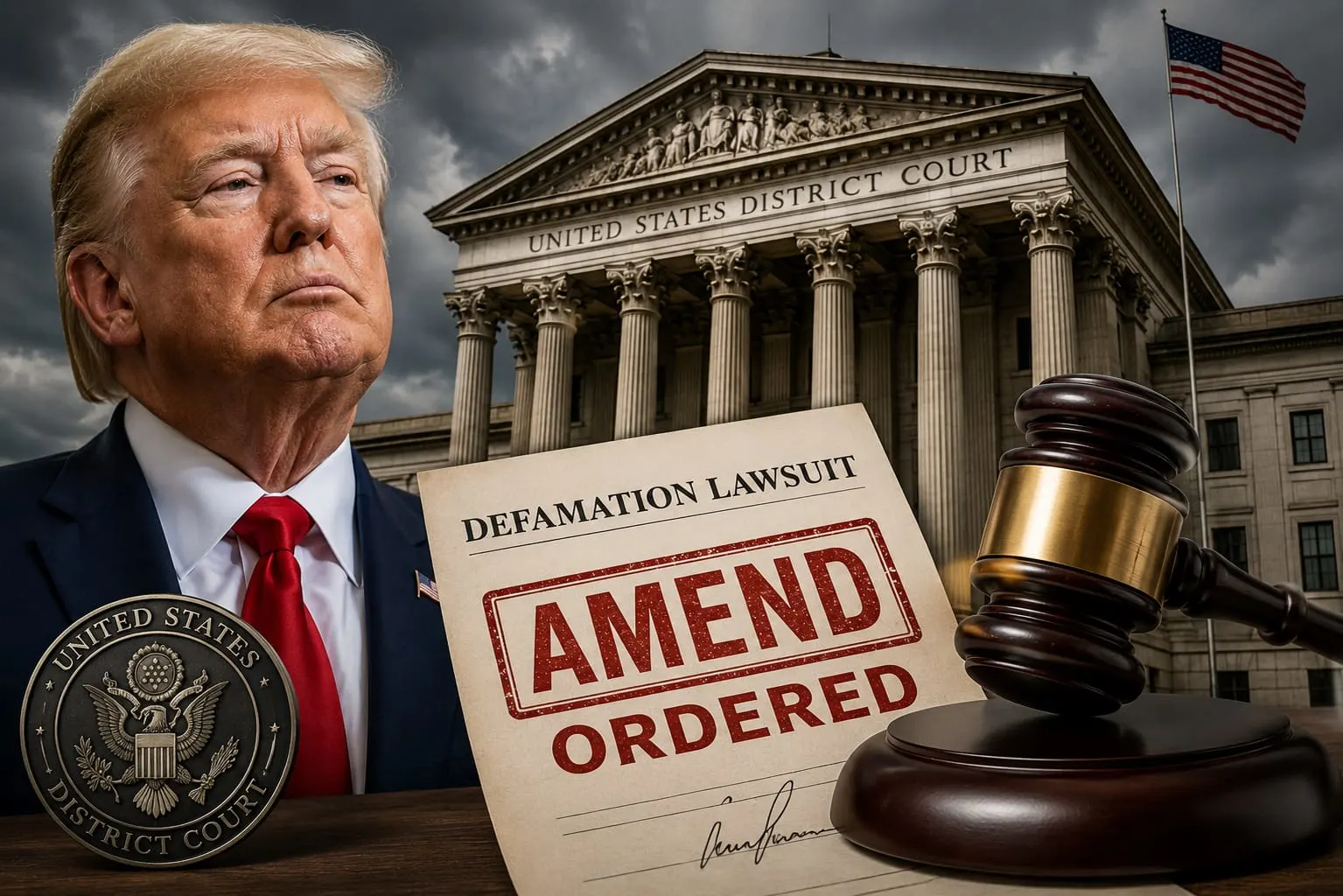
Tampa, Florida: A federal judge has declined to dismiss President Donald Trump's $15 billion defamation lawsuit against The New York Times, instead ordering the president's legal team to file an amended complaint by August 27. The ruling, issued Monday by U.S. District Judge Steven D. Merryday in the Middle District of Florida, keeps the long-running legal battle alive while deferring a decision on the newspaper's motion to dismiss the case entirely.
The order marks the latest turn in a legal dispute that has stretched on for months and touches on questions of press freedom, the legal standard for proving defamation against public figures, and the limits of what a formal court complaint may contain.
The Judge's Ruling
Judge Merryday, who was appointed to the federal bench by former President George H.W. Bush, presided over more than two hours of oral arguments from both legal teams on July 22 before issuing his written order this week. Rather than ruling directly on the Times' motion to dismiss, the judge chose to give Trump's attorneys another opportunity to revise their complaint. In doing so, he granted a request the president's own legal team had made in an earlier filing, asking the court to allow them to "cure any deficiencies" should the judge find the lawsuit legally insufficient as written.
According to the order, the amended complaint must demonstrate why the statements at the center of the case are not substantially true, and it must include additional facts and evidence showing actual malice on the part of each individual defendant named in the suit. Actual malice is a demanding legal standard in American defamation law, requiring a public figure such as Trump to show that a publication knew a statement was false, or acted with reckless disregard for whether it was false, at the time it was published. Once the amended complaint is filed, the Times and the other defendants will have three weeks to respond before the court considers the renewed motion to dismiss.
This is not the first time Trump has been asked to revise this lawsuit. Merryday previously struck an earlier version of the complaint, describing it in blunt terms as "tedious and burdensome." In that earlier ruling, the judge wrote that a legal complaint is not "a protected platform to rage against an adversary," and ordered that any refiled version be limited to 40 pages and comply strictly with standard rules of civil procedure. Monday's order gives Trump's legal team a second chance to meet that bar.
Background of the Lawsuit
Trump originally filed the lawsuit in September, naming The New York Times as the lead defendant alongside reporters Susanne Craig and Russ Buettner, journalist Peter Baker, and publisher Penguin Random House. The complaint centers on reporting connected to the book "Lucky Loser," which examined Trump's financial history and business dealings, as well as a separate article exploring how his public image was shaped during his years hosting "The Apprentice." A further article by Baker chronicled controversies across Trump's career and was also named in the suit.
Trump's complaint alleges that the reporting in question was "filled with repugnant distortions and fabrications" about him, his family, his business record, his wealth, and his overall reputation. The filing further claims that the defendants made numerous other statements it characterizes as malicious, defamatory, and disparaging, extending beyond Trump personally to his family and his political movement.
The Times and the other named defendants moved to dismiss the amended complaint on multiple grounds. Their motion argued, first, that the case had been filed in an improper venue, since the lawsuit was brought in Florida rather than New York, where the newspaper is based and where much of the reporting originated. Second, the defendants argued that Trump had failed to plausibly allege actual malice, the legal threshold required for a public figure to succeed in a defamation claim under longstanding U.S. Supreme Court precedent. Third, the motion noted that many of the statements being challenged reflected the authors' subjective interpretations of facts that are not themselves in dispute, and such interpretive statements are generally not considered capable of being proven false, a key requirement in defamation law.
Reactions From Both Sides

Trump characterized Monday's ruling as a clear victory in a lengthy Truth Social post, writing that the Times had "failed again" in its attempt to have the lawsuit dismissed. In the post, he stated that the amended complaint would lay out, in his words, "in extreme detail," the ways he believes the newspaper acted with actual malice in its coverage of him, his family, his political movement, and the country. He also said he intended to continue holding the Times and other outlets accountable for what he described as inaccurate and damaging reporting, and thanked the public for its attention to the matter.
A spokesperson for The New York Times offered a markedly different characterization of the ruling. The spokesperson said the judge's decision makes no statement in support of the accusations contained in Trump's earlier complaint. Instead, the spokesperson said, the ruling simply gives Trump another chance to draft a complaint capable of demonstrating legal merit, noting that his legal team has already had two previous opportunities to do so and has been unsuccessful both times. The newspaper reiterated that it stands by its journalism and said it would not be deterred by the litigation. It added that it intends to continue defending its reporters' constitutionally protected rights, as well as the public's right to access information, and expressed confidence in the legal protections that underpin those rights.
What Happens Next
Under the terms of Judge Merryday's order, Trump's legal team must file the revised complaint in the U.S. District Court for the Middle District of Florida in Tampa no later than August 27. Once that filing is submitted, the Times and the other defendants will have a three-week window to respond before the court takes up the renewed motion to dismiss.
The judge's order did not specify which particular sections of the original complaint require revision, leaving that determination largely to Trump's legal team as they prepare the new filing. Legal observers following the case have noted that the outcome will likely hinge on whether the amended complaint can meet the actual malice standard with specific, verifiable evidence, rather than broad characterizations of unfair or unfavorable coverage.
No ruling has yet been made on the underlying merits of the defamation claims themselves, and the case remains in its pretrial stage. The dispute is one of several ongoing legal actions Trump has pursued against major media organizations in recent years, and its outcome could carry broader implications for how courts evaluate defamation claims brought by public officials against news publishers. For now, both sides are expected to continue preparing their respective filings ahead of the August 27 deadline, with the court's eventual ruling on the motion to dismiss expected to shape the next phase of the litigation.