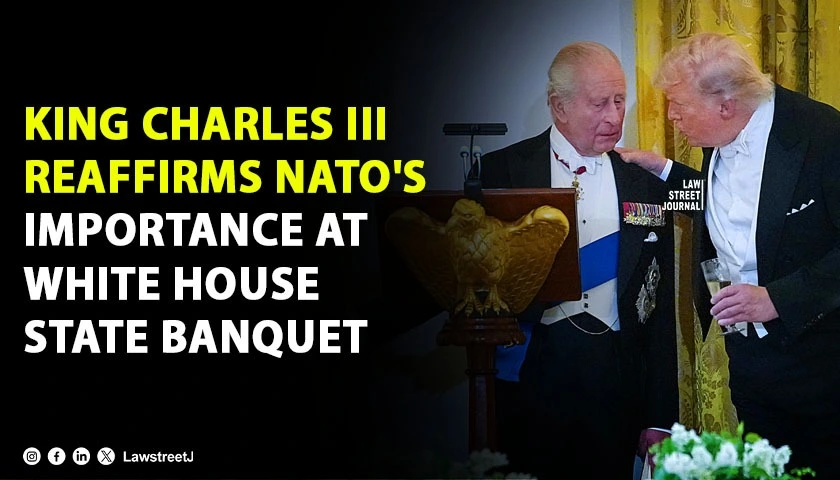
King Charles III concluded a landmark day of diplomatic engagement on Tuesday, April 28, 2026, by attending a White House state dinner hosted by President Donald Trump, where the British monarch used his toast to reaffirm the enduring significance of the NATO alliance in what he called an "increasingly complex and contested world." The evening capped a day that had already made history, when Charles became only the second British monarch, and the eleventh sovereign in history, to address a joint session of the United States Congress. The first was his late mother, Queen Elizabeth II, who did so in 1991.
The four-day state visit, the official purpose of which, according to Buckingham Palace, was to "recognize the shared history of our two nations" ahead of the United States' 250th anniversary of independence, unfolded at a particularly strained moment in the bilateral relationship. The White House has grown increasingly frustrated in recent weeks with London's hesitance to provide military aid to U.S. forces in the ongoing Iran war, and President Trump has publicly criticized British Prime Minister Keir Starmer, calling him a coward and stating that he "ruins relationships."
A Speech to Congress Steeped in History and Pointed in Substance
King Charles III delivered a dynamic address to a joint meeting of Congress on Tuesday, drawing bipartisan standing ovations from a chamber that has in recent years been marked by divisions and walkouts. The speech covered ground that was at once ceremonial and diplomatically significant. Charles spoke about the two countries' NATO ties, noting that in the twentieth century, the United States helped rebuild a shattered European continent, "playing a decisive role as a defender of freedom in Europe." He tied that historical commitment directly to the present, stating that freedom is "again under attack following Russia's invasion of Ukraine." Charles made an explicit call for the United States to help fund defense for Ukraine, comparing the situation to NATO's collective response following the September 11 attacks in 2001, the only time in the alliance's history that Article 5, the mutual defense clause, has been invoked.
Despite President Trump's public critiques of NATO, which have included posts on his Truth Social platform stating "NATO WASN'T THERE WHEN WE NEEDED THEM," the King held steadfast in highlighting the importance of the alliance, calling on Congress to rededicate itself to collective defense and stressing that mutual defense, intelligence, and security ties are "hardwired together through relationships, measured not in years, but in decades." The King also drew a line between the Magna Carta, the thirteenth-century document establishing that the British king was subject to law and constitutional and legal precedent in the United States, calling it "the foundation of the principle that executive power is subject to checks and balances." This remark landed on the same day that the White House was reported to be pursuing new import tariffs in a manner that raised questions about judicial oversight, giving the statement an immediate and pointed context.
Charles also credited shared values that create "vibrant, diverse and free societies" as giving the United States and United Kingdom their "collective strength." His speech was drafted in consultation with the United Kingdom's Foreign and Commonwealth Offices as well as Prime Minister Starmer's office, a standard constitutional requirement for royal addresses on matters of state.
The State Dinner: Toasts, Gifts, and a Diplomatic Tightrope
At the White House state dinner held on the evening of April 28, King Charles highlighted how both nations had supported each other in their "darkest days," tracing that history through to the establishment of NATO in 1949. In his toast, Charles said that "today, our partnerships in NATO and AUKUS deepen our technological and military cooperation and ensure that together we can meet the challenges of an increasingly complex and contested world," referring to the trilateral security partnership among the United States, the United Kingdom, and Australia.
The King arrived bearing a carefully chosen diplomatic gift. Charles presented President Trump with the bell from a former British Navy submarine named HMS Trump, which launched from a United Kingdom shipyard in 1944 and played a critical role in the Pacific War. The monarch said: "I am delighted to present to you as a personal gift, the original bell which hung on the conning tower of your valiant namesake. May it stand as a testament to our nation's shared history and shining future." The gift carried symbolic weight at a moment when Trump had publicly disparaged the British Royal Navy, referring to its aircraft carriers as "toys."
King Charles III also invoked Queen Elizabeth II's 1957 visit to the United States in his remarks, noting that part of her task then had been to help "put the special back into" the relationship following a crisis in the Middle East, a comment received with laughter in the room. He added that it is "not hard to see how important the relationship remains, in matters both seen and unseen."
Charles also touched on President Trump's controversial project to build a new ballroom in the White House's East Wing, joking that Britain had made "our own small attempt at real estate development of the White House in 1814", a reference to when British troops set fire to the building during the War of 1812. The guest list for the evening was extensive. Among those in attendance were Vice President JD Vance, Treasury Secretary Scott Bessent, Secretary of State Marco Rubio, Defense Secretary Pete Hegseth, and General Dan Caine, Chairman of the Joint Chiefs of Staff. Supreme Court justices, including Chief Justice John Roberts and five Associate Justices, were also present, alongside senior Republican senators and prominent media figures.
Constitutional Questions Over Trump's Iran Remarks and the Palace's Silence
The most legally and constitutionally sensitive moment of the evening came not from the King's address, but from President Trump's remarks during his own toast. Trump drew the traditionally apolitical British monarchy into a diplomatic conversation about the Iran war when he stated that King Charles agreed with his efforts to prevent Iran from developing a nuclear weapon. Trump said at the dinner: "We have militarily defeated that particular opponent, and we're never going to let that opponent ever, Charles agrees with me even more than I do, we're never going to let that opponent have a nuclear weapon."
As a constitutional monarch, King Charles is bound to remain above politics, able only to represent the United Kingdom rather than speak for its government. The disclosure of what was apparently a private conversation between the two heads placed the monarch in a constitutionally difficult position. The longstanding convention under British constitutional law is that conversations with the sovereign are held in strict confidence and are never publicly disclosed by the other party. Both Britain and the United States have, over the years, maintained that Tehran should not develop nuclear weapons. Iran, which does not currently possess nuclear weapons, denies seeking them and maintains that it has the right to develop nuclear technology for peaceful purposes, including uranium enrichment, as a signatory to the Nuclear Non-Proliferation Treaty.
The British Embassy in Washington, when asked by Reuters about Trump's dinner remarks, referred the inquiry to Buckingham Palace, which did not immediately respond to requests for comment. The Palace's silence was consistent with its constitutional obligations, confirming or denying the King's position on a live foreign policy matter falls outside the remit of the monarchy. The episode highlighted the ongoing tension between the informality of Trump's public statements and the formal protocols that govern royal diplomacy.
Craig Prescott, a constitutional expert and lecturer in law at Royal Holloway, University of London, noted that the King's speech to Congress contained "plenty of genuine political content," while still operating within the conventions expected of the monarchy. Prescott described it as "a perfect example of the role of the King in politics: to reflect those points of consensus in British politics and project that on the world stage." The King's visit continues through April 29 and 30. The state visit stands as one of the most diplomatically loaded royal engagements in recent decades, touching on the future of NATO, the war in Ukraine, the Iran conflict, constitutional principles, and the durability of the so-called special relationship between two nations navigating a period of considerable friction.