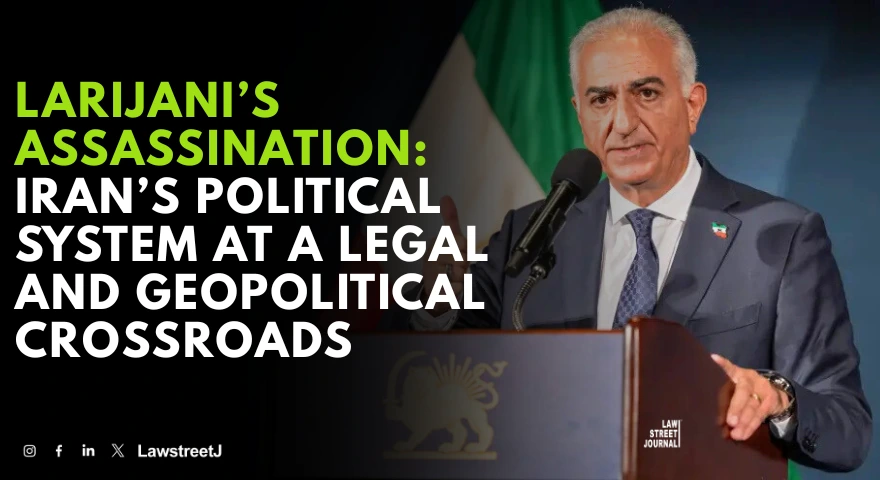
New Delhi: On March 18, 2026, Iranian authorities confirmed the assassination of Ali Larijani, Secretary of the Supreme National Security Council and former Speaker of Parliament, in what officials described as an Israeli strike. Larijani, a veteran politician and one of the country’s most prominent figures, had played a central role in shaping Iran’s defense and foreign policy strategies. His death follows the earlier assassination of Supreme Leader Ayatollah Ali Khamenei, intensifying concerns about regional stability.
Foreign Minister Abbas Araghchi addressed the nation, stressing that Iran’s political system remains resilient. He stated that “the presence or absence of a single individual does not affect this structure,” drawing parallels to the assassination of Ayatollah Khamenei, which, despite its gravity, did not dismantle the political system. Araghchi’s remarks highlight the collective nature of Iran’s governance, which relies on institutional continuity rather than individual leadership.
Iran’s political framework is built on multiple layers of authority, including the Guardian Council, the Assembly of Experts, and the Supreme National Security Council. This structure ensures that leadership transitions, even under extraordinary circumstances, do not paralyse the state. Analysts note that while Larijani’s death is a significant blow, the system is designed to absorb such shocks.
IRGC’s Vow of Retaliation: Legal Dimensions:
The Islamic Revolutionary Guard Corps (IRGC) issued a statement vowing “definite revenge” against Israel, framing the assassination as a violation of Iran’s sovereignty and international law. Under Article 2(4) of the United Nations Charter, the use of force against another state is prohibited unless authorized by the Security Council or justified under self-defense. Iran has consistently argued that targeted killings of its leaders constitute acts of aggression and terrorism under international law.
Legal experts emphasize that extrajudicial assassinations of state officials raise serious concerns under the Geneva Conventions and customary international humanitarian law. Larijani, as a senior government official not directly engaged in combat, would be entitled to protection under international law. Israel has historically justified such actions as preemptive self-defense against perceived threats, a position contested by most international legal scholars.
Iran’s potential retaliation also carries legal dimensions. Any military response must comply with international law, particularly the principles of necessity and proportionality under Article 51 of the UN Charter. Past Iranian responses have included missile strikes on U.S. and Israeli assets in the region, calibrated to demonstrate resolve while avoiding escalation into full-scale war.
The assassination also raises questions about accountability mechanisms. While the International Criminal Court (ICC) has jurisdiction over war crimes and crimes against humanity, Israel is not a party to the Rome Statute. This complicates efforts to pursue legal remedies, leaving Iran to rely on diplomatic channels and regional alliances to press its case.
Regional and Global Consequences:
Larijani’s assassination comes at a time of heightened instability in the Middle East. Following the killing of Ayatollah Khamenei, Iran has sought to project continuity in governance, with institutions such as the Supreme National Security Council and the Guardian Council maintaining operational control. Analysts suggest that while Larijani’s death is significant, Iran’s political framework, built on collective leadership, remains intact.
International reactions have varied. Russia and China condemned the assassination, urging restraint and adherence to international law. The United States reiterated its support for Israel’s right to self-defense, while European Union officials called for de-escalation. The United Nations has yet to issue a formal statement, though past precedents suggest calls for dialogue and restraint.
Economically, the assassination has already impacted global markets. Brent crude prices rose by approximately 3% amid fears of supply disruptions, reflecting Iran’s role as a major global oil exporter. Any instability in its leadership or potential escalation of conflict could further affect global energy security.
The assassination also has implications for ongoing negotiations over Iran’s nuclear program. Talks aimed at reviving the Joint Comprehensive Plan of Action (JCPOA) had already stalled following Khamenei’s death. Larijani’s assassination further complicates the diplomatic landscape, reducing prospects for near-term progress.
The assassination of Ali Larijani marks a critical escalation in the ongoing confrontation between Iran, Israel, and the United States. While the IRGC has vowed retaliation, Iran’s leadership insists that its political system remains resilient and capable of absorbing such shocks. The incident underscores the fragile balance of power in the Middle East and raises pressing legal questions about the legitimacy of targeted killings under international law.
As the region braces for potential retaliation, the international community faces renewed urgency to prevent further escalation. The killing of Larijani, following the assassination of Ayatollah Khamenei, highlights the volatility of the current geopolitical landscape and the enduring risks of conflict in the Middle East.

.webp)