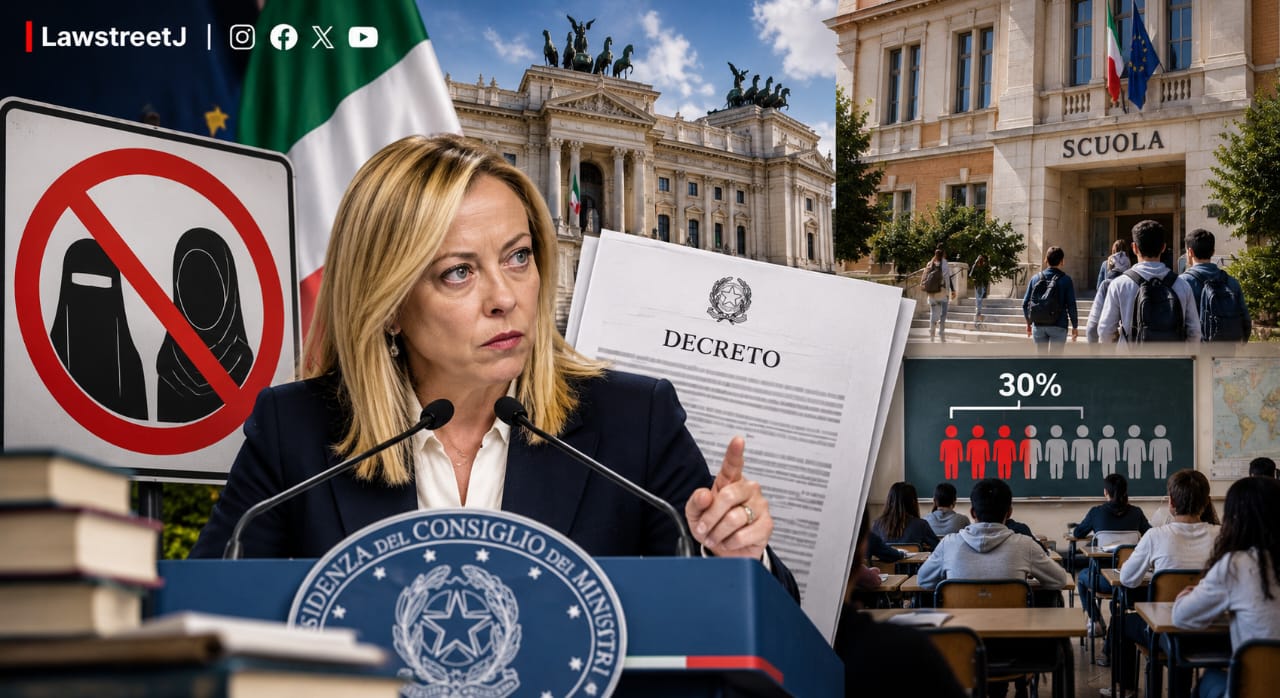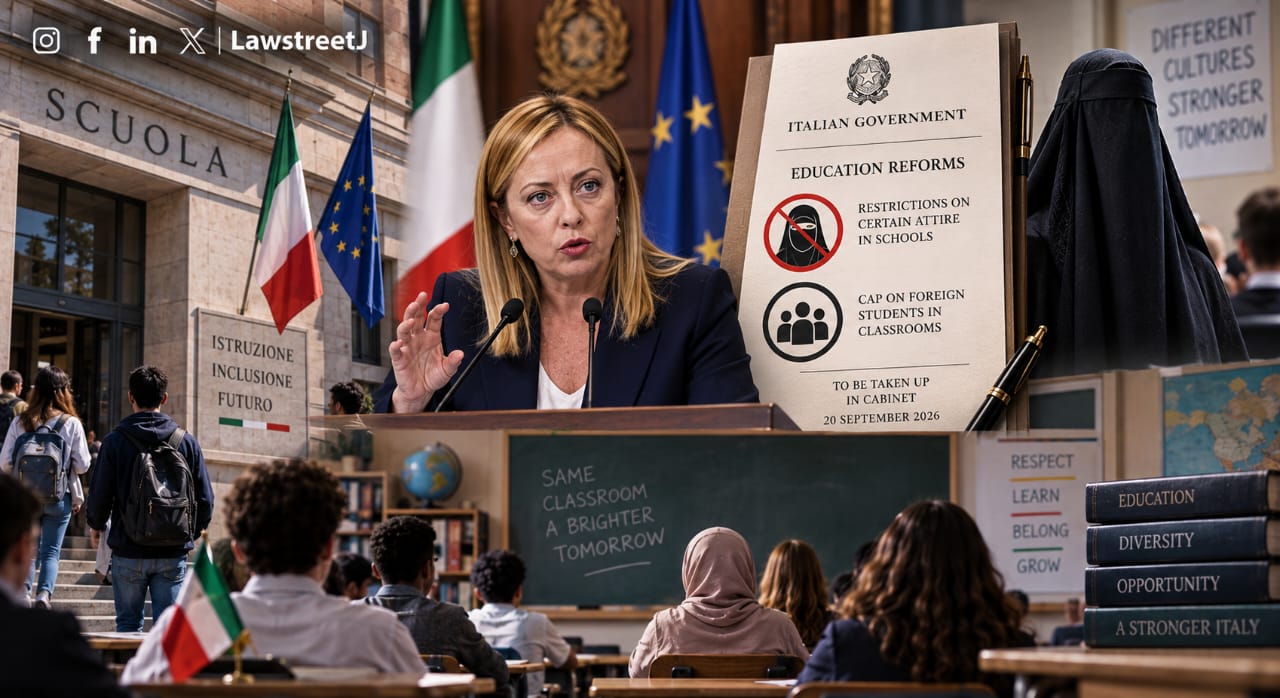
ROME — Italian Prime Minister Giorgia Meloni used a Sunday address to her own party's youth wing to unveil one of the more consequential immigration and education proposals of her tenure so far. Speaking at the Gioventù Nazionale national festival in Rome on September 20, 2026, Meloni told the crowd she will soon introduce a measure to her government that would cap the number of foreign students allowed in individual classrooms and ban the wearing of burqas and niqabs inside schools.
The setting mattered. Gioventù Nazionale is the youth wing of Meloni's own party, Brothers of Italy, a nationalist conservative movement with roots tracing back to Italy's post-fascist political tradition. Addressing that particular audience, on a stage built for the party's base rather than a neutral press briefing, gave the announcement a distinctly political framing from the outset, even before its policy substance is examined on its own terms.
What the Proposal Actually Covers
Meloni was specific in her remarks about which garments the proposed ban would target. She referred to the burqa, the all-covering garment worn by some Muslim women, and the niqab, the face veil worn by more conservative Muslim women that leaves, at most, only the eyes visible. Both are face- and body-covering garments, and the proposal as outlined is framed around that shared characteristic rather than headwear more broadly.
Beyond the dress-code element, Meloni outlined two further components to the plan, each targeting a different aspect of how foreign and immigrant families interact with Italy's school system. The first is a legal cap on how many foreign students can be placed in a single classroom, a measure aimed, according to Meloni's framing, at easing integration pressures on both students and teachers. The government has not yet specified what that numerical limit would actually be, leaving one of the proposal's most consequential details still undefined at the announcement stage.
The second component addresses parents rather than students directly. Meloni said the measure would make Italian-language lessons compulsory for parents of foreign students found to be facing "serious difficulties integrating into the school system." This extends the policy's reach beyond the classroom itself and into family life more broadly, treating a child's integration difficulties as, at least in part, a matter the state can address by mandating language instruction for the parents themselves.
Framing all three elements together, Meloni told the crowd: "For us, anyone who comes to Italy and wants to build their future here must learn our language, understand our culture, and respect our rules." She added, "It is the only serious way to welcome them," a line that reportedly drew a standing ovation from the youth wing audience in attendance.
From Party Festival to Actual Law: A Longer Road Than It Sounds
It's worth being precise about where this proposal actually stands in Italy's legislative process, since an announcement delivered to a party's youth wing is not the same thing as an enacted law. As of Sunday, the measure has not yet been formally presented to Italy's Cabinet for approval. That is the first procedural step still outstanding.
Once, and if, the Cabinet does approve it, the measure would then need to clear the Italian Parliament within 60 days in order to pass into law. That window gives opposition parties and civil society groups time to respond, lobby, or push for amendments to specific provisions before anything becomes binding. In other words, Sunday's speech marks the start of what is likely to be a contested legislative process rather than its conclusion, and the specifics, including that still-unspecified foreign-student classroom cap, could shift considerably before any final vote.
Meloni's political roots lie firmly in Italy's far-right tradition, and she has consistently taken a hawkish position on immigration throughout her time in office, a stance that has remained a defining feature of her domestic political identity since well before she became prime minister. At the same time, her tenure in government has coincided with a notable shift in how she is perceived on the international stage.
Analysts and commentators covering European politics have tracked her evolution from what was initially seen as a nationalist outlier among EU leaders into a more established, mainstream figure within that same bloc, engaging constructively with counterparts who might once have kept her at arm's length.
That balancing act, between satisfying her party's traditional base and maintaining her credibility as a governing EU leader, appears directly relevant to the timing of Sunday's announcement. Italy is heading toward a general election next year, and Meloni has been rolling out a series of policies widely read as aimed at shoring up her popularity ahead of that vote. Alongside the schools measure, this includes an exemption from a widely unpopular property tax that had applied to small and medium-sized cars and scooters, a separate policy shift that fits the same broader pattern, targeted, popularity-oriented announcements timed well ahead of an election, addressing distinct voter concerns, taxation on one hand, immigration and integration on the other, but both clearly calculated for electoral effect.
Italy in the Context of Europe's Wider Debate Over Face Coverings
Italy would not be the first European country to restrict face-covering garments in educational or public settings, and placing this proposal alongside earlier European precedents helps clarify both what's novel about it and what isn't. France has taken some of the most far-reaching action in this area over the past three decades. As early as 1994, the French Ministry of Education sent formal recommendations to teachers and headteachers advising against the Islamic veil, specified at the time as covering the hijab, niqab and burqa alike, within educational institutions, a notably broader scope than what Meloni has so far proposed for Italy.
France went considerably further in the years that followed. A subsequent French law restricted conspicuous religious symbols more broadly across public primary and secondary schools, a measure that proved deeply controversial and split opinion across the political spectrum, with critics arguing it disproportionately targeted Muslim women and infringed on religious freedom, while supporters framed it as essential to preserving France's particular model of state secularism.
Separately, in 2010, France adopted a nationwide ban on face coverings in public spaces generally, a measure aimed in particular at the niqab and the chador, extending restrictions well beyond the school setting that Italy's current proposal is confined to.
Restrictions of this kind have proven consistently controversial wherever they have been introduced across Europe, drawing objections from across the political spectrum on quite different grounds. Some critics frame such bans as necessary secular or integration measures essential to a functioning multicultural society; others argue they infringe on religious freedom and disproportionately single out Muslim women specifically, treating a form of religious or cultural expression as a public order problem.
Italy's proposed measure, still in its early, pre-Cabinet stage and considerably narrower in scope than France's public-space ban, is likely to generate a similarly polarised range of reactions once its full legislative text, including the still-undefined foreign-student classroom cap, is formally presented to Parliament.
The immediate marker to watch is whether, and when, Meloni's government formally brings the measure to Cabinet. That step will convert Sunday's speech into an actual legislative proposal with defined language, at which point the specific numerical cap on foreign students per classroom, currently left open, will need to be spelled out. From there, the 60-day parliamentary clock becomes the next meaningful checkpoint, and it is during that window that the measure's final scope will most likely be settled.