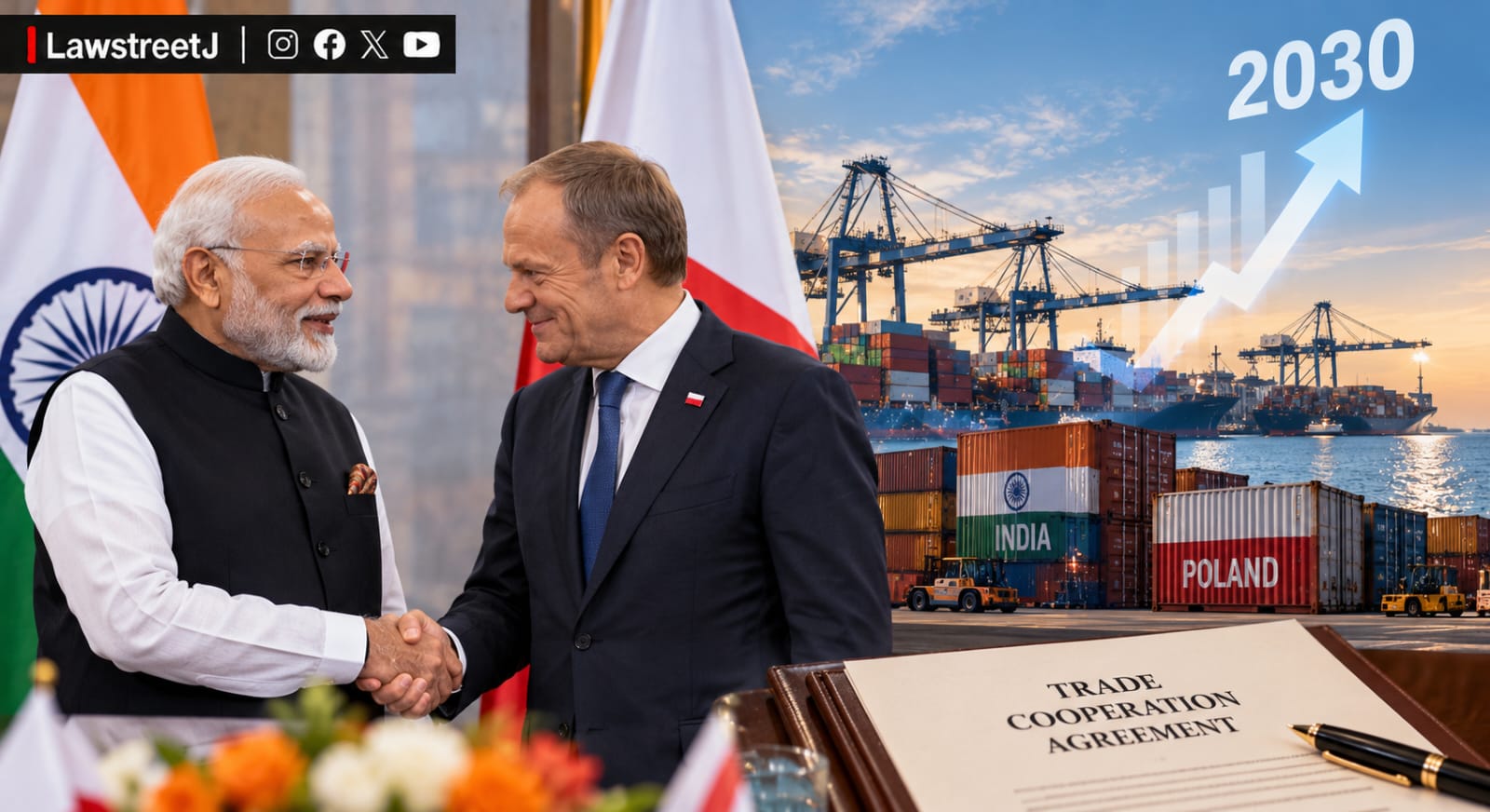
New Delhi — Prime Minister Narendra Modi and Polish Prime Minister Donald Tusk held wide-ranging talks in New Delhi on October 22, 2026, agreeing to double bilateral trade to roughly $10 billion by 2030, deepen defence and security cooperation, and discussing India's proposed role in bringing an end to the Russia-Ukraine war. The talks took place during Tusk's three-day official visit to India, the first by a Polish prime minister since 2010.
Following the meeting at Hyderabad House, the two sides announced several concrete outcomes. India and Poland agreed to double their current $6 billion annual bilateral trade to approximately $10 billion by 2030. The countries also announced the establishment of a Defence Industry Dialogue to explore co-development and co-production of defence equipment, agreed to a separate dialogue on counter-terrorism cooperation, and signed an agreement on the protection of classified information, a standard bilateral instrument that enables deeper intelligence and defence-related information sharing between the two countries. The two leaders also committed to collaborative research in artificial intelligence, semiconductors and quantum technologies, alongside cooperation in critical minerals, renewable energy and space.
Around 100 Polish company representatives and CEOs accompanied Tusk on the visit, participating in business forums held in Delhi and Bengaluru aimed at exploring new investment opportunities, particularly in renewable energy and defence manufacturing.
Modi's and Tusk's Remarks
PM Modi said both India and Poland believe in democratic values and the rule of law, and reaffirmed that India will continue to support every meaningful effort toward bringing peace to Ukraine and West Asia. He said the friendship between the two countries rests not only on diplomatic relations but on a shared heritage of humanity and compassion, and invited Polish companies to engage in co-development and co-production with India across strategic sectors.
Modi noted that the upcoming India-European Union free trade agreement, once it enters into force, would open further opportunities for Indian exports of machinery, chemicals, plastics and engineering goods to Poland, and expressed confidence that India and Poland would work together to build trusted global supply chains.
Tusk described Modi as his "friend" and referred to the deepening defence cooperation between the two countries, making an apparent reference to the reported use of Polish-origin drones by the Indian military during Operation Sindoor. Poland's government had separately, ahead of the visit, flagged its concerns about possible Russian drone or missile activity near NATO territory, forming part of the broader security backdrop to the defence-cooperation discussions, which reportedly included talks on safeguarding Polish defence technology from unauthorised access, including by Russia.
Discussion of India's Proposed Role in the Ukraine-Russia War
The talks also touched on the ongoing Russia-Ukraine war, with Tusk saying he believed India could play a constructive, positive role in influencing the course of the conflict, a position he had first raised with Modi during their August 2024 meeting in Warsaw. India has, over the course of the war, sought to position itself as a potential intermediary between Russia and Ukraine, citing its close relationships with both Moscow and Kyiv, as well as with Western capitals. Reports earlier in the conflict indicated that India had proposed elements of a phased ceasefire framework to both Ukraine and Russia.
Questions over the credibility of India's potential mediating role have persisted given India's deepening energy and defence ties with Russia, which remains India's largest supplier of crude oil and a long-standing defence partner, the United States imposed tariffs of up to 50 percent on Indian goods during 2025 partly in response to India's continued purchases of discounted Russian oil.
India's government has consistently responded to such criticism by describing its energy purchasing decisions as driven by market conditions and national economic interest rather than political alignment, while simultaneously stating that these commercial ties with Russia do not compromise its sincerity in supporting a peaceful resolution to the war, a position consistent with the broader framing, referenced in some reporting on the Modi-Tusk talks, that India sees no inherent conflict of interest between maintaining its strategic partnership with Russia and genuinely supporting international efforts to end the war in Ukraine.
Background: The India-Poland Relationship
Poland is India's largest trading partner in Central and Eastern Europe. The two countries upgraded their relationship to a "Strategic Partnership" during Modi's visit to Warsaw in August 2024, during which the two sides adopted a five-year Action Plan for 2024-2028. That 2024 visit was notable for taking place en route to Modi's subsequent visit to Kyiv, where he met Ukrainian President Volodymyr Zelenskyy, following an earlier, separately controversial visit by Modi to Moscow that drew criticism from Kyiv. During the current October 2026 visit, Tusk's engagement built on this existing strategic-partnership framework rather than establishing an entirely new bilateral mechanism.
Agreements of the kind signed during the visit, including the classified-information protection accord, are typically formalised as bilateral treaties or executive agreements under international law, requiring ratification or formal exchange of instruments according to each country's domestic constitutional procedures before taking full legal effect, such agreements establish reciprocal obligations for the handling, storage and sharing of classified defence and security-related information between the two governments and their respective defence industries, a standard precondition for deeper defence-industrial cooperation, including the kind of co-development and co-production envisioned under the newly announced Defence Industry Dialogue.
India's broader diplomatic posture on the Ukraine war has consistently emphasised the principles of sovereignty and territorial integrity in its public statements, while declining to directly condemn Russia's invasion in United Nations forums, a position reflected in India's abstentions on several UN General Assembly resolutions concerning the conflict since 2022.