Kathmandu and New Delhi locked in formal diplomatic standoff over Kailash Manasarovar Yatra route as Foreign Secretary's May 11–12 trip draws near
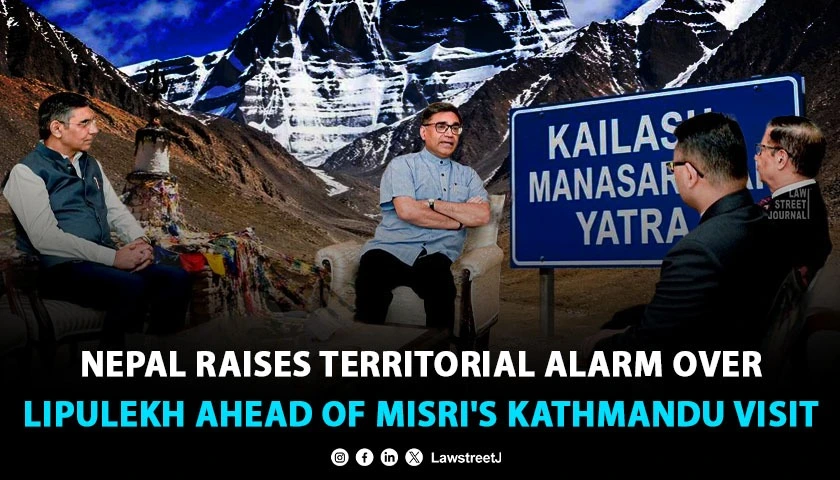
With India's Foreign Secretary Vikram Misri scheduled to arrive in Kathmandu on May 11–12, Nepal's Ministry of Foreign Affairs has formally communicated its concerns to both New Delhi and Beijing over the conduct of the Kailash Manasarovar Yatra through the Lipulekh Pass, a territory Nepal considers its own sovereign land. The timing of the statement, issued in the days leading up to what is being described as the first high-level diplomatic outreach from India to Nepal's new government, has deepened an already complex boundary conversation that traces its roots to a colonial-era treaty signed more than two centuries ago.
Nepal's Ministry of Foreign Affairs stated that the government is "completely clear and steadfast" that Limpiyadhura, Lipulekh, and Kalapani, situated east of the Mahakali River, are integral parts of Nepal's territory under the 1816 Sugauli Treaty. Kathmandu confirmed it had formally conveyed this position to both India and China through diplomatic channels and urged both nations not to undertake activities such as road construction, border trade, or religious pilgrimage through the pass without Nepal's consent.
India's response was firm. Ministry of External Affairs Spokesperson Randhir Jaiswal stated that India's position has been consistent and clear, asserting that the Lipulekh Pass has been a long-standing route for the Kailash Manasarovar Yatra since 1954 and that the Yatra through this route has been going on for decades. New Delhi further characterized Nepal's territorial claims as neither justified nor supported by historical facts, describing the 2020 constitutional map amendment that incorporated Lipulekh into Nepal's official boundaries as an "artificial enlargement of territorial claims."
The Treaty at the Centre of the Dispute
The legal foundation of Nepal's position rests on the Treaty of Sugauli, signed on December 2, 1815, and ratified on March 4, 1816, between Nepal and the British East India Company following the conclusion of the Anglo-Nepalese War. Article 5 of that treaty delimited the Kali River, now known as the Mahakali River as the western border of Nepal, and the treaty remains the primary historical foundation of Nepal's claims over the territories of Kalapani, Lipulekh, and Limpiyadhura.
The central legal disagreement between the two countries concerns the identification of the river's source. Nepal argues that the river originates at Limpiyadhura, which would place all territory east of it, including Kalapani and Lipulekh within Nepal. India disputes this and maintains that the river begins further east, near Kalapani village, where multiple tributaries converge, and has also presented administrative and revenue records dating back to the 1830s to support its position. Maps published by the British colonial government and independent India between 1850 and 1950 marked Kalapani and Lipulekh inside Nepal's territory. Nepal published maps in 1969, 1975, and 2015, each reaffirming the territories as part of Darchula district. However, the legal and cartographic picture shifted considerably after 1962, when India stationed troops in Kalapani following the Sino-Indian War, a presence Nepal has consistently described as without treaty basis.
The 1956 Nepal–China Trade Treaty officially recognized Lipulekh as one of the designated trade passes between Nepal and Tibet, an acknowledgment from China that the territory belonged to Nepal. Nepal has raised this agreement repeatedly in diplomatic correspondence.
In June 2020, Nepal's parliament unanimously passed a constitutional amendment altering the official map to include Limpiyadhura, Lipulekh, and Kalapani as part of Nepali territory, with all 258 lawmakers present voting in favour. India firmly rejected that move, stating the act was not based on historical facts and evidence and was contrary to the bilateral understanding to resolve outstanding boundary issues through diplomatic dialogue.
The Yatra Route and the 2026 Pilgrimage Season
The immediate trigger for Nepal's latest diplomatic protest is India's decision to resume the Kailash Manasarovar Yatra for 2026, a Hindu pilgrimage to Mount Kailash (6,638 metres) and Lake Manasarovar (4,590 metres) in the Tibet Autonomous Region of China, through the Lipulekh Pass for the second consecutive year.
India's Ministry of External Affairs announced that the Kailash Manasarovar Yatra, organised in coordination with the Chinese government, is set to take place from June to August 2026. Ten batches of 50 pilgrims each are scheduled to travel through Uttarakhand, crossing at Lipulekh Pass, while another ten batches of 50 pilgrims each will travel through Sikkim, crossing at Nathu La Pass. In total, 1,000 Indian pilgrims are expected to undertake the pilgrimage under this arrangement. The Lipulekh Pass, known as Pulang-Gunji in the local Tibetan dialect, is one of three villages located in the Kalapani area. Though currently under Indian administrative control, Nepal has consistently asserted its claim over the area. The resumption of the yatra, after years of suspension due to the COVID-19 pandemic and diplomatic frictions, has added fresh urgency to Nepal's long-standing protests.
Nepal's Ministry of Foreign Affairs spokesperson Lok Bahadur Thapa Chhetri confirmed that diplomatic notes have been formally sent to both India and China. Nepal raised concerns with India over including Lipulekh in its pilgrimage route and urged it to avoid infrastructure development, trade operations, or religious travel in the disputed territory.
Nepal's Rastriya Swatantra Party had previously condemned the August 2025 India-China agreement to reopen Lipulekh for border trade in the strongest terms, stating that neither India nor China can conduct trade through the pass without Nepal's consent.
Misri's Kathmandu Visit and the Diplomatic Stakes
Foreign Secretary Vikram Misri's scheduled May 11–12 visit to Nepal marks the first high-level diplomatic outreach from New Delhi to the new government led by Prime Minister Balendra "Balen" Shah, who was sworn into office on March 27, 2026. Nepal's Foreign Secretary Amrit Bahadur Rai has sent a formal invitation to Misri, with the visit's core objective being to understand the new administration's priorities and India's expectations going forward. Misri is expected to extend an invitation, on behalf of Indian Prime Minister Narendra Modi, for Prime Minister Shah to visit India, and while in Kathmandu he will call on key ministers and hold talks with his counterpart Rai. The visit is also intended to set the groundwork for Foreign Minister Shishir Khanal's trip to New Delhi in late May 2026 for the India-Africa Forum Summit.
In the fiscal year 2024–25, India emerged as the largest bilateral donor to Nepal, disbursing USD 107.8 million, according to Nepal's finance ministry. India and Nepal maintain nearly three dozen bilateral mechanisms, ranging from the district to the foreign minister level, covering security, water resources, irrigation, border management, boundary issues, trade, commerce, and agriculture, among others. Several of these mechanisms have not convened for years.
This is the first verbal confrontation between the two neighbours over the boundary issue since Balen Shah was sworn in as prime minister following an overwhelming electoral victory. Diplomatic sources on both sides have indicated uncertainty over whether Misri will meet Prime Minister Shah during the visit, with the visit's agenda still being finalized through informal consultations between the two embassies.
Whether the Lipulekh dispute will formally feature on the agenda of the May 11–12 meeting remains to be seen. Nepal's Ministry of Foreign Affairs has said it will continue to pursue a dialogue-based resolution and expects both India and China to engage through established diplomatic channels on what Kathmandu considers a matter of sovereign territory. India, for its part, has maintained that its position on the Lipulekh Pass is consistent and that the outstanding boundary issues should be resolved through direct bilateral talks, a process that has been formally underway since 1981, without resolution, through the Joint Technical Boundary Committee.