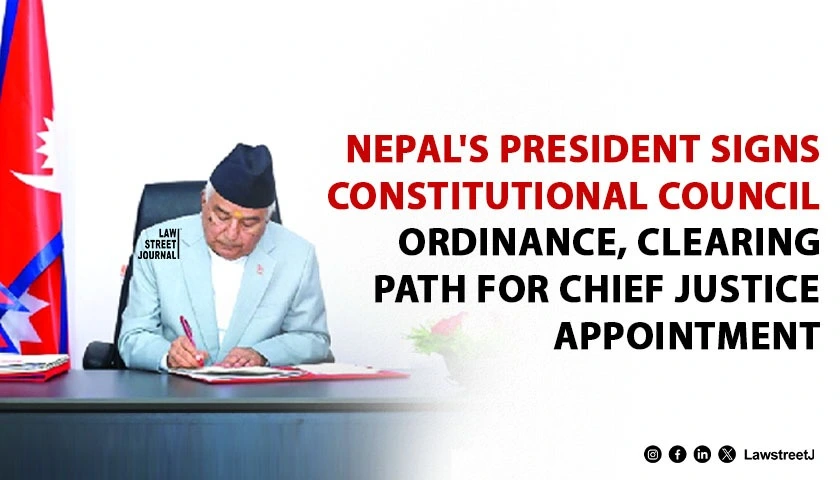
President Ramchandra Paudel has issued the Constitutional Council (Works, Functions, Rights and Procedures) (First Amendment) Ordinance, 2026, in accordance with Article 114(1) of the Constitution of Nepal, 2015, on the recommendation of the Council of Ministers. The development, confirmed by the Office of the President on Tuesday, brings to a close a prolonged institutional standoff that had left Nepal's apex judicial and constitutional appointment machinery paralysed for the better part of eight months.
With this, the President has now issued all eight ordinances forwarded by the Council of Ministers. The Constitutional Council ordinance was the last of the batch and the most consequential, given that the post of Chief Justice of the Supreme Court of Nepal has been lying vacant without a permanent incumbent for a considerable period.
The Ordinance and Its Legal Provisions
The new provision allows decisions to be made by just three members of the six-member Constitutional Council. According to the ordinance, a quorum of four members is required for a meeting of the Council, meaning the chairperson and at least three other members must be present for the meeting to take place. Furthermore, decisions can be made if at least three members, including the chairperson, agree. The ordinance also includes a provision for a tie-break situation. If all six members are present and voting results in a three-to-three tie, the side supported by the chairperson will be considered the majority.
The ordinance provision sits in Article 114 of Nepal's 2015 Constitution, framed as a narrow exception. When both houses of parliament are not in session and the government concludes that immediate action is necessary, the President can promulgate an ordinance on the recommendation of the Council of Ministers. Once issued, it carries the same legal force as a parliamentary Act. Once Parliament reconvenes, the ordinance must be placed before it, and from the first day of that session, a 60-day clock begins ticking. Within those 60 days, the government must introduce a replacement bill and get both chambers to pass it. If Parliament explicitly rejects it, or if the window closes without a vote, the ordinance ceases to have any legal effect.
The six-member Constitutional Council is chaired by the Prime Minister and includes the Speaker of the House of Representatives, the Chief Justice, the Chairperson of the National Assembly, the Leader of the Main Opposition, and the Deputy Speaker.
A Prolonged Vacancy and the Road to This Ordinance
Following the retirement of Chief Justice Prakash Man Singh Raut upon reaching the mandatory age limit, the Supreme Court had been functioning under an acting arrangement, with Senior Justice Sapana Pradhan Malla leading the court in an acting capacity. Although the constitution requires recommendations to be made one month before a vacancy arises, the political transition following the Gen Z movement and the subsequent dissolution of parliament left key positions, including the Speaker, Deputy Speaker, and opposition leader, unfilled, rendering the council inactive. After the elections held on March 5, the new House of Representatives was formed, allowing the council to regain full membership.
The Judicial Council has already recommended six eligible candidates for the post of Chief Justice, all of whom have completed at least three years as Supreme Court justices. Under Article 129(3) of the Constitution of Nepal, a minimum of three years of service as a Supreme Court Judge is the qualifying criterion for appointment as Chief Justice. Under Article 129(2), the President holds the power of formal appointment on the recommendation of the Constitutional Council.
The Constitutional Council First Amendment Ordinance 2026 was recommended by the Balendra Shah-led government through a cabinet decision on April 27. After sitting on it for a week, President Paudel returned the ordinance to the government for review, having insisted on a four-member majority in the Constitutional Council. The government refused to revise the ordinance and sent it back unchanged, and a Cabinet meeting held on Monday decided to resend the ordinance in its existing form.
Senior advocate Chandra Kanta Gyawali stated that even if the government resends the ordinance in the same form for the second time, the constitution does not allow the President to block it. The President's legal advisor and senior advocate Baburam Kunwar stated that the President has always wished that the constitutional spirit is reflected in any bill or ordinance, and has maintained the same position both in the past and in this ordinance.
Legal Debate, Parliamentary Concerns, and What Lies Ahead
Despite the council's completion, legal uncertainty surrounding its functioning had been a matter of ongoing concern. Several ordinances regulating the Constitutional Council's powers had been issued and allowed to lapse in the past without parliamentary approval, leaving gaps in the legal framework. As a result, the council had been unable to make decisions by majority vote if consensus was not reached. The move drew criticism from opposition parties, especially the Nepali Congress, which questioned the timing of the ordinance, noting it was introduced after the suspension of Parliament. The government defended the process, saying it is aimed at ensuring smooth functioning of constitutional institutions.
Sources close to the Prime Minister argued that the amendment by ordinance was necessary to ensure that appointments to constitutional bodies are not obstructed even amid opposition from opposition parties. In the Constitutional Council, three members are inclined towards the opposition: the leader of the main opposition Nepali Congress parliamentary party, Bhishma Raj Angdembe; the National Assembly Chairperson, Narayan Dahal, elected from the Nepal Communist Party; and the Deputy Speaker, Ruby Kumari Thakur, elected from the Shram Sanskriti Party.
Earlier, the President had also issued the Some Nepal Laws (Amendment) Ordinance, the Health Sciences Academies Ordinance, the Universities (Amendment) Ordinance, the Special Provisions on the Removal of Public Officials Ordinance, the Prevention of Money Laundering (Third Amendment) Ordinance, the Public Procurement (Second Amendment) Ordinance, and the Cooperatives (First Amendment) Ordinance.
Under Article 284(3) of the Constitution of Nepal, the Constitutional Council is mandated to make a recommendation for the appointment of the Chief Justice within one month of the office falling vacant. With the ordinance now in force, the Council has the legal framework to convene, reach a quorum, and formally recommend a candidate to the President. The immediate priority, as confirmed by multiple official sources, remains the appointment of a permanent Chief Justice, a step considered critical to restoring full institutional stability to Nepal's Supreme Court and the broader constitutional order.