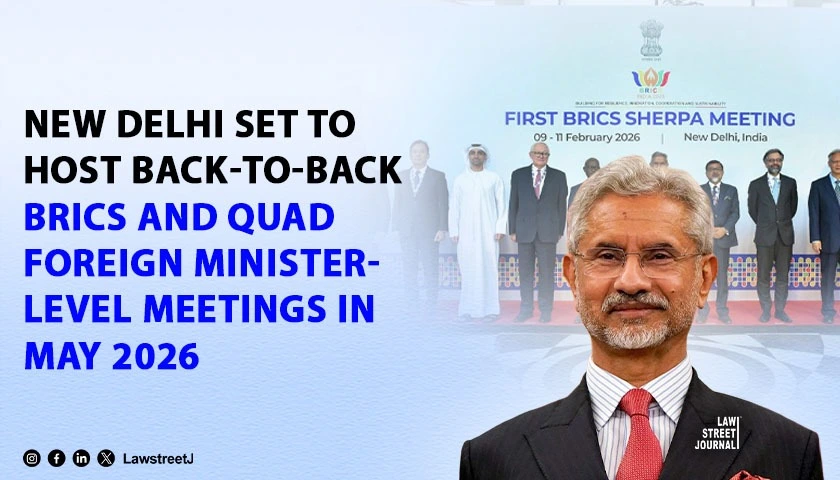
India's diplomatic calendar grows significantly denser as the nation prepares to bring together two of the world's most consequential multilateral groupings within the same month, with US Secretary of State Marco Rubio's confirmed visit adding substantial weight to the proceedings. India is set to host Foreign Minister-level meetings of both BRICS and the Quad in May 2026, marking a significant convergence of diplomatic activity in New Delhi. The back-to-back engagements come at a time when India holds the BRICS chairmanship and continues to deepen its strategic partnerships with Western allies, placing the country at the centre of a complex and evolving geopolitical landscape.
The BRICS Foreign Ministers' Meeting is scheduled for May 14 and 15, 2026, and will bring together top diplomats from key member nations at a time when the grouping is gaining greater global significance. Separately, the Quad foreign ministers are expected to meet in New Delhi in May as well, in what would be the first such engagement on Indian soil since 2023.
India's BRICS Chairmanship and the Road to the Summit
India assumed the BRICS chairmanship on January 1, 2026, having previously held the position in 2012, 2016, and 2021. This makes 2026 India's fourth time at the helm of the bloc, and the stakes this time are considerably higher given the grouping's recent and substantial expansion. BRICS now comprises eleven full members: Brazil, Russia, India, China, South Africa, Egypt, Ethiopia, Iran, Saudi Arabia, the United Arab Emirates, and Indonesia. Ten partner countries— Belarus, Bolivia, Cuba, Kazakhstan, Malaysia, Nigeria, Thailand, Uganda, Uzbekistan, and Vietnam, joined in 2025.
India's 2026 chairmanship is guided by the theme "Building for Resilience, Innovation, Cooperation and Sustainability," reflecting a people-centric and humanity-first approach. Under this framework, the May ministerial meeting is expected to lay the groundwork for the larger 18th BRICS Summit, which is scheduled for September 9 and 10, 2026, in New Delhi. Russian Foreign Minister Sergey Lavrov is expected to attend the meeting, signalling its diplomatic significance. The discussions are also expected to cover de-dollarisation, the promotion of local currency trade, and emerging areas such as water security and atmospheric technologies. The agenda carries notable complexity. Indian officials are reportedly uncertain whether Iran and the UAE will attend the upcoming meeting in person. Citing officials, The Hindu reported that as of now, the BRICS foreign ministers' meeting will be held in person.
Iran's President Masoud Pezeshkian, in a telephonic conversation with Prime Minister Narendra Modi on March 21, urged India, in its capacity as BRICS chair, to play an independent role in brokering an end to the war on Iran, stating that the nations of BRICS must not stand silent while the sovereignty of a member state is violated. This puts India in a diplomatically delicate position as it seeks to build consensus among member states that hold fundamentally divergent positions on the West Asia crisis. Climate finance is also expected to feature prominently in the discussions, with conversations centred on enabling green transitions without overburdening developing economies. India is additionally likely to push for reforms in global institutions, particularly the United Nations Security Council. The ministerial meeting is expected to emphasise digital public infrastructure, with India showcasing initiatives like Aadhaar and the Unified Payments Interface as scalable models for other member nations.
Rubio's Visit and the Quad Foreign Ministers' Meeting
Alongside the BRICS engagement, India is also preparing to host a Quad Foreign Ministers' Meeting in the last week of May. India is likely to hold the Quad foreign ministers' meeting in the last week of May, during US Secretary of State Marco Rubio's planned travel to New Delhi. People familiar with the matter confirmed that the other two members of the Quad— Japan and Australia, are looking at the proposed dates. While the Japanese foreign ministry has indicated that the dates should work, India is awaiting confirmation from Australia on whether Foreign Minister Penny Wong would be able to travel to India during that period.
Rubio's planned visit to New Delhi was announced following a productive meeting between US Secretary of State Marco Rubio and India's Foreign Secretary Vikram Misri at the White House. The two leaders reviewed bilateral relationships, focusing on trade, critical minerals, defence, and the Quad. US Ambassador to India Sergio Gor, who was present at the meeting, posted on social media confirming that Secretary Rubio looks forward to visiting India next month. The Indian embassy in the US also expressed anticipation, stating both sides look forward to deepening engagement in these important sectors to strengthen the India-US Comprehensive Global Strategic Partnership. The India-US relationship faced headwinds for much of 2025 due to tariff disputes and American pressure on New Delhi to curtail Russian oil purchases. However, India and the US struck an interim trade deal in February 2026, which paved the way for improved ties and a series of high-level exchanges between the two administrations since.
The Quad, comprising India, the United States, Japan, and Australia, is a grouping focused on maintaining a free and open Indo-Pacific. At the last Quad Foreign Ministers' Meeting, held in Washington, the officials reaffirmed their commitment to a free and open Indo-Pacific and announced the launch of the Quad Critical Minerals Initiative, aimed at securing and diversifying critical mineral supply chains.
The Legal and Institutional Framework
Both BRICS and the Quad operate within the framework of international law, though they function through distinct institutional structures. BRICS is an intergovernmental grouping with no formal treaty-based charter, operating instead through consensus-based declarations and working group outcomes. Its ministerial and summit-level declarations carry political weight but do not constitute binding legal instruments under international law. However, the outcomes of summits and ministerial meetings have historically shaped member states' positions at international bodies such as the United Nations General Assembly and the World Trade Organization.
The Quad, formally known as the Quadrilateral Security Dialogue, similarly operates without a binding treaty framework. It functions as a strategic forum, with its commitments expressed through joint statements. At the July 2025 Quad Foreign Ministers' Meeting in Washington, the ministers reaffirmed their commitment to defending the rule of law, sovereignty, and territorial integrity, and underscored cooperation in support of a free and open Indo-Pacific.
India's hosting of both these meetings in the same month is not merely a logistical coincidence. It reflects India's continuing effort to maintain strategic autonomy, a foreign policy posture through which New Delhi engages with both the Global South-aligned BRICS bloc and the Indo-Pacific-focused Western grouping, while retaining independent decision-making on matters of national interest. This dual engagement places India at a rare diplomatic crossroads, managing the expectations of groupings with sharply different geopolitical orientations, and doing so in the same capital, within the same calendar month.
The outcomes of both meetings are expected to carry significant implications, not only for India's bilateral relationships, but for the broader multilateral order as it continues to take shape in 2026.