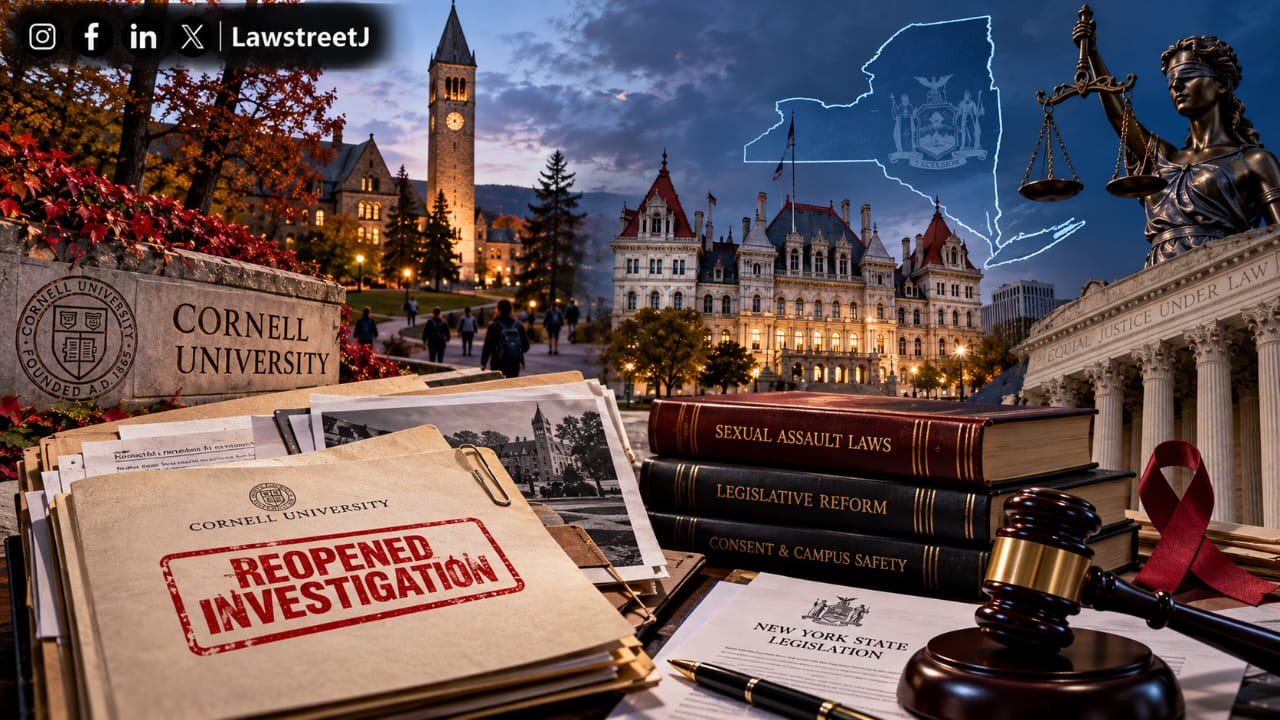
Albany / Ithaca, N.Y. — New York state lawmakers and Governor Kathy Hochul are calling for reforms to the state's sexual assault laws following the reopening of a 2024 criminal investigation into an alleged assault involving members of a Cornell University fraternity. The push for legislative change follows a civil lawsuit filed by the alleged victim and a decision by the Tompkins County District Attorney to present the case to a grand jury after initially declining to bring criminal charges.
Background of the Case
The case centres on an incident alleged to have occurred in 2024 at the Chi Phi fraternity house at Cornell University in Ithaca, New York. According to reporting on the matter, a woman who was a 20-year-old Cornell student at the time has stated that she was sexually assaulted by multiple men after visiting the fraternity while under the influence of drugs and alcohol she had voluntarily consumed. The Chi Phi fraternity was shut down by the university in 2024 following the allegations.
The woman reported her allegations to campus police in 2024. The Cornell Daily Sun, the university's student newspaper, has been credited with bringing renewed public attention to the case through its reporting. In November 2024, the woman provided a sworn statement to investigators. According to Tompkins County District Attorney Matthew Van Houten, that statement described consensual sexual activity accompanied by heavy voluntary drug use, but did not allege that she was drugged against her will, physically forced, unconscious, or that she had clearly expressed a lack of consent. Based on the office's review of that statement, prosecutors determined at the time that the alleged facts did not constitute a chargeable crime under New York law, and declined to pursue criminal charges.
The Civil Lawsuit and Reopened Investigation
Renewed attention to the case followed the filing of a civil lawsuit by the alleged victim, identified in court filings as Jane Doe, naming seven Chi Phi fraternity members, the fraternity itself, her own sorority chapter, and Cornell University as defendants.
Following the lawsuit and significant public outcry, Van Houten announced in a statement that his office would reexamine the case and present it to a grand jury once appropriate charges were determined. He said he had assigned a senior prosecutor with experience in sex crimes cases to begin preparations. Van Houten noted similarities between the woman's original 2024 statement to police and details contained in the civil lawsuit, and said he had reached out to the woman's attorneys to understand discrepancies between the two accounts, having said his office had not previously been contacted by them.
He stated that his office had not seen a transcript of a more recent interview with the woman and had relied on her original sworn statement when the decision not to prosecute was made in 2024.
In his public statement, Van Houten described the conduct alleged against certain Chi Phi members as morally reprehensible, while maintaining that his office's original legal determination, based on the statement available to it at the time, was correctly reached under the constraints of existing law. He said that seeking justice sometimes requires reconsidering or reopening cases when new evidence is provided, and confirmed that the matter would be presented to the Tompkins County Grand Jury, which will determine whether an indictment is warranted.
Cornell University issued a statement supporting the District Attorney's decision to allow the case to be heard by a criminal grand jury.
Governor Kathy Hochul has called for an independent review of Cornell University's handling of the sexual assault allegations. In a public statement, Hochul said that while New York already has some of the toughest laws on sexual assault on college campuses in the country, she believes the state can do better, and indicated she was considering new legislation to tighten the state's sexual assault statutes. Cornell subsequently agreed to an independent probe into its handling of the case.
Proposed Legislative Reforms
State lawmakers have advanced two bills in response to the case, both of which previously passed the New York State Senate but have not yet advanced through the State Assembly.
One bill, sponsored by Democratic State Senator Jamaal Bailey, would clarify consent language in the state's sexual assault statutes. Under the proposal, assault charges could be brought in circumstances where a perpetrator reasonably should have known that a victim was unable to consent due to intoxication, including in cases where the victim voluntarily consumed alcohol or drugs rather than being involuntarily drugged or physically forced.
Advocates have argued for years that the existing legal framework, which generally requires proof of physical force, incapacitation to the point of unconsciousness, or an involuntary intoxication, makes it difficult to prosecute cases in which a victim's judgment or capacity to consent was impaired by voluntarily consumed substances.
Under the state's current sexual offences statutes, contained in Article 130 of the New York Penal Law, a lack of consent for purposes of a sex offence generally must be established through specific statutory routes, including forcible compulsion, incapacity to consent due to factors such as unconsciousness or involuntary intoxication, or circumstances where the victim clearly expressed through words or conduct that they did not consent. Voluntary intoxication, where a victim consumed drugs or alcohol by their own choice and the impairment resulting from that consumption affected their ability to consent, does not, under current New York law, automatically satisfy the statutory definitions used to establish lack of consent in a criminal prosecution, which is the specific gap that the proposed legislation seeks to address.
Separately, Title IX of the Education Amendments of 1972, the federal civil rights law prohibiting sex-based discrimination in education programmes receiving federal funding, requires universities including Cornell to investigate and respond to reports of sexual misconduct through their own internal administrative processes, which operate independently of, and under different evidentiary standards than, the criminal justice system. The case has prompted renewed public scrutiny of how Cornell's Title IX processes and campus disciplinary procedures interacted with the criminal investigation into the same underlying allegations.
As of October 1, 2026, the following facts are on record, Tompkins County District Attorney Matthew Van Houten has reopened the criminal investigation into the 2024 Cornell fraternity case and intends to present it to a grand jury, which will determine whether an indictment is warranted, the underlying civil lawsuit filed by the alleged victim against seven individual defendants, the fraternity, her sorority chapter and Cornell University remains pending, Governor Kathy Hochul has called for an independent review of Cornell's handling of the matter, which the university has agreed to and two legislative bills aimed at reforming New York's consent and sexual assault statutes, including the bill sponsored by State Senator Jamaal Bailey, have passed the State Senate but remain pending before the State Assembly. No criminal charges have yet been filed against any of the individuals named in the civil lawsuit, and the grand jury process had not concluded at the time of this report.