NEW DELHI — New Zealand just cleared the last major domestic hurdle standing between the India-New Zealand Free Trade Agreement and actually taking effect.
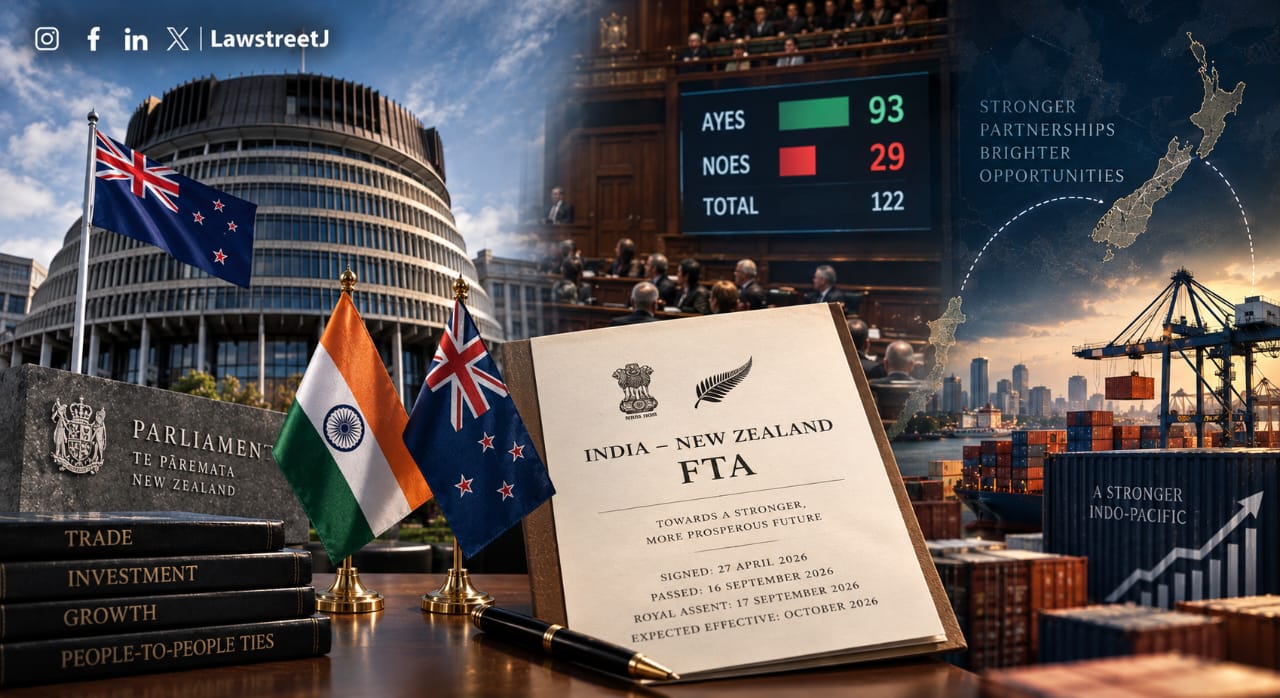
On Wednesday, September 16, 2026, Parliament in Wellington passed the enabling legislation by a commanding 93 votes to 29, with the ruling National Party picking up support from the opposition Labour Party as well. That's not a small thing for a trade bill. Cross-party backing on something this size usually means the politics are settled, even if the paperwork isn't quite finished yet.
India's Ministry of External Affairs called it "an important step towards bringing the Agreement into force," language that reflects the shared commitment of both countries to deepen and broaden their economic partnership. The FTA itself had already been signed back on April 27, 2026, in New Delhi, by Commerce and Industry Minister Piyush Goyal and New Zealand's Todd McClay. What Wednesday's vote did was turn a signed agreement into something New Zealand's domestic law actually recognises.
Nine Months, Start to Finish
Here's what's genuinely unusual about this deal, how fast it came together.
Formal negotiations launched on March 16, 2025, in a meeting between Goyal and McClay. By December 2025, just nine months later, the talks were done, wrapped up across five formal negotiating rounds. For a comprehensive agreement covering goods, services, investment and mobility, across two economies that don't look remotely alike on paper, that's a sprint, not a marathon.
The third round, held in Queenstown from September 15 to 19, 2025, gives a sense of how that pace was maintained. Officials on both sides described the discussions as constructive, with several chapters closed out entirely during that single round. And the numbers backing the push weren't nothing either: bilateral merchandise trade between the two countries hit USD 1.3 billion in FY 2024-25, up nearly 49 percent year-on-year, giving both governments a concrete reason to move quickly rather than let the talks drag.
New Zealand Prime Minister Christopher Luxon didn't hold back after the vote. Posting on X, he wrote: "People told me a Free Trade Agreement with India wasn't possible. Well, today that deal passed its final vote in Parliament. It's happening." He tied it directly to a campaign promise, noting his National Party had said it would secure exactly this kind of deal in its first term, and now had.
Todd McClay struck a similarly confident note, framing the agreement as opening access to one of the world's largest consumer markets for New Zealand exporters. The fact that Labour, the main opposition, backed the bill alongside National says something too, this hasn't become a partisan football in New Zealand's domestic politics, at least not yet.
What's Actually in It for India
Strip away the diplomatic language and the headline number for Indian exporters is simple, 100 percent of Indian exports get duty-free access across every New Zealand tariff line once the deal takes effect. Full stop, no carve-outs.
That's expected to land hardest, in a good way, for a specific set of industries: textiles and apparel, leather and footwear, engineering goods, pharmaceuticals, and agriculture and processed food products, sectors that have long run into tariff walls trying to break into the New Zealand market. Beyond goods, there's a services and investment layer too, along with enhanced mobility pathways for Indian professionals and students. And on the investment side specifically, the agreement is expected to help unlock up to USD 20 billion flowing into India, a figure that shows this was never just about tariffs on physical goods.
What New Zealand Gets Back
This isn't a one-way street, and New Zealand walked away with real gains of its own. India has committed to eliminating or reducing tariffs on 95 percent of New Zealand's exports once implementation is complete. More strikingly, 57 percent of those exports become duty-free from day one, no phase-in required, climbing to 82 percent as the remaining tariff reductions kick in over time.
Wood products, wool, sheep meat, leather raw hides, these are the categories New Zealand has pushed hardest on, areas where it's traditionally strong but has struggled against Indian tariff barriers. The staged rollout, immediate relief on the majority of exports with a clear runway toward broader coverage, is fairly standard for deals this size. It gives industries on both sides room to adjust rather than absorbing everything at once.
None of this happened in a vacuum. Prime Minister Narendra Modi's visit to New Zealand in July 2026, notably the first by an Indian prime minister to the country in four decades, gave the whole process real political momentum. Modi and Luxon used that visit to reaffirm their commitment to deeper economic engagement, and specifically to push for early implementation of the FTA rather than letting it sit in bureaucratic limbo after signing.
That urgency is translating into an actual date now. India's Commerce Secretary, Rajesh Agrawal, said last week the agreement could become operational as early as October 2026. That's an aggressive timeline, especially given both countries still have to finish their own domestic ratification processes. With New Zealand's side of that now done, the pressure shifts to India to move at a matching pace.
Where This Goes From Here
The remaining work is procedural but not trivial, both governments still need to complete their respective domestic processes before the FTA formally enters into force. Once it does, officials on both sides are framing it as something bigger than a tariff-reduction exercise, a template for using economic partnerships to open real opportunities for exporters, workers, students and consumers on both ends. Whether that October target actually holds depends almost entirely on how fast India's own remaining steps get done now that New Zealand has cleared its half of the finish line.