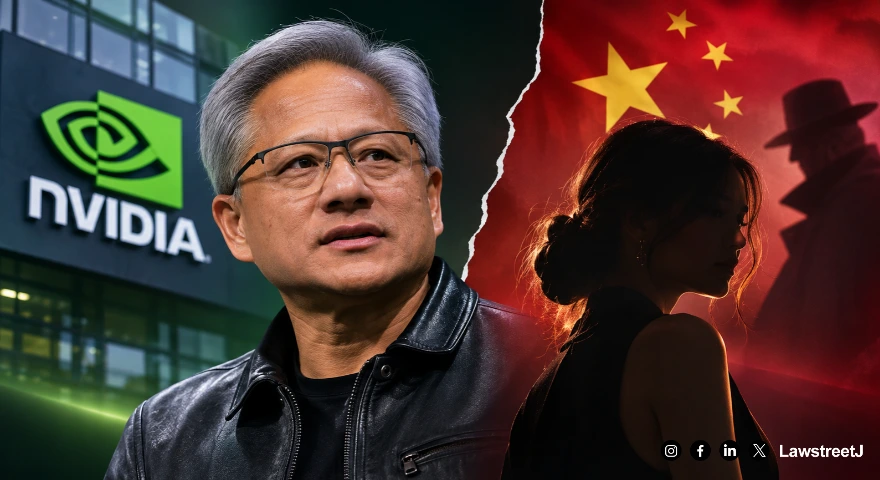
San Jose — Nvidia chief executive Jensen Huang has admitted to a romantic relationship with a woman US officials reportedly concluded was a Chinese intelligence asset, prompting an independent board investigation, congressional demands for a briefing, an FBI inquiry and a proposed shareholder class action. The allegation that the woman was a spy comes from US officials cited in New York Times reporting and has not been independently confirmed. Nvidia says it has no reason to believe national security or company secrets were compromised.
What Huang Admitted
On Sunday, November 8, 2026, Huang told employees in an email, a draft of which was obtained by Axios: "I owe my family and all of you an apology." He said he took "full responsibility" for his actions and had fallen short of his responsibilities to Nvidia's employees, board and shareholders. "Leading NVIDIA is the privilege of my life," he wrote, adding that he would "work to earn back your confidence."
The same day, Nvidia's board said a committee of independent directors, assisted by outside counsel, would investigate "in light of recent reporting that founder and CEO Jensen Huang has been the target of a foreign intelligence effort." The board said it had no reason to believe national security or company secrets were compromised and expressed confidence in Huang's leadership. Nvidia's head of public policy communications said Huang "is committed to continuing to lead NVIDIA as CEO without interruption."
Reactions and Inquiries
- Congress: Three House Republican committee chairs, Brian Mast (Foreign Affairs), John Moolenaar (China Select Committee) and Rick Crawford (Intelligence), asked Huang for a closed-door briefing, writing that the reports raised "significant national security concerns" about Chinese access to sensitive US technology and information. Nvidia responded with a statement largely mirroring one it earlier gave the Times, suggesting Huang's meetings with Alice Huang were no different from his meetings with other executive clients.
- The White House: President Donald Trump said on Monday, November 9, that he spoke to Huang and that Huang denied knowing the woman was a spy, and called him "an honorable guy." Trump also said the FBI was looking into the matter. The Times separately reported that Trump was briefed on the intelligence about a year ago, and, in a later report, that Secretary of State Marco Rubio told him aboard Air Force One in May. The administration has not publicly addressed what, if anything, it did with that information.
- Markets and shareholders: Nvidia's shares fell 4.27 percent after the revelations, erasing about $192.1 billion in market value, according to one report. A proposed class action filed Monday in federal court in San Jose, California, alleges Nvidia and Huang defrauded shareholders by concealing the relationship; it covers investors who bought between October 9 and November 8.
Legal Framework
An extramarital relationship is not itself a legal violation, the legal questions arise from national-security, export-control and corporate-governance rules. US export regulations administered by the Commerce Department restrict sales of advanced AI chips to China, which is why Megaspeed's role has drawn scrutiny. In securities law, the proposed class action must show, among other things, that Nvidia and Huang knowingly misled investors and that the statements artificially inflated the stock.
Under Delaware corporate law, directors can face shareholder suits if they failed to maintain proper monitoring systems or ignored warning signs of misconduct, which is the context for the board's independent investigation. Congressional committees can request briefings and, if refused, issue subpoenas, and the FBI handles counterintelligence inquiries.
As of November 11, 2026, Huang remains CEO. The board investigation, the FBI inquiry and the shareholder lawsuit are unresolved, and Huang had not been reported as having agreed to the congressional briefing. The claim that Alice Huang was a Chinese intelligence agent rests on unnamed US officials cited by the Times and has not been confirmed publicly by the US government or tested in court.