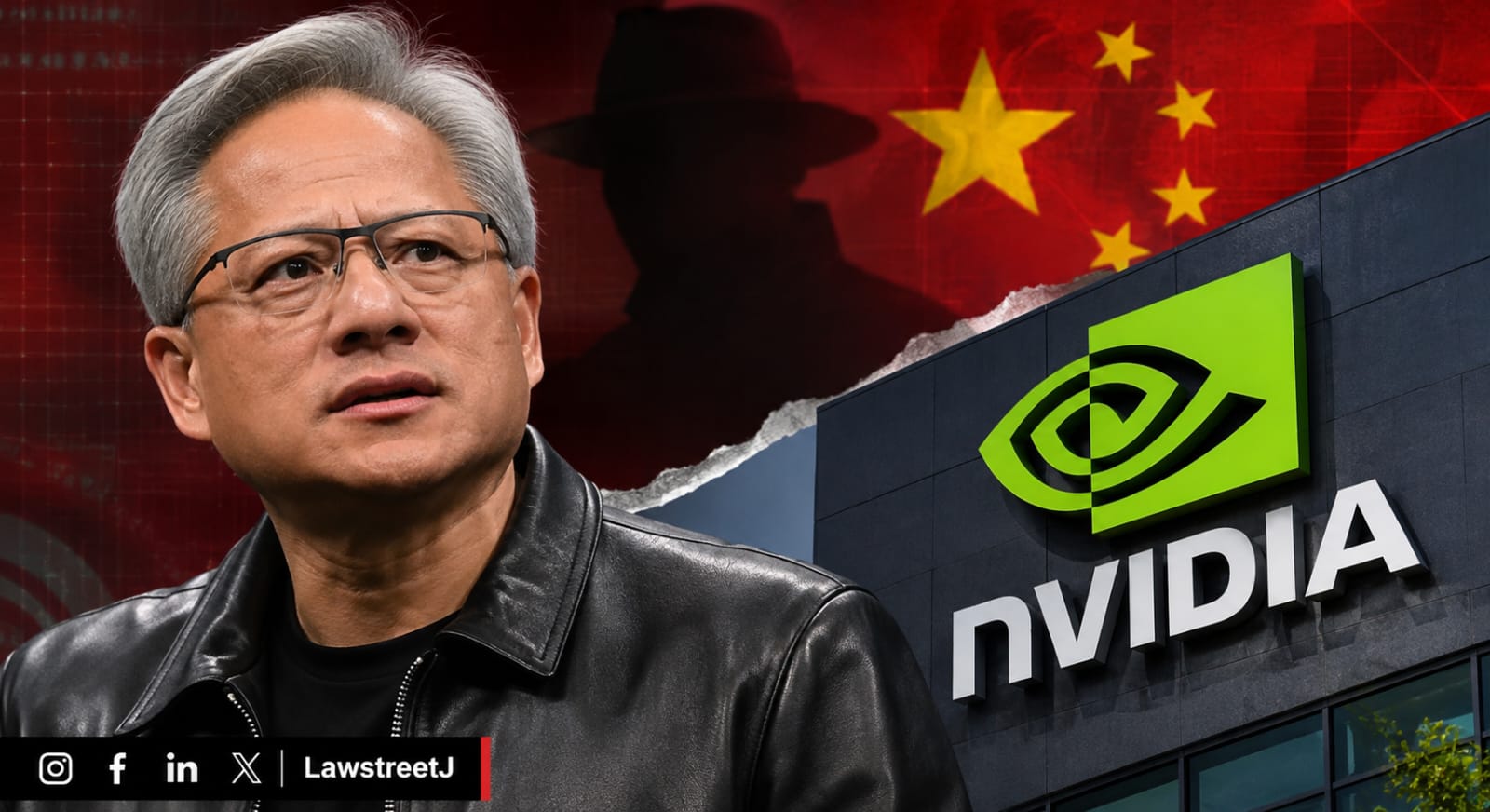
SANTA CLARA : Jensen Huang, the co-founder and longtime chief executive of Nvidia, has resigned as the company's president, CEO and board member, effective immediately, following a controversy involving reported personal relationships and allegations of a possible connection to a woman suspected by US intelligence of having links to Chinese espionage.
Nvidia announced the leadership change on November 12, confirming that Chief Financial Officer Colette Kress would serve as interim CEO while the board searches for a permanent successor. The board also appointed Harvey C. Jones as its first-ever chair.
Huang's departure marks a major leadership transition at one of the world's most influential technology companies. Nvidia's processors power much of the infrastructure used to develop and operate artificial intelligence systems, making the company's leadership and business relationships strategically important. The resignation followed reports about Huang's relationship with Alice Huang, a Chinese businesswoman suspected by US intelligence of having links to China's intelligence services. Reports of a separate relationship with a Nvidia employee also added to the controversy.
Importantly, the espionage allegations remain allegations. They have not been established as proven findings, and Nvidia's board had previously stated that it had no reason to believe that national security or company secrets had been compromised.
Colette Kress Takes Over as Interim CEO
Nvidia confirmed that Colette Kress, who has served as the company's executive vice-president and chief financial officer since September 2013, will lead the company during the transition. She will retain her finance responsibilities while serving as interim chief executive.
Kress joined Nvidia after spending nearly 25 years in finance positions at major technology companies, including Cisco and Microsoft. During her time at Nvidia, she has overseen the company's financial operations through its transformation into a global leader in artificial intelligence and accelerated computing. The board has begun searching for a permanent chief executive and will consider both internal and external candidates. It has not announced a timeline for completing the appointment.
Harvey C. Jones, who has served on Nvidia's board since 1993, has been appointed its first-ever chair. He is a technology executive and investor who previously served as chief executive and executive chairman of Synopsys.
In its announcement, Nvidia thanked Huang for his contribution to the company and the wider technology industry. Kress said she would work with the leadership team to build on the foundation established during Huang's 33-year leadership. The company also stated that its operations, customer commitments and product roadmap would continue without interruption. Its third-quarter fiscal 2027 financial results were scheduled to be announced on November 17, as previously planned.
Espionage Allegations Trigger National Security Scrutiny
The controversy intensified after reports identified Alice Huang, a Chinese businesswoman associated with Singapore-based data-centre company Megaspeed International, as the subject of suspicions involving possible Chinese intelligence connections. US intelligence officials reportedly suspected that she was gathering information for Beijing. These concerns attracted attention because Nvidia manufactures advanced semiconductor technology that is central to artificial intelligence, cloud computing and other strategically sensitive industries.
The company had already announced an independent investigation on November 8 following reports that Huang had been the target of a foreign intelligence effort. The board appointed a committee of independent directors, assisted by outside legal counsel, to oversee the inquiry.
In its November 8 statement, Nvidia said it had no reason to believe that either US national security or the company's confidential information had been compromised. It also confirmed that Huang supported the investigation and had agreed to cooperate. The controversy also involved reports of a separate relationship between Huang and a Nvidia employee. Huang reportedly apologised to his family and colleagues over his personal conduct. However, the company has not publicly established that either reported relationship resulted in the disclosure of confidential business information.
China has rejected the espionage allegations. The claims concerning Alice Huang should therefore be treated as allegations rather than established facts. The investigation has broader implications because Nvidia operates within an increasingly sensitive US-China technology relationship. Washington has imposed restrictions on exports of advanced semiconductor technology to China over concerns about its potential military and strategic applications.
The controversy has consequently raised questions about corporate security, executive conduct and the protection of sensitive technology. However, no publicly confirmed finding has established that Nvidia's technology or trade secrets were transferred to Chinese intelligence.
Nvidia Faces Leadership Uncertainty Amid AI Industry Pressure
Huang's resignation has unsettled investors because of his central role in Nvidia's growth. He co-founded the company in 1993 and led its transformation from a graphics-processing business into one of the world's most important suppliers of AI computing infrastructure.
Nvidia's graphics processing units are widely used by technology companies, cloud service providers and research organisations to train and operate advanced AI models. Demand for these processors has grown significantly as businesses increase investment in artificial intelligence. The departure of a leader so closely associated with the company's strategy has raised questions about succession and long-term management. Nvidia's board has said that Kress and the existing leadership team will maintain business operations while the search for a permanent CEO continues.
The leadership transition also comes at a sensitive time for the semiconductor industry, with companies navigating export restrictions, competition over advanced chips and rising demand for computing capacity.
According to reporting by the Associated Press, Nvidia shares fell more than 4% on November 12 following the announcement. The market reaction reflected investor uncertainty surrounding the sudden departure and its potential implications for the company. Nvidia's next quarterly financial results, scheduled for November 17, are expected to provide investors with an opportunity to assess the company's performance and hear more about its immediate priorities under Kress.
For now, the board has not named a permanent successor. The independent investigation and the leadership transition remain separate but closely watched developments as Nvidia seeks to maintain confidence among employees, customers, investors and government stakeholders.
Huang's resignation ends his 33-year tenure at the company he helped establish. The immediate challenge for Nvidia is to preserve its technological and commercial momentum while addressing the questions raised by the controversy.