WASHINGTON D.C. — The United States Department of Justice announced on Tuesday that it has secured a $3.2 million settlement with OpenAI and its subsidiary Statsig Inc. over allegations that the companies violated federal law by deliberately discouraging American workers from applying for certain jobs and instead favouring foreign nationals holding temporary employment visas. The settlement, confirmed by the DOJ's Civil Rights Division, is the largest of its kind to involve a company of OpenAI's profile and serves as a formal signal from the Trump administration that it intends to hold the technology sector accountable for misuse of the federal immigration process meant to protect American workers.
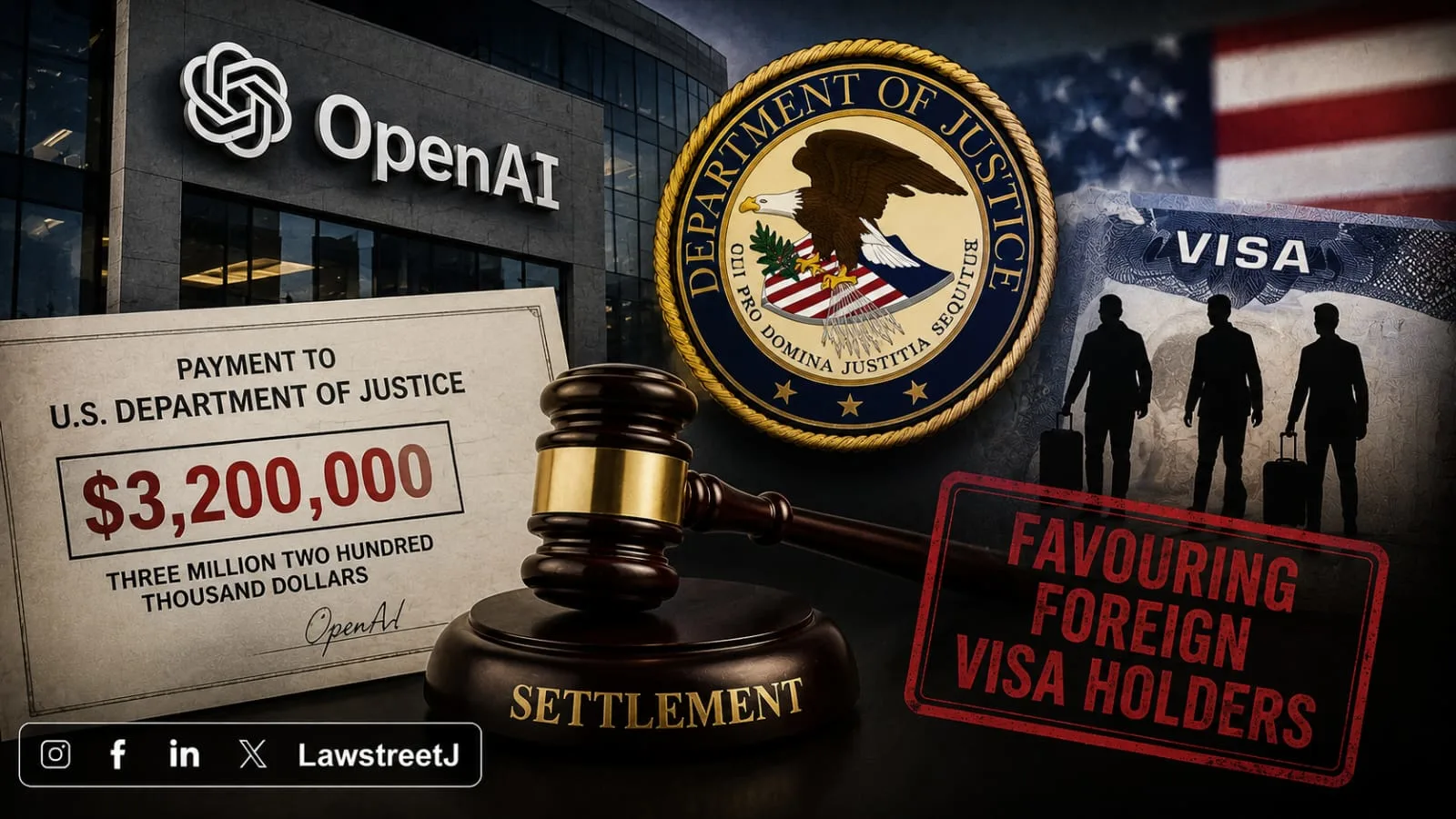
The Justice Department's Civil Rights Division announced it has secured a combined $3,200,000 settlement with OpenAI OpCo LLC, a San Francisco, California-based artificial intelligence company, and its subsidiary, Statsig Inc., a Bellevue, Washington-based software development company. The settlement addresses allegations that both companies violated the Immigration and Nationality Act by discriminating against US workers and instead preferred workers with temporary employment visas, when the companies hired and recruited during the Permanent Labor Certification process.
OpenAI denied wrongdoing as part of the settlement agreement, but agreed to pay and accepted binding obligations to reform its hiring practices under DOJ monitoring.
What OpenAI and Statsig Were Accused of Doing
The federal government's case against OpenAI rests on a specific legal obligation that applies to any company that uses the Permanent Labor Certification process, a federal programme that allows employers to sponsor foreign workers for permanent residency in the United States.
The DOJ alleges OpenAI and its subsidiary Statsig violated the Immigration and Nationality Act by favouring potential employees with temporary employment visas under a federal programme that requires companies to prioritise Americans. That programme is PERM, or the Permanent Labor Certification Process.
The PERM programme allows employers to sponsor foreign workers for permanent residency if they first make a good-faith effort to recruit qualified US workers. The central allegation is that OpenAI and Statsig did the opposite, taking active steps to ensure American workers would not find, see, or be able to respond to those job openings before they were filled with foreign nationals already holding H-1B or other temporary employment visas.
The DOJ says its investigation found that OpenAI did not advertise the roles it was planning to fill on its external jobs website. The company reportedly also required applicants to mail paper applications for those roles, even though it accepted electronic applications for others, and advertised positions on the radio late at night.
Federal investigators alleged that OpenAI failed to advertise certain PERM positions on its careers website, required applicants to mail paper applications for those jobs while accepting electronic applications for other positions, and in some cases aired radio advertisements late at night, practices the Justice Department said discouraged US workers from applying.
Each of these practices, taken individually, might appear procedural. Taken together, they present a documented pattern in which the most effective channels for reaching qualified American job applicants, online job postings, digital applications, prime-time advertising were deliberately avoided for specific positions while being used for all others.
Fewer than 10 positions were at issue, but the "resolution amount reflects the harm to US workers when they are shut out of applying for lucrative technology jobs," according to the DOJ.
The Financial Terms and What OpenAI Must Now Do
The settlement includes $1.2 million in civil penalties and $2 million to compensate alleged victims of discrimination. OpenAI also agreed to revise its employment policies, conduct training and submit to Justice Department monitoring.
The settlement requires OpenAI to post jobs on its career sites, accept electronic applications, train relevant staff and submit to DOJ monitoring and reporting.
The $2 million back-pay fund is intended to compensate US workers who the DOJ says were effectively shut out of applying for positions they were qualified to fill. The DOJ has not yet publicly detailed how eligible victims will be identified, given that the discriminatory practices in question, restricted advertising and paper-only applications, may have prevented potential applicants from ever knowing the jobs existed.
OpenAI has also agreed to post positions that are available for PERM recruitment on a public career website, to train its employees on anti-discrimination requirements and to revise its employment practices, the DOJ said.
The DOJ monitoring requirement means OpenAI's hiring practices will remain under active federal scrutiny for a defined period, ensuring that the changed policies are not simply stated on paper but implemented in practice.
The DOJ's Message to the Tech Sector
"It is illegal to discriminate against US workers by preferring temporary visa holders for jobs," DOJ Civil Rights Division Assistant Attorney General Harmeet K. Dhillon said in a statement. "This substantial settlement ensures that OpenAI redresses harm and changes its recruitment practices so that US workers receive a fair opportunity for highly sought-after technology positions."
Slapping a multimillion-dollar fine on one of the world's biggest AI companies puts the tech sector on notice that the Trump administration is cracking down on companies that game the visa system to bypass American talent.
The case is not an isolated one. Other companies have reached similar settlements with the DOJ during previous administrations. The Justice Department has announced at least a dozen settlements of this sort since last year, as several cases were opened involving alleged discrimination against US workers, mostly by tech companies. However, none of the previous cases involved companies as high-profile as OpenAI.
The settlement with OpenAI carries particular resonance because the company's chief executive, Sam Altman, has repeatedly made public statements about OpenAI's role in creating American jobs and investing in the American economy, including a high-profile pledge made at the White House earlier in 2026 about domestic data centre investment and American hiring commitments. The DOJ's action makes clear that those public commitments were not being consistently reflected in the company's internal recruitment process at the time of the investigation.
What This Means Going Forward
The settlement does not include an admission of guilt. OpenAI has denied the underlying allegations. But the financial penalty, $1.2 million directly to the US government and $2 million in compensation to workers, along with the mandatory reforms, monitoring, and training obligations, represent a binding legal outcome that will govern the company's recruitment conduct for the foreseeable future.
The INA's anti-discrimination provisions have existed for decades, but enforcement against major technology employers has historically been infrequent. The current DOJ's willingness to pursue and publicise a settlement against OpenAI, among the most closely watched companies in the world, marks a shift in how seriously federal authorities are treating visa-related hiring violations in the artificial intelligence industry.
OpenAI has not issued a public statement on the settlement beyond the DOJ's confirmation of its denial of wrongdoing.

![India reacts to US accusing Indian in foiled plot to kill Khalistan separatist [Read Unsealed Indictment]](/secure/uploads/2023/11/lj_1593_Khalistan_Row.jpg)