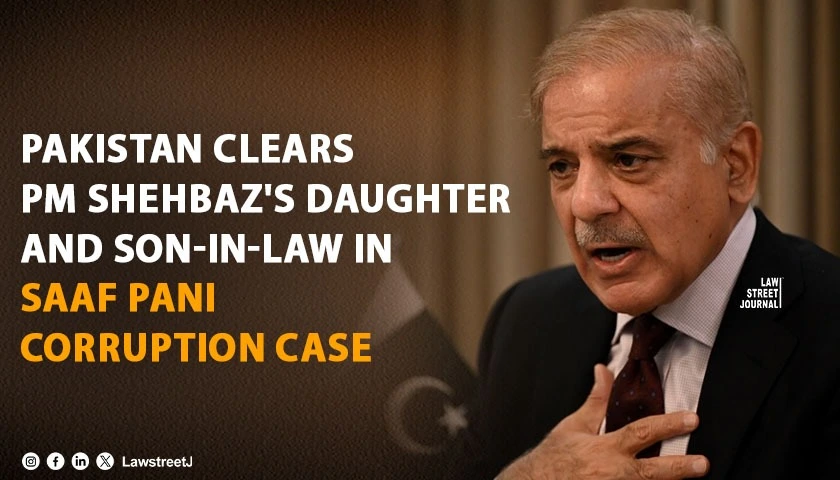
A legal chapter that had stretched across nearly a decade came to a significant close this week in Lahore, when the Anti-Corruption Establishment formally declared Rabia Imran and her husband Ali Imran Yousaf innocent in the Punjab Saaf Pani Company corruption case. A report submitted before an anti-corruption court confirmed that Rabia Imran and her husband Ali Imran Yousaf were not found involved in the case, as no evidence was available against them. The couple, daughter and son-in-law of Prime Minister Shehbaz Sharif had been entangled in the case for years, during which time they were declared absconders, had their assets frozen, and faced active warrants including red notices through Interpol.
The development came on May 5, when both accused appeared before the court and the ACE's formal innocence report was placed on record. The ACE report further noted that an accountability court had already acquitted PM Shehbaz Sharif and all other accused persons in the Saaf Pani Company case.
The Origins of the Saaf Pani Case: A Nine-Year Legal Journey
The Saaf Pani case first surfaced in 2017 when the National Accountability Bureau launched a wide-ranging probe into alleged corruption in 56 public-sector companies, including the Punjab Saaf Pani Company. Investigators cited violations of procurement rules, nepotism, inflated contracts, and project delays. The case quickly expanded to include some of the most prominent names in Pakistani politics and public administration. The reference alleged that contracts, including one awarded to KSB Pumps for installing water filtration plants, were approved at inflated costs and without proper technical sanction, causing an estimated loss of over Rs345 million to the national exchequer. Separately, NAB alleged a total loss of Rs370.5 million to the national exchequer, with water filtration plants, civil, electrical, and solar works all executed at exorbitant rates.
The specific allegations against Rabia Imran and Ali Imran Yousaf centred on their privately-owned real estate firm. NAB alleged that the former Chief Executive Officer of the Saaf Pani Company illegally approved payment of Rs24.7 million to the management of Ali and Fatima Developers (Pvt) Limited in lieu of office rent for the Saaf Pani Company, though possession of the building was never taken. Ali and Fatima Developers is a company jointly owned by the couple.
In a separate but linked matter, NAB alleged that former Punjab Power Development Company CEO Ikram Naveed confessed to giving illegal monetary benefit worth Rs132 million to Ali Imran Yousaf, having purchased three floors worth Rs132 million in the Ali Trade Centre owned by Ali Imran. Court filings had also reported that the couple owned 6.5 million and 3.5 million shares respectively in Fatima Developers, along with various other business and property interests that were frozen as part of the proceedings.
From Proclaimed Offenders to Cleared: The Legal Sequence
The road from accused to cleared was neither short nor straightforward. For several years, both Rabia Imran and Ali Imran Yousaf remained outside Pakistan, and their prolonged absence triggered formal legal consequences. NAB stated that the process under Section 87 of the Code of Criminal Procedure for declaring the suspects as absconders had been completed, as the couple failed to attend proceedings despite being given a final opportunity. The court subsequently declared them absconders and directed the investigation officer to initiate proceedings under Section 88 of the CrPC, which included confiscation of their moveable and immoveable properties.
A turning point came in late April 2026. An accountability court in Lahore suspended the perpetual arrest warrants, including Interpol red notices, after both individuals assured the court they would return and face trial. Judge Rana Muhammad Arif accepted their request and directed both to appear on May 5. The court noted in its written ruling that the warrants were originally issued in March 2021 and had remained active due to the continued absence of the accused.
Following their return, the couple appeared before multiple courts in quick succession. A special court (central) granted interim pre-arrest bail to Rabia Imran and her husband in a money laundering case, with Judge Ashfaq Ahmed restraining the Federal Investigation Agency from arresting them until May 7. In the Punjab Power Development Company reference, a special central court also granted interim bail to the couple. In the same reference, former PPDC Chief Financial Officer Ikram Naveed had previously entered into a plea bargain.
In the Saaf Pani-specific proceedings, Judge Javed Iqbal Warraich presided over the bail hearing and the court extended their interim bail while seeking a reply from the ACE.
Jurisdictional Shifts and the NAO Amendments
One of the more significant legal dimensions of this case is the institutional journey it took through Pakistan's accountability framework. The case originated under NAB and was heard by an accountability court, but legislative changes fundamentally reshaped where it ultimately landed.
The case was transferred to the anti-corruption court after the accountability court lost jurisdiction following amendments to the National Accountability Ordinance. This shift moved the matter from NAB's domain to the Anti-Corruption Establishment, a provincial anti-graft body operating under Punjab's administrative framework. It was the ACE, now the investigating body of record, that filed the final report before the anti-corruption court finding no evidence against the couple.
Several officials and executives had been arrested during the investigation phase between 2018 and 2019 as the probe expanded to include multiple departments and contractors. However, as proceedings progressed and jurisdictions changed, outcomes shifted for several of the accused. PM Shehbaz Sharif had already been acquitted prior to this latest development, and with the ACE's innocence report now formally on record, the legal standing of Rabia Imran and Ali Imran Yousaf has materially changed.
The case carries broader significance within Pakistan's ongoing accountability landscape, particularly as the country continues to examine the impact of legislative amendments on pending references, and the due process rights of individuals who faced prolonged legal proceedings spanning nearly a decade. No further hearing date had been publicly confirmed at the time of writing.