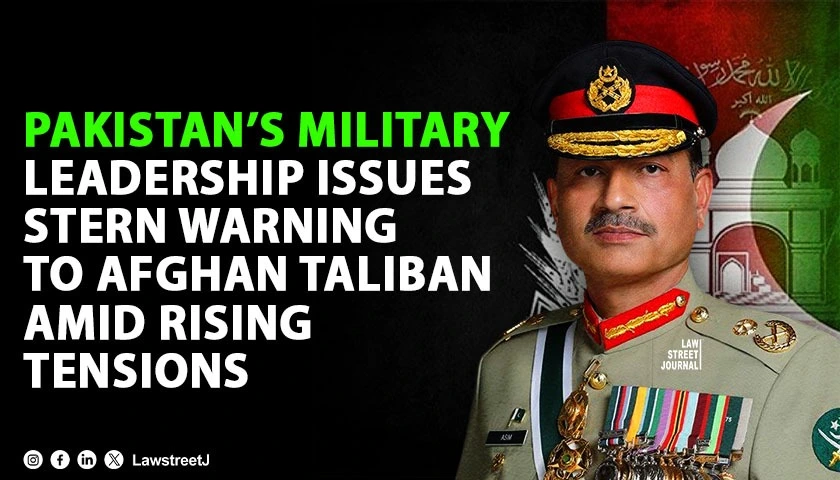
Pakistan: Field Marshal Asim Munir, Pakistan’s newly appointed Chief of Defence Forces, warned on December 8, 2025, that any aggression against Pakistan would be met with a “swift and severe” response. The declaration signals a significant recalibration of Pakistan’s defence and regional security strategy at a time of heightened tensions along the Afghan border and renewed friction with India.
Munir’s Dual Role and Defence Consolidation
On December 8, 2025, Field Marshal Syed Asim Munir was formally inducted as Pakistan’s first Chief of Defence Forces (CDF), a newly created tri-services position centralizing operational command over the Army, Navy, and Air Force. The ceremony at the General Headquarters (GHQ) in Rawalpindi marked the official commencement of Pakistan’s restructured military hierarchy.
Munir, who continues simultaneously as the Chief of Army Staff (COAS), now holds consolidated authority over Pakistan’s defence institutions. The Defence Forces Headquarters was established under the Defence Services Reorganization Act, 2025, passed by the National Assembly in October 2025. The legislation aims to strengthen inter-services coordination and enhance strategic response capabilities. His appointment was approved by the President of Pakistan under Article 243 of the Constitution, which outlines command and appointment procedures for the armed forces.
Addressing senior military officials during the ceremony, Munir stated that Pakistan remained committed to peace but would not compromise on sovereignty or territorial integrity. He emphasized that any hostile action directed at Pakistan would be met with decisive operational measures. His remarks reinforced the country’s effort to project a unified command structure and a coherent national security posture under the newly created defence framework.
A significant portion of Munir’s address was directed at the Taliban administration in Kabul. He urged Afghanistan to take a clear position on the Tehreek-e-Taliban Pakistan (TTP), a proscribed militant outfit responsible for numerous attacks in Pakistan. Munir warned that the Afghan government must choose between maintaining diplomatic relations with Pakistan or continuing its alleged support for TTP operatives believed to be sheltering within Afghan territory.
The warning comes after several months of escalating tensions, during which Pakistan repeatedly accused the Afghan Taliban of failing to curb TTP activities along the border. Pakistan has invoked the Doha Agreement of 2020, which obligates the Taliban to ensure Afghan soil is not used for operations against other states. In his remarks, Munir described TTP as “Fitna al-Khawarij,” signaling a rejection of the group’s ideological foundations and highlighting its destabilizing role within Pakistan.
From a legal standpoint, Pakistan’s position aligns with principles under the United Nations Charter. Article 2(4) prohibits the use of force against the territorial integrity of any state, while Article 51 recognizes the right to self-defence in the event of armed attacks. Analysts note that Pakistan’s emphasis on international law indicates its intent to justify any defensive action should cross-border violence persist.
Diplomatic sources indicate that Islamabad may invoke clauses from bilateral agreements, including the 2015 Border Management Protocol, to pressure Kabul into stricter enforcement measures against militant movement across the Durand Line. Backchannel communication has reportedly intensified as Pakistan seeks a firm commitment from the Afghan Taliban regarding TTP activities.
Link to India’s Operation Sindoor
Munir’s statement also comes against the backdrop of India’s Operation Sindoor, launched on May 7, 2025, in response to the Pahalgam terror attack that killed 26 civilians. The Indian operation targeted terror infrastructure inside Pakistan and Pakistan-occupied Kashmir (PoK). Pakistan’s inability to deter these strikes prompted internal reviews of defence readiness and strategic vulnerabilities.
Although Munir did not mention India directly, he alluded to regional developments by cautioning that “no country should be a victim of self-deception and assumption.” The remark is widely interpreted as a message to New Delhi and international observers monitoring South Asian security dynamics, indicating Pakistan’s intent to project a strengthened military posture following India’s cross-border actions earlier in the year.
No separate formal statement has been issued by Pakistan’s Ministry of Foreign Affairs. However, diplomatic officials confirm that Pakistan is monitoring regional developments closely and reviewing bilateral and multilateral legal frameworks, including border management agreements and counterterrorism provisions relevant to cross-border militancy and regional stability.
Field Marshal Munir’s warning to the Afghan Taliban and his indirect signaling to India reflect a decisive shift in Pakistan’s defence and regional security strategy. The consolidation of military leadership under the newly established Chief of Defence Forces marks a structural transformation under the Defence Services Reorganization Act, 2025. Pakistan’s invocation of constitutional provisions, international legal principles, and bilateral commitments indicates its intent to ground future security actions within formal legal frameworks.
As tensions continue to rise along Pakistan’s western frontier and regional dynamics evolve, the coming months will reveal whether diplomatic engagement, stronger border management, or increased military preparedness will shape South Asia’s security landscape.