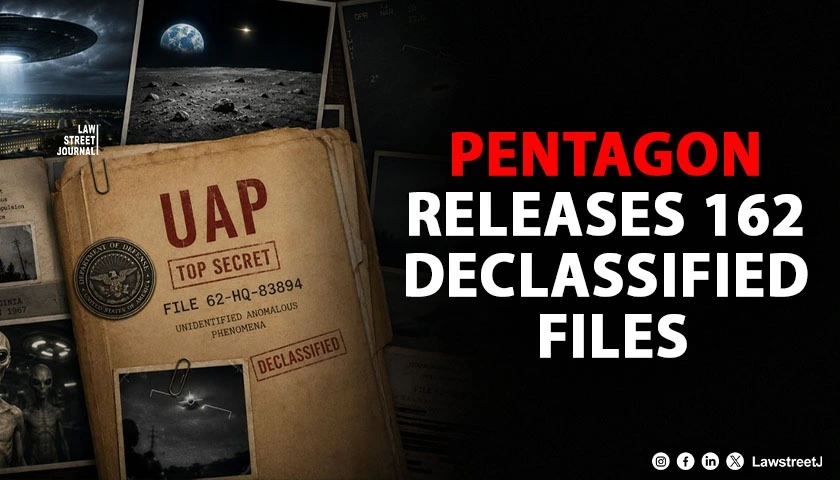
The United States Department of War announced the initial release of new, never-before-seen files on Unidentified Anomalous Phenomena on May 8, 2026, as part of a Trump administration transparency effort. The release, described by officials as the most comprehensive public disclosure of government UAP records in American history, marks a turning point in how the federal government handles decades of unresolved encounters between military personnel and unidentified objects in restricted airspace and beyond.
The United States government made its most sweeping public disclosure of UFO and UAP records in history on Friday, May 8, 2026, dropping 162 never-before-seen files at war.gov/UFO, with no security clearance required. The released records include Cold War reports of mysterious rotating saucers and recent sightings of metallic elliptical objects floating in mid-air, spanning the full modern history of U.S. government UFO investigation.
The initial release consists of 120 PDFs, 28 videos, and 14 image files drawn from the FBI, the Department of War, NASA, and the State Department. The documents make available to every American citizen, without restriction, material that had previously sat behind layers of government classification for years, and in some cases, for decades.
What the Files Contain: From Cold War Reports to Active War Zones
The documents span decades and continents. The roughly two dozen videos run for a total of 41 minutes and show reported encounters between 2020 and 2026. The footage is largely captured through infrared military systems and presents objects whose flight characteristics, in several cases, cannot be attributed to any known aerial platform. The roughly two dozen videos, which run for a total of 41 minutes, show reported encounters around the world between 2020 and 2026. Most show footage from an infrared camera tracking a white object that appears as a speck on the screen moving through the air. The report that accompanied a video taken in Greece in 2023 said the object was making multiple "90-degree turns" at approximately 80 miles per hour. One of the videos shows an object described as resembling a football in the Indo-Pacific and another from Syria shows two semi-transparent, irregularly shaped orange areas that each appear for two seconds.
Among the more historically significant portions of the release are materials linked to NASA's Apollo program. Among the files in the newly unsealed trove are incidents from the Apollo 11, Apollo 12 and Apollo 17 moon missions. In a 1969 debriefing after the Apollo 11 flight, astronaut Buzz Aldrin reported seeing "little flashes inside the cabin, spaced a couple of minutes apart," while trying to fall asleep. In another incident, Aldrin described seeing "what appeared to be a fairly bright light source which we tentatively ascribed to a possible laser." During Apollo 12 in 1969, astronaut Alan Bean reported "flashes of light" that he described as "sailing off into space." Another document says Apollo 17 astronaut Jack Schmitt reported seeing "a flash on the lunar surface north of Grimaldi crater."
The files also cover active military theaters. The files include internal military memos describing "one possible small UAP" in Iraq in 2022, as well as "multiple glares or light from an unknown origin" observed in Syria in 2024. U.S. troops were stationed in Iraq and Syria during that time as part of ongoing operations against ISIS. There are also recent reports from U.S. troops in the United Arab Emirates and Greece. A large share of the alleged encounters date back to the 1950s and 1960s, particularly in Cold War-era hotspots like Germany and the Soviet Union, according to the documents. More recent reports are concentrated in the Middle East, including around the Strait of Hormuz, Iraq and Syria,, where the U.S. has maintained a substantial military presence and some of its most sophisticated monitoring capabilities.
One of the more striking recent accounts involves a western U.S. encounter. A notable encounter took place over the course of two days in the western U.S. in 2023. In that incident, federal law enforcement officers independently reported strange incidents involving orbs, with one reporting "orbs launching other orbs." The Pentagon calls this "among the most compelling" of the reports it holds.
Regarding threat assessment, the Pentagon's position is measured. The documents don't suggest any wide-ranging government cover-up of extraterrestrial encounters. The files show no indication that the U.S. government has had any interaction with beings from other planets or that it has any reason to believe such beings have visited Earth. The Pentagon website where the new documents were posted contains a disclaimer saying that the "descriptive and estimative language" in these military memos reflect the "subjective interpretation" of the person who wrote the report and therefore "should not be interpreted as a conclusive indication" of what actually happened.
The Legal and Institutional Framework Behind the Release
The release did not happen in a vacuum. It is anchored in a formal legal and institutional structure that has been years in the making.
The All-domain Anomaly Resolution Office (AARO) was formally established in July 2022 as the U.S. government's central authority for investigating UAP reports. Housed within the Department of Defense, AARO coordinates efforts across the DoD and the Intelligence Community. Its primary mission is to minimize technical and intelligence surprise by identifying, attributing, and mitigating UAP appearing near military installations or in special use airspace. The office's scope covers anomalous, unidentified objects in the air, sea, space, and transmedium environments.
The James M. Inhofe National Defense Authorization Act for Fiscal Year 2023 codified UAP reporting procedures, creating a secure channel for current and former government employees to provide classified or sensitive information related to UAP programs. The law protects individuals making these disclosures from retaliation. Additionally, postponed records must be periodically reviewed for declassification, with mandated public disclosure occurring no later than 25 years after creation. Congress must also be informed within 15 days of any decision to postpone a UAP record disclosure.
The current release operates under a dedicated interagency program. PURSUE, the Presidential Unsealing and Reporting System for UAP Encounters is coordinated across the White House, the Office of the Director of National Intelligence, the Department of Energy, the Department of War's All-Domain Anomaly Resolution Office, NASA, the FBI, and components of other intelligence agencies. The UAP Disclosure provisions created a unique legal mechanism: they mandate the automatic transfer of legacy UAP records directly to the National Archives and Records Administration, effectively limiting the Pentagon's role as the final gatekeeper over such materials.
In Congress, H.R. 1187 of the 119th Congress, the UAP Transparency Act directs the President to require the head of each federal department or agency in possession of documents, reports, or other records relating to unidentified anomalous phenomena to declassify and make available on a publicly available website all such documents, reports, or records, not later than 270 days after the date of enactment. The bill also requires quarterly progress reports to the House Committee on Oversight and Accountability and the Senate Committee on Homeland Security and Governmental Affairs.
Scope of the Program and What Comes Next
Director of National Intelligence Tulsi Gabbard confirmed that Friday's action "is the first in what will be an ongoing joint declassification and release effort." The Defense Department said it will be "releasing new materials on a rolling basis as they are discovered and declassified, with tranches posted every few weeks." Some of the materials were previously released by the FBI, but the versions made public Friday had fewer redactions. A large FBI file containing hundreds of pages describing "eyewitness testimonies and public reports" about UFOs between 1947 and 1968 was among the documents with reduced redactions.
Two-thirds of the documents in the current release are partially redacted. The government has not provided a timeline for when the remaining classified portions of those documents will be made fully public, though the stated policy is that new tranches will be added every few weeks as the declassification process proceeds. NASA Administrator Jared Isaacman applauded the effort, stating: "We will remain candid about what we know to be true, what we have yet to understand, and all that remains to be discovered."
The establishment of war.gov/UFO as a centralized, publicly accessible portal represents the first time in U.S. history that a dedicated government website has been launched exclusively to house UAP-related records, accessible to any member of the public without any registration, clearance, or formal request process. Defense Secretary Pete Hegseth, in an official statement, said: "These files, hidden behind classifications, have long fueled justified speculation and it's time the American people see it for themselves."
Whether the documents raise more questions than they answer remains, for now, an open matter. The government has been explicit that what has been released represents only the first batch of what is expected to be an ongoing, multi-year declassification effort, one with legal obligations, institutional oversight, and an established public-facing infrastructure to support it.

![India reacts to US accusing Indian in foiled plot to kill Khalistan separatist [Read Unsealed Indictment]](/secure/uploads/2023/11/lj_1593_Khalistan_Row.jpg)