New Delhi / Washington — In a two-track news development spanning India's diplomatic posture abroad and the US response to criticism of India's domestic handling of protests, US Secretary of State Marco Rubio has declined to comment on demonstrations in Delhi against India's Election Commission, dismissing the term "UN experts" as an "oxymoron," while separately, India's government issued an advisory for Indian nationals in France amid that country's ongoing wave of violent unrest.
Rubio's Remarks on the Delhi Protests
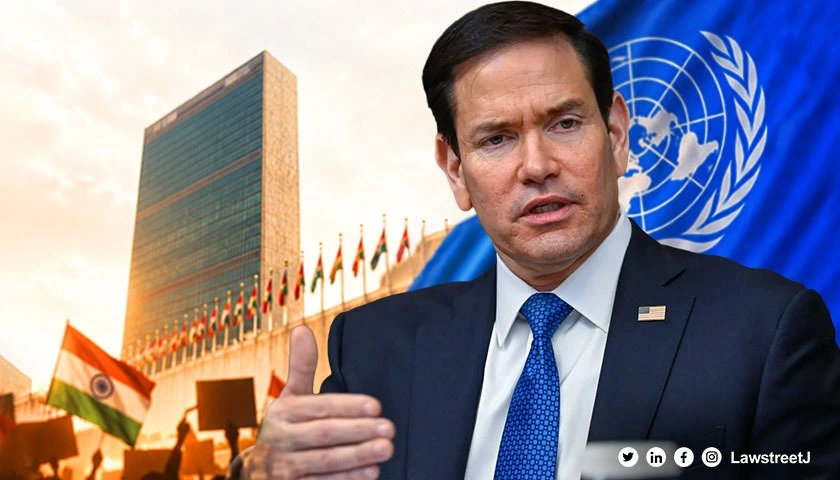
Speaking to reporters on Wednesday, October 21, 2026, before departing for Jamnagar, US Secretary of State Marco Rubio was asked about the protests by opposition parties and students in India demanding the resignation of Chief Election Commissioner Gyanesh Kumar, as well as allegations that Indian authorities had used excessive force against demonstrators. Rubio responded: "It's a domestic political matter. They have elections here, so I'm not going to opine on their domestic political matters. We have protests every day in the United States."
Asked separately about criticism levelled by United Nations human rights experts against India's handling of the protests, Rubio said: "The UN experts, my favourite. The UN experts are the oxymoron." He went on to distinguish peaceful protests, which he characterised as a normal part of democratic political discourse, from violent unrest involving vandalism and destruction of property.
Rubio's remarks came a day after more than 20 UN human rights experts had issued a statement urging Indian authorities to respect, protect and fulfil the right to peaceful protest, and to ensure accountability for human rights violations they said were reported during the recent and earlier rounds of demonstrations in Delhi. India's government had already rejected the UN experts' criticism prior to Rubio's comments, describing the allegations as unverified and based on incomplete statistics.
The demonstrations in question were organised by the Cockroach Janta Party (CJP), led by Abhijeet Dipke, along with opposition parties, centred on demands for the resignation of Chief Election Commissioner Gyanesh Kumar over objections to the Special Intensive Revision of India's electoral rolls.
The protests, which have continued intermittently in Delhi since September 2026, have previously drawn statements of concern from the UN Human Rights Office (OHCHR), to which India's government has repeatedly responded by characterising such international commentary as "unwarranted interference" in India's internal affairs, a position broadly consistent with Rubio's own characterisation of the matter as domestic in nature.
India's Advisory for Nationals in France
Separately, India's Embassy in Paris has issued an advisory for Indian nationals in France as the country continues to experience its most serious wave of civil unrest in years. The embassy's advisory recommends that Indian nationals take care of their valuables in crowded places such as metro and railway stations, airports and tourist destinations, and advises Indians travelling to, studying in, or living in France to save relevant embassy emergency contact numbers in advance.
The advisory clarifies that Indian tourists need not necessarily cancel planned trips to France on account of the unrest, but should remain alert and informed. For Indian nationals who lose their passport while in France, the embassy has stated it can provide consular assistance and issue an Emergency Certificate for eligible travellers seeking to return to India.
India's advisory follows a pattern seen among several other countries in response to the French unrest. Italy asked its citizens in France to register their presence through a government website or app to enable location tracking if needed, and advised them to avoid large crowds. Germany's foreign ministry warned that further riots in the coming days could not be ruled out and urged German nationals to follow local police instructions. The Czech Republic, Poland, Denmark, Sweden, Finland and the Netherlands have issued broadly similar advisories urging their citizens to avoid demonstrations and public gatherings while in France.
The French unrest, which began in mid-September 2026 over school staffing shortages before broadening into nationwide protests over the cost of living, escalated into serious rioting over the weekend of October 17-18, 2026.
Demonstrations that drew hundreds of thousands of participants degenerated into looting and arson in several cities, including the torching of a town hall, leaving one police officer and one protester dead and resulting in nearly 2,400 arrests, according to figures reported at the time. President Emmanuel Macron subsequently acknowledged an intelligence failure in anticipating the scale of the violence and vowed to hold accountable those he said had "sought to bring down the Republic."