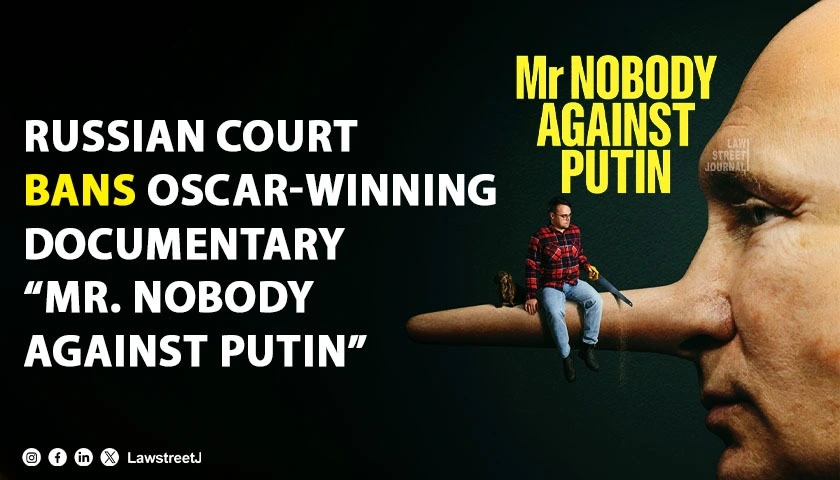
Russia: A Russian regional court has officially banned the Oscar-winning documentary “Mr. Nobody Against Putin,” ruling that the film violates national laws relating to extremism, terrorism propaganda, and child protection. The decision, delivered by the Central District Court of Chelyabinsk, has triggered global debate over censorship, freedom of expression, and Russia’s compliance with international human rights obligations.
The Film’s Origins and Global Recognition:
Directed by Pavel Talankin and co-directed by David Borenstein, “Mr. Nobody Against Putin” documents two years of secretly recorded footage inside a school in Russia’s Chelyabinsk region. The recordings, captured by a school videographer, reveal children being exposed to pro-war lessons and patriotic indoctrination following Russia’s invasion of Ukraine in February 2022. The footage was smuggled out of Russia and later compiled into a documentary that resonated internationally for its human-centered portrayal of indoctrination during wartime. The film won the Academy Award for Best Documentary Feature at the 98th Oscars in March 2026, cementing its place as one of the most significant cultural works of the decade.
International audiences praised the documentary for its courage and authenticity. However, Russian authorities quickly labeled it hostile to the state, claiming that it damaged the government’s image and undermined national security.
Legal Grounds for the Ban:
On March 26, 2026, prosecutors filed an administrative lawsuit against the documentary, arguing that it violated multiple provisions of Russian law. The court ruling cited the following grounds:
- Extremist symbolism and terrorism propaganda: Authorities claimed that the film promoted extremist attitudes and undermined state security, invoking the Federal Law on Countering Extremist Activity (2002).
- Unauthorized use of minors’ images: The Kremlin-appointed Human Rights Council argued that children were filmed without parental consent, violating the Law on Protecting Children from Harmful Information (2010).
- Negative portrayal of the government and military operations: Prosecutors alleged that the film fostered hostility toward the state and its “special military operation” in Ukraine.
The court classified the documentary as extremist material, placing it under Russia’s Federal List of Extremist Materials. This designation prohibits distribution and subjects violators to administrative or criminal penalties. From a legal standpoint, the ruling demonstrates how Russian courts combine child protection statutes with national security laws to justify censorship. While the unauthorized filming of minors is a legitimate legal issue, its framing alongside charges of terrorism propaganda amplifies the severity of the ruling.
Censorship and Media Control:
The ban reflects a broader trend of tightening censorship in Russia. Since the start of the war in Ukraine, Russian authorities have expanded the definition of extremism to include criticism of the government, military operations, and state institutions. Independent media outlets have faced closures, journalists have been prosecuted under “fake news” laws, and cultural works deemed critical of the state have been restricted. The banning of “Mr. Nobody Against Putin” fits within this pattern, reinforcing the government’s control over narratives related to the war and domestic policy.
Legal experts note that the ruling illustrates the elastic interpretation of extremism laws, which can be applied to a wide range of content, from political speeches to artistic works. This flexibility allows authorities to suppress dissent while maintaining a veneer of legality.
International Reaction and Human Rights Concerns:
The ban has drawn condemnation from international human rights organizations, cultural institutions, and legal scholars. Critics argue that the ruling violates Russia’s obligations under the International Covenant on Civil and Political Rights (ICCPR), which guarantees freedom of expression. Several European cultural institutions have expressed solidarity with Talankin and Borenstein, emphasizing the importance of protecting artistic freedom. The Academy of Motion Picture Arts and Sciences has not yet issued an official statement, but the controversy has intensified debates about the role of documentary filmmaking in exposing systemic abuses.
Human rights organizations, including Amnesty International and Human Rights Watch, have highlighted the case as evidence of Russia’s increasing use of legal mechanisms to silence dissent. They argue that the combination of child protection laws and extremism statutes creates a chilling effect on independent filmmakers and journalists. From a legal perspective, the case raises complex questions about the balance between child protection and freedom of expression. The unauthorized filming of minors without parental consent is a legitimate concern under Russian law. However, the classification of the documentary as extremist material extends beyond child protection, framing the film as a threat to national security.
This dual framing underscores how Russian courts often combine different legal provisions to justify censorship. By invoking both child protection and extremism laws, authorities strengthen their case while limiting avenues for appeal. International legal experts argue that while child protection is a valid legal principle, its use in this context appears disproportionate. The film’s primary focus is on exposing systemic propaganda, not exploiting minors. As such, the ruling raises questions about proportionality and the misuse of legal frameworks to suppress dissent.
Cultural and Political Implications:
The banning of “Mr. Nobody Against Putin” has significant cultural and political implications. Domestically, it reinforces the government’s control over narratives related to the war and its broader political agenda. Internationally, it highlights the risks faced by filmmakers and journalists working in authoritarian contexts. The case also underscores the role of documentary filmmaking in shaping global perceptions of political regimes. By exposing systemic abuses, documentaries can challenge official narratives and mobilize international support. However, such works also face heightened risks of censorship and legal retaliation.
The banning of “Mr. Nobody Against Putin” represents a pivotal moment in Russia’s cultural and legal landscape. While authorities justify the ruling on grounds of extremism and child protection, international observers view it as part of a broader crackdown on dissenting voices. The case illustrates the intersection of law, politics, and human rights, raising urgent questions about the future of independent filmmaking in Russia and the global implications of censorship in authoritarian regimes. As the international community continues to debate the ruling, the documentary’s legacy as a symbol of resistance and artistic courage remains intact.