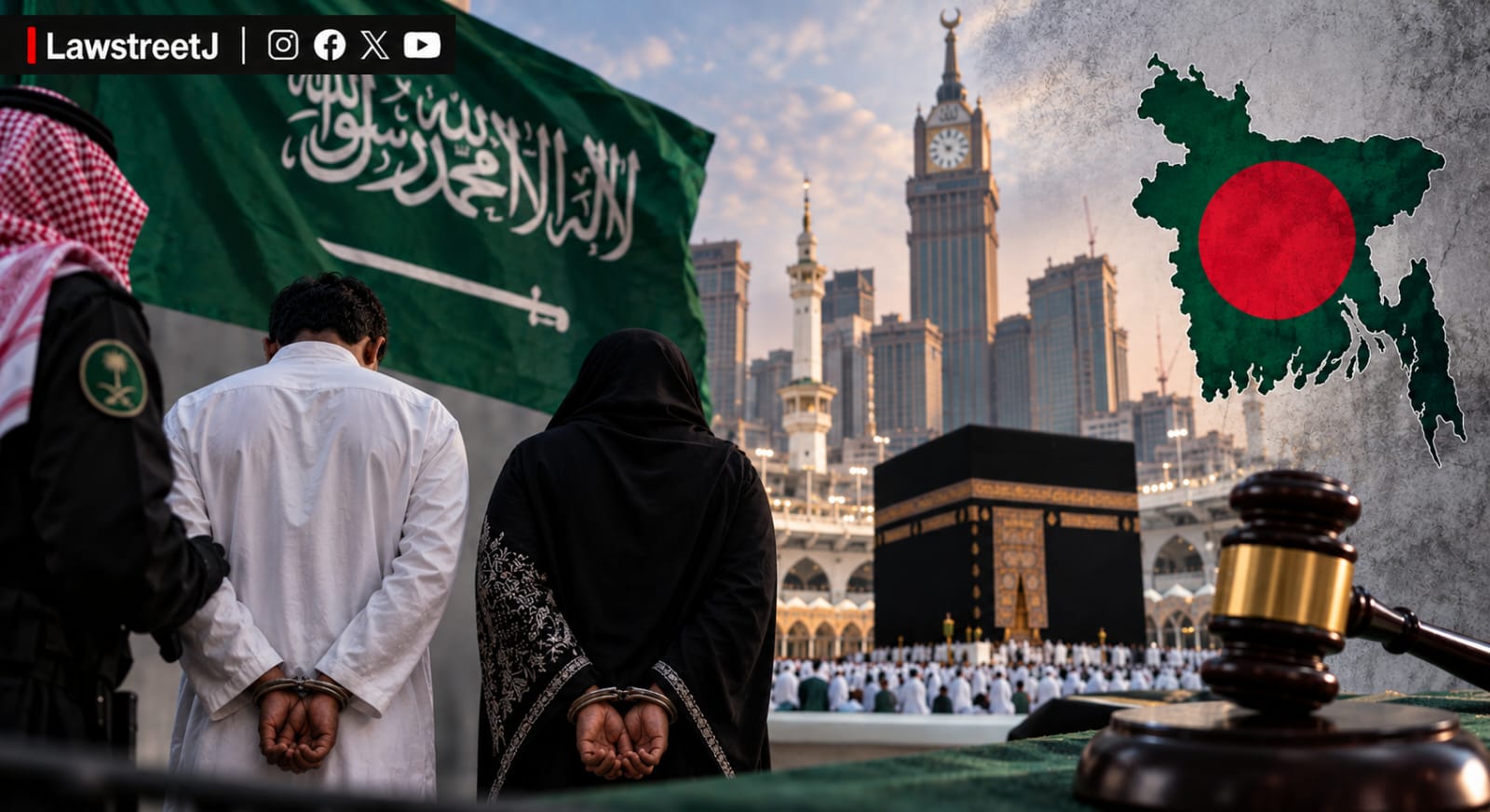
Mecca / Dhaka — Saudi Arabia executed two Bangladeshi nationals, identified as Nazrul Islam Abdul Basir and Siti Akhtar, in the Mecca region on October 14, 2026, after a court convicted them of an "immoral" or "indecent" act inside a mosque. The case has gone viral internationally, with widely circulated social media claims describing the pair as honeymooning newlyweds executed over a forehead kiss, a narrative that remains unverified and is directly contradicted by at least one family member's account. This report separates the confirmed official record from the unverified viral claims.
What Is Officially Confirmed
Saudi Arabia's Ministry of Interior, in a statement carried by the state-run Saudi Press Agency, confirmed that Nazrul Islam Abdul Basir and Siti Akhtar were executed in the Makkah region on October 14, 2026. According to the ministry, security authorities apprehended the pair following an incident inside a mosque, after which an investigation was conducted and charges were filed before a competent court. The court found them guilty and sentenced them to death, citing the seriousness of the offence and the violation of the sanctity of the time and place in which it occurred. The death sentences were imposed under ta'zir, a category of discretionary punishment under Islamic law applied at a judge's determination rather than through a fixed scriptural penalty, and the ministry stated the judgment became final after review by the competent appellate authority. The ministry's statement did not specify the exact nature of the act, describing it only as "indecent" or "immoral."
Bangladesh's government has stated it was not notified of the executions in advance. The Bangladesh Consulate General in Jeddah said it had not been informed beforehand and submitted a formal note verbale to the Saudi Ministry of Foreign Affairs requesting acknowledgement of the matter and further case details. Reports indicate Bangladesh's government has since summoned the Saudi ambassador over the matter.
What Remains Unverified or Disputed
The widely shared claim that the pair were newlyweds on their honeymoon, and that the "immoral act" consisted specifically of a kiss on the forehead expressing gratitude for their marriage, originates from social media posts and reports circulating in Bangladesh rather than from any official Saudi or Bangladeshi government statement. Multiple outlets reporting on the case, explicitly note that it has not been confirmed whether the two were married to each other, and that Saudi authorities have not publicly specified the nature of the act.
Further complicating the "newlywed honeymoon" narrative, one widely circulated account states that Nazrul's own father confirmed the two were not married, and that his son had travelled to Saudi Arabia as a migrant worker in 2022, roughly four years before the executions, rather than as part of a recent honeymoon trip. Separate reporting has noted allegations from Nazrul's family that a Pakistani co-worker had conspired against him, a claim that has not been independently substantiated. Some social media accounts additionally claimed the couple had an eight-year-old daughter and were performing Hajj at the time, claims explicitly flagged as false by other users tracking the story's spread online, and which do not appear in any verified official source reviewed for this report.
Given these significant, unresolved contradictions, including conflicting accounts of whether the two were even married, the specific "forehead kiss while on honeymoon" framing should be treated as an unverified viral narrative rather than an established fact, pending clarification from Saudi or Bangladeshi authorities on the specific nature of the offence and the relationship between the two individuals.
Legal Context
Saudi Arabia's legal system is based on Sharia law, under which offences and punishments fall into three broad categories: hudud (crimes with fixed punishments specified in Islamic scripture), qisas (retribution-based offences, primarily murder and bodily harm, where punishment or compensation may be determined by the victim's family), and ta'zir, the category invoked in this case, which covers offences not assigned a fixed punishment under hudud or qisas and allows judges discretion in determining an appropriate penalty based on the circumstances of the case, including, in cases a court deems sufficiently grave, the death penalty.
Offences related to indecency or violations of the sanctity of a mosque, particularly within the Grand Mosque precincts in Mecca, Islam's holiest site, are treated with particular severity under Saudi law given the site's religious significance.
Saudi Arabia does not require diplomatic notification to a foreign national's home country before carrying out an execution, though many countries, including Bangladesh in this case, have separately sought such notification and case details as a matter of consular practice and diplomatic relations, rather than a binding legal requirement under international law. The 1963 Vienna Convention on Consular Relations provides that a receiving state should, without delay, inform a foreign national's consular post of their arrest or detention if the individual so requests, and should facilitate consular access, though enforcement and compliance with these provisions vary significantly in practice across countries, including in capital cases.
Bangladesh is one of the largest sources of foreign migrant labour in Saudi Arabia, with reports estimating over three million Bangladeshi nationals living and working in the kingdom. The case has prompted widespread discussion in Bangladesh and online more broadly regarding Saudi Arabia's strict enforcement of religious and moral laws, particularly as applied to foreign migrant workers, a population that includes a substantial number of Bangladeshi labourers working in construction, services and other sectors across the country.