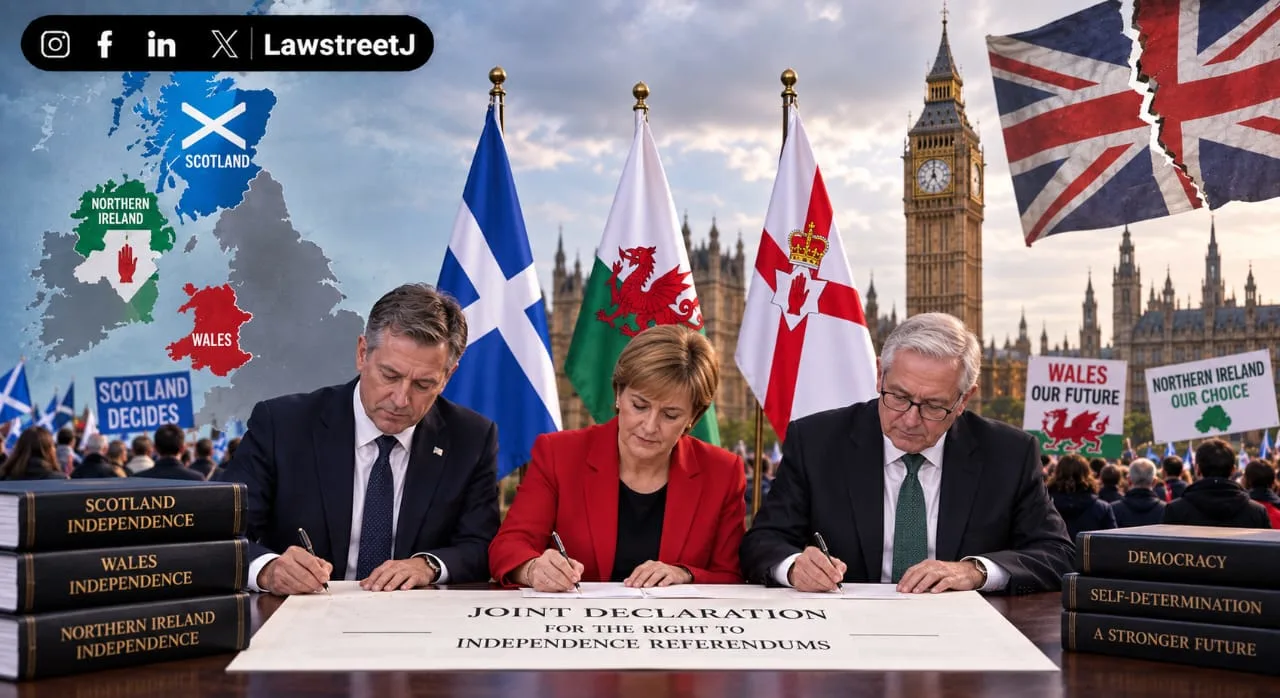
CARDIFF, WALES - The leaders of Scotland's SNP, Wales's Plaid Cymru and Northern Ireland's Sinn Féin signed a joint memorandum of understanding in Cardiff on Monday, September 14, 2026, aimed at pressuring the UK government to allow constitutional referendums in their respective nations. SNP leader John Swinney, Plaid Cymru leader Rhun ap Iorwerth, and Sinn Féin vice president Michelle O'Neill met at the St David's Hotel overlooking Cardiff Bay, with Sinn Féin president Mary Lou McDonald also in attendance for what several UK outlets, including ITV News, described as a landmark moment for devolved politics.
What the Pact Actually Says
The declaration calls on UK Prime Minister Andy Burnham's government to "prepare, plan and facilitate constitutional change" in Scotland, Wales and Northern Ireland, and it asserts each nation's right to self-determination, including the right to hold independence referendums. It does not declare independence, and it does not unilaterally end Westminster's authority. Nothing in the agreement carries legal force over the UK Parliament, it is, in substance, a coordinated political demand rather than a binding constitutional instrument.
Beyond the headline demand for referendums, the agreement also sets out areas of practical cooperation between the three parties, covering the economy, energy policy, and international affairs.
On the question of Europe, the pact does set out a genuine long-term vision. Scotland and Wales would seek to join the European Union as new member states in the event of independence, while Northern Ireland's path to EU membership would run not through separate accession but through unification with the Republic of Ireland, which is already an EU member state. This detail reflects the distinct constitutional paths each nation would realistically follow, shaped heavily by Northern Ireland's unique position under the Good Friday Agreement.
Why Now: A Political Flip-Flop From Downing Street
The timing of the Cardiff meeting traces directly back to a fumbled moment in Westminster the week before. Prime Minister Andy Burnham told the House of Commons that another Scottish independence referendum could be considered if there was a "clear consensus" for one north of the border, language that briefly raised hopes among independence supporters that the UK government's long-standing opposition to a second vote might be softening. Within days, however, a letter sent to Swinney clarified that a referendum remained "off limits," a reversal that reportedly angered the independence-aligned parties and directly provided the impetus for the Cardiff summit.
Burnham's government had already ruled out a referendum before the three leaders ever met in Cardiff. The pact was, in effect, a response to that rejection rather than a proposal that was subsequently shot down.
It is also worth noting that this is not the first time such tensions have surfaced. Successive UK governments have consistently opposed further independence referendums since the original 2014 Scottish vote, a position that has held regardless of which party has occupied Downing Street. Burnham's predecessor, Keir Starmer, held a similarly firm line during his time in office, and the current friction fits into a longer pattern of devolved leaders pushing against a consistently resistant central government.
Historic, But For a Specific Reason
What makes this moment genuinely notable, is that it marks the first time in the history of devolution that Scotland, Wales and Northern Ireland have simultaneously been led by pro-independence or pro-unification first ministers. This alignment followed a wave of nationalist results in this year's devolved elections, including Plaid Cymru's historic victory in the Senedd election in May, which ap Iorwerth said gave his party "a clear mandate to do things differently."
Swinney used notably strong language at the summit, describing the moment as a "pivotal moment of constitutional change" and suggesting Burnham "must now be facing up to the idea that he will go down in history as the final prime minister of the United Kingdom." A source close to Sinn Féin framed the Cardiff meeting in similarly assertive terms, telling the Press Association that "the constitutional future belongs to the people of this island," and that the Good Friday Agreement already provides the democratic mechanism through which that choice should be prepared for.
Ap Iorwerth was notably more measured than his counterparts, describing the meeting instead as an opportunity to discuss how the three parties "can work together". He noted that "across these islands, we are seeing a new political landscape emerge, with a growing recognition that the Westminster model is no longer working," language that reads as considerably more cautious than Swinney's prediction of the UK's dissolution.

.webp)
![UK High Court Rejects Nirav Modi’s Application to Reopen Extradition Appeal; Holds Government of India’s Assurances Against Interrogation Comprehensive, Detailed and Reliable [Read Judgment]](/secure/uploads/2026/03/lj_7964_UK_High_Court_Rejects.webp)