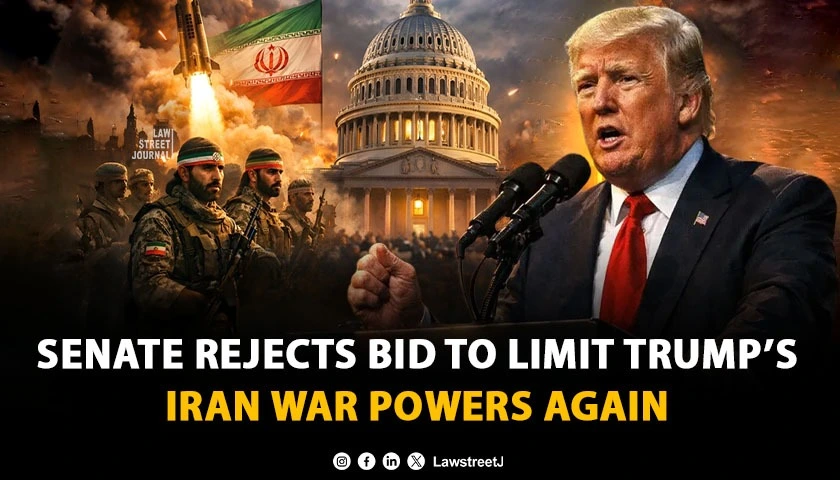
The United States Senate on Wednesday rejected, for the fourth consecutive time, a war powers resolution that would have directed President Donald Trump to withdraw American armed forces from hostilities in Iran without explicit congressional authorization. The measure failed on a 47-52 vote, largely along party lines, with all Republicans except Senator Rand Paul of Kentucky voting against it, while all Democrats except Senator John Fetterman of Pennsylvania supported it. The outcome leaves the President's authority over the ongoing conflict effectively unchecked, at least for now, as a legally significant deadline draws near.
The vote Wednesday came as the conflict stretched into its seventh week, with a two-week ceasefire nearing expiration. It was the first such vote since Congress returned from a two-week recess.
The Resolution and Its Legal Foundation
The resolution, led by Senator Tammy Duckworth of Illinois, a former Army helicopter pilot who lost both her legs during combat in the Iraq War, directed the President to remove United States Armed Forces from hostilities within or against Iran, unless explicitly authorized by a declaration of war or a specific authorization for use of military force. The resolution draws its legal basis from one of the most consequential statutes in American constitutional history. The War Powers Resolution of 1973, enacted by Congress over President Nixon's veto, requires that in the absence of congressional authorization for the use of military force, a president must report to Congress within 48 hours after introducing military forces into hostilities and must end the use of such forces within 60 days unless Congress permits otherwise. The Resolution also requires the president to consult with Congress before introducing the military into imminent hostilities.
Supporters of the resolution have maintained that Trump acted outside of constitutional authority in launching the war alongside Israel on February 28. The U.S. Constitution reserves the power to declare war to Congress, with presidents only permitted to unilaterally launch operations in instances of immediate self-defense. The Trump administration has offered several explanations for initiating military action, including arguing that the totality of Iran's actions since the Islamic Revolution in 1979 provided sufficient legal justification. The administration has also alternately described the conflict as a "military operation" or an "incursion" rather than a war, a distinction Democrats and legal scholars have largely rejected as inconsistent with the statutory language of the War Powers Resolution.
The Critical 60-Day Deadline
While Wednesday's vote ended in familiar fashion, the legal and political landscape surrounding the conflict is shifting considerably. Under the War Powers Act of 1973, presidents must terminate military operations after 60 days unless Congress has voted to declare war or passed legislation to authorize the use of force. The U.S. military campaign, which began on February 28, will reach the 60-day mark on April 29, but Trump has until May 1 to seek congressional approval since he formally notified Congress of the strikes on March 2, when the 60-day clock is triggered. Under the 1973 War Powers Resolution, the President must withdraw forces from military conflicts within 60 days if there is no congressional authorization for the war. That period can be extended to 90 days if more time is needed to safely complete a withdrawal.
Many lawmakers in both parties have pointed to May 1 as both a legal inflection point and a moment of reckoning for the legislative branch, when Congress can either end the war or give it a stamp of approval to continue indefinitely. This approaching date is rapidly becoming a defining issue for a Republican Party that has broadly backed the President's posture on Iran but is increasingly uneasy about the prospect of an open-ended engagement.
The estimated cost of the war so far has been placed at nearly $30 billion, according to the Center for Strategic and International Studies. The Washington Post has reported that the administration is expected to request between $80 billion and $100 billion in supplemental war funding from Congress.
Cracks in Republican Unity
Though most Senate Republicans continued to stand with President Trump on Wednesday, signals of fracture within the party are becoming more audible. Senator Thom Tillis of North Carolina stated: "We've got to start answering questions. The 60-day target is what I'm looking at." Senator John Curtis of Utah, typically a reliable vote for the President's agenda, published a piece stating he would not support ongoing military action beyond the 60-day window without congressional approval. Senator Susan Collins of Maine said she would not vote for ground troops or to extend the conflict past 60 days "unless there is a dramatic change," and further stated that congressional authorization would be completely required under the War Powers Act if the President commits ground troops to Iran.
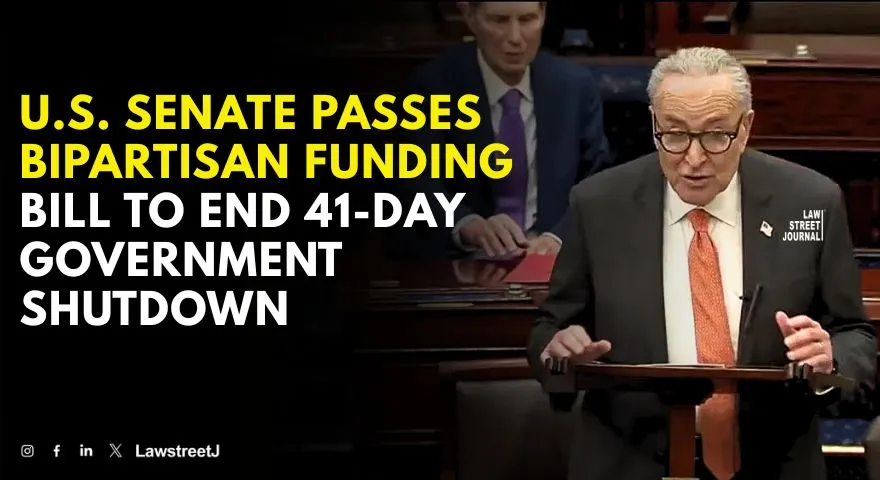
Senator Josh Hawley of Missouri, who had backed a Venezuela war powers resolution earlier this year before reversing course, told reporters: "There's the 60-day shot clock, so to speak, that we're currently in the midst of, and I think that we can revisit this once we get to that point and see where we are." Senator Roger Wicker of Mississippi, the Republican chairman of the Senate Armed Services Committee, said the panel will likely hold a hearing on the conflict in May. Democrats, meanwhile, have shown no sign of easing their legislative pressure. Senate Minority Leader Chuck Schumer stated that Democrats have filed approximately ten more war powers resolutions, in addition to several that have not yet been called up, and vowed to bring them to the floor every week until the conflict ends or Congress formally authorizes it.
On the diplomatic front, the United States and Iran are in a fragile ceasefire set to expire April 22. Even amid the ceasefire, the U.S. Navy is blockading Iranian ports, and Pakistan, serving as the mediator, is working to arrange a second round of talks after negotiations in Islamabad over the weekend failed to produce an agreement to end the war. The success of any war powers resolution passing both chambers would remain largely symbolic in the immediate term, since even if it passed both the House and the Senate, it could be vetoed by President Trump. Both chambers would then require a two-thirds vote to override the veto, a threshold considered highly unlikely given the current composition of Congress.
The coming two weeks will be among the most consequential in this conflict's short but turbulent history. With the legal 60-day clock ticking, the question before Congress is no longer merely political, it is a constitutional one that has remained unresolved for more than five decades, ever since the War Powers Resolution was signed into law over a presidential veto in November 1973.