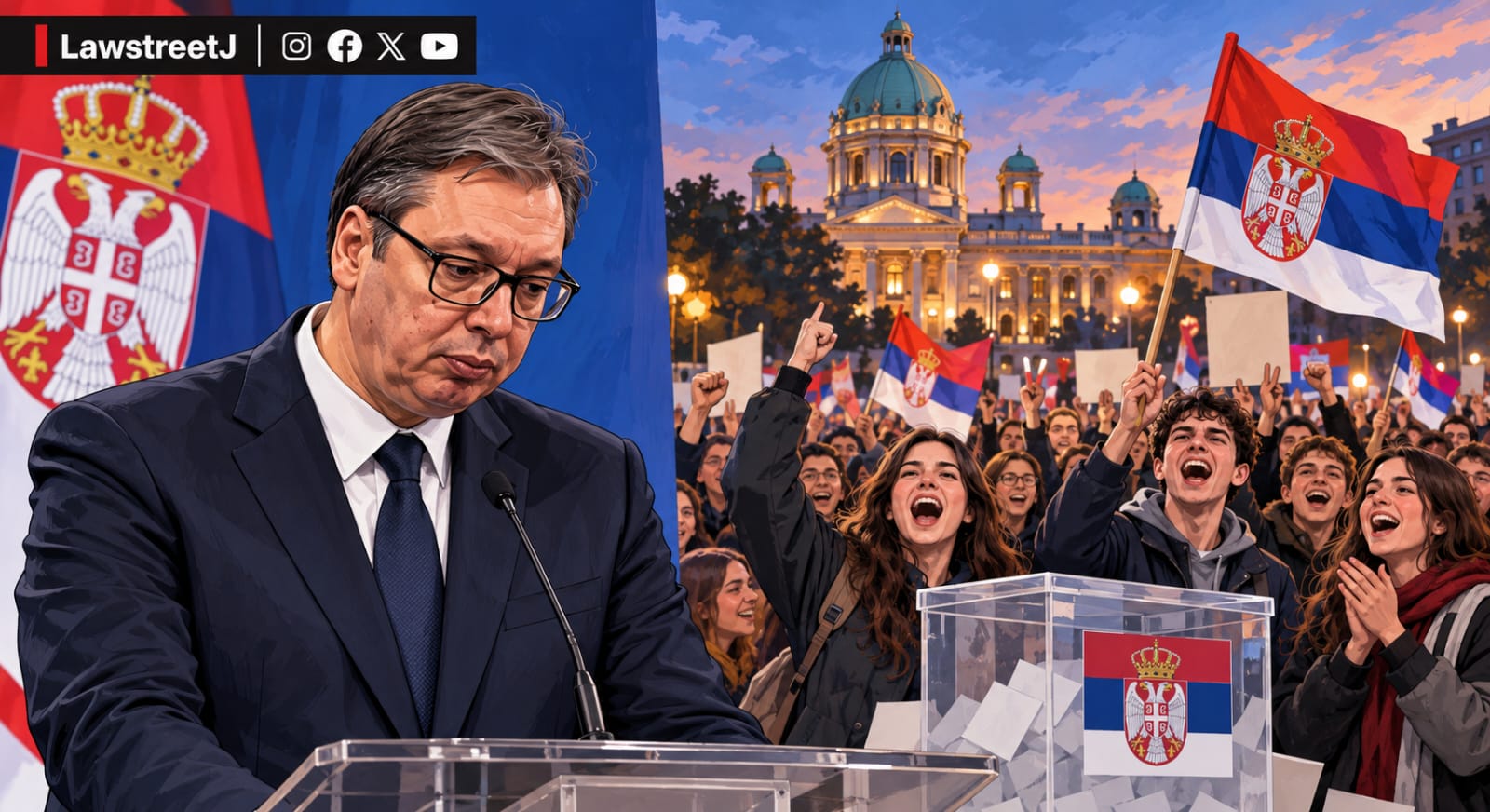
Belgrade — Serbian President Aleksandar Vučić conceded defeat in a snap parliamentary election on Sunday, October 25, 2026, to the Students' List, a movement that emerged from nearly two years of student-led protests against his government, in a result that ends his long dominance over Serbian politics and marks one of the most significant political shifts in the Balkans in decades.
Addressing supporters at his party's election-night event in Belgrade, Vučić said: "It is clear that we have lost these elections, the Student List has won." Preliminary results indicated his Serbian Progressive Party (SNS) list was projected to win around 105 seats in Serbia's 250-member parliament, compared with between 135 and 140 seats for the Students' List. Voter turnout reached its highest level in more than 30 years. Celebrations erupted across the country immediately after Vučić's concession, including fireworks in Belgrade and street celebrations in Novi Sad, the northern city at the centre of the events that originally triggered the protest movement.
In his concession remarks, Vučić also blamed what he described as Serbia's independent media, alleged interference by unnamed European countries, and an "American deep state," for his party's defeat.
Background: The Novi Sad Tragedy and the Student Movement
The protest movement that ultimately defeated Vučić traces back to November 1, 2024, when a concrete canopy collapsed at the railway station in Novi Sad, killing 16 people. The station building had been renovated twice before the collapse, and critics attributed the disaster to corruption-linked negligence and disregard for safety standards during the renovation work. The tragedy sparked sustained protests across Serbia demanding accountability and the rule of law, drawing hundreds of thousands of participants at their peak and continuing in various forms for close to two years.
University students were at the forefront of the movement throughout, organising under the banner "Students in Blockade" and later campaigning, as the "Students' List," for reforms including banning corrupt officials from politics and investigating their wealth as a precondition for any post-Vučić government. Vučić had for an extended period refused to call an early election in response to the protests, at one point suggesting such a vote might be held "sometime next year," while characterising the demonstrators as stirring a Western-backed "colour revolution." Serbia's populist prime minister had earlier resigned in January 2025 amid the pressure generated by the protests, and Vučić subsequently launched a crackdown on demonstrators that drew international criticism.
Under continued pressure from the movement, Vučić ultimately resigned from his position as President of Serbia in September 2026 and called the snap parliamentary election, running himself as a candidate for prime minister in the resulting vote rather than continuing in the presidency.
During the election campaign, the Students' List was led by Ilija Srdanović, a professor at the Faculty of Medicine in Novi Sad. Notably, none of the students who had organised the original protest movement actually appeared as candidates on the Students' List itself, with the movement instead being shaped by, and drawing its political legitimacy from, the broader base of university students, professors, doctors and workers who had participated in the demonstrations over the preceding two years. Radomir Saicic, a parliamentary candidate for the Students' List, said in a speech at the movement's election headquarters that preliminary results showed students "convincingly leading in almost all polling stations."
Vučić's 14-Year Dominance of Serbian Politics
Aleksandar Vučić has dominated Serbian politics, serving as either prime minister or president, since 2014, a tenure of roughly 14 years. He came to power with a formal commitment to steer Serbia toward European Union membership, a position he maintained in name throughout his time in office, while simultaneously deepening Serbia's ties with Russia and China, Serbia's traditional ally and main supplier of natural gas, and a major foreign investor in the country, respectively.
His supporters credit him with modernising Serbia's economy and expanding infrastructure, including new highways, railways, schools and hospitals, during his time in power. His critics have accused him of curbing democratic freedoms, stifling independent media, and allowing corruption and organised crime to flourish, criticisms that formed a central part of the student movement's case against his government.
Regional and International Significance
Commentators and reporting on the result have drawn a direct comparison between Vučić's defeat and the earlier loss suffered by Hungary's Viktor Orbán, a close Vučić ally, in April 2026, framing both results as part of a broader shift in parts of Central and Eastern Europe away from long-entrenched populist leadership. Analysts have also noted that Vučić's defeat is likely to resonate across Europe at a time when several countries, including France, have simultaneously experienced large-scale student-led protest movements, though the specific political outcomes and grievances driving those separate movements differ from the Serbian case.
The incoming Students' List-led government faces immediate questions about Serbia's foreign policy orientation, given the delicate balancing act the country has maintained between the European Union, its largest trading partner, Russia, its traditional political ally and primary gas supplier; and China, a major source of investment. Reporting following the election noted that the student movement had been relatively quieter about its specific international ambitions and foreign-policy priorities during the campaign compared to its clear domestic anti-corruption agenda, leaving significant uncertainty about how it will navigate these relationships once in government.
Under Serbia's constitutional framework, the presidency and the premiership are formally distinct offices, with the National Assembly, Serbia's 250-member unicameral parliament, responsible for electing the government following a parliamentary election, typically on the nomination of the president or the party or coalition commanding a parliamentary majority.
Although the Serbian presidency is constitutionally a more limited office than the premiership in terms of day-to-day executive authority, Vučić, during his time as president, retained substantial practical dominance over his party and broader state policy, a dynamic frequently cited by his critics as evidence of a concentration of informal power beyond what the constitutional text of the presidency alone would suggest.
His decision to resign the presidency and seek the premiership instead, ahead of this election, reflected his continued intention to remain Serbia's dominant political figure through the office carrying more direct governmental authority under the country's constitutional structure, a plan that the Students' List's electoral victory has now disrupted.