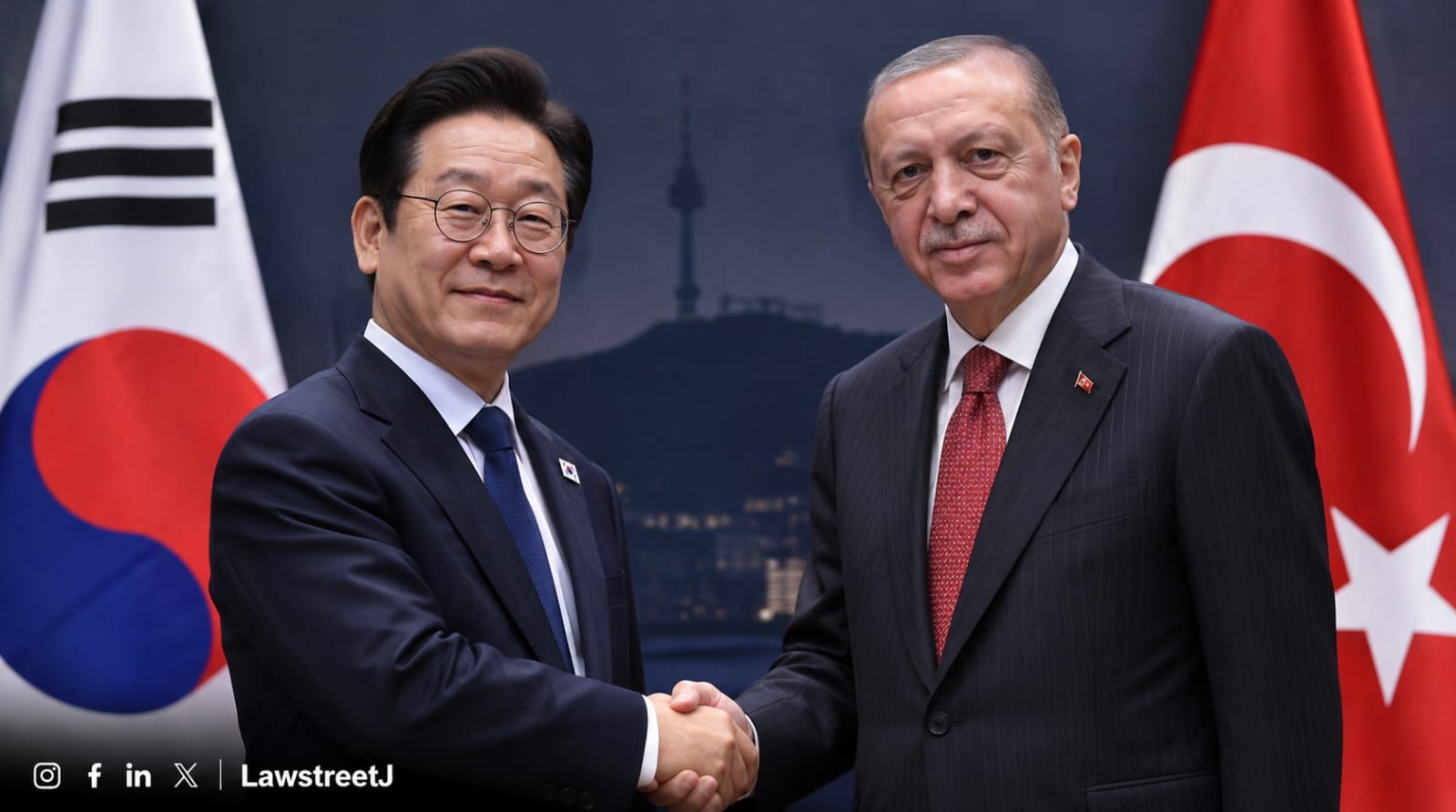
Seoul — South Korean President Lee Jae Myung and Turkish President Recep Tayyip Erdoğan agreed at a summit in Seoul on Tuesday, November 3, 2026, to expand cooperation in nuclear energy and defence, including on Turkey's planned Sinop nuclear power plant, and to work together on infrastructure, biotechnology, artificial intelligence and critical minerals. The two sides also signed a new memorandum of understanding on financing for nuclear projects.
The Summit
The meeting took place during Erdoğan's state visit to South Korea from November 2 to 4, his first in eight years, since 2018. Lee told a joint press conference that the two sides agreed cooperation on the Sinop project "has been progressing smoothly." Erdoğan said the documents signed on nuclear energy, building on an earlier memorandum, "will take this cooperation even further."
On defence, Erdoğan said "our strategic partnership has yielded tangible results" in the sector, and he noted Turkey's interest in South Korean expertise in semiconductors and other technology fields. The leaders also agreed to work closely on infrastructure, biotechnology and critical minerals.
A second memorandum of understanding signed on Tuesday concerns "financing cooperation for nuclear power projects," which Lee said was intended "to proactively support South Korean companies' participation" in Turkey's future nuclear power plant projects. It follows a first memorandum signed in November 2025, which created the framework for cooperation on Sinop, the only project named under that earlier text. Memoranda of this kind are political and framework instruments, they signal intent and set up cooperation, but commercial contracts, financing terms and construction rights would require separate, binding agreements.
The Sinop Project
Sinop, on Turkey's Black Sea coast, would be the country's second nuclear power plant after Akkuyu, which is being built with Russian participation. According to reporting on the summit, the project involves four 1,400-megawatt units at an estimated cost of 40 trillion won. Turkey has been pursuing the Sinop site for years, an earlier agreement with a Japanese consortium was announced in the 2010s but did not proceed after one of its participants, Itochu, pulled out, according to reference sources on the project.
Russia has separately signalled interest in taking part, its foreign minister, Sergey Lavrov, said in 2024 that both countries would benefit if the parameters of Russian participation could be agreed. South Korean companies, including the state utility Korea Electric Power Corporation, which Lee said last November he would promote to Ankara, are now seeking a role. No contract has been announced.
Defence has been a stated priority on both sides. Before his visit to Turkey in November 2025, Lee said Turkey is highly interested in the defence industry, an area of South Korean strength, and floated the possibility of combining Turkey's unmanned systems with South Korean conventional platforms such as tanks, artillery and naval vessels. He also described Turkey as a "brother country bound by blood," noting that it sent the fourth-largest number of troops during the Korean War. Bilateral trade reached $10.7 billion in 2025. Separately, the South Korean firm SK Plasma is involved in building a plasma fractionation plant in Turkey as part of Ankara's effort to achieve self-sufficiency in blood products.
Civil nuclear cooperation between states is governed by a layered framework. Both countries are parties to the Treaty on the Non-Proliferation of Nuclear Weapons, and any plant built in Turkey would be subject to International Atomic Energy Agency safeguards and to licensing by Turkey's own nuclear regulator. A foreign vendor's participation would depend on a project agreement, financing arrangements and regulatory approvals in Turkey, which is why the financing memorandum is regarded as a preparatory step rather than a commitment to build.