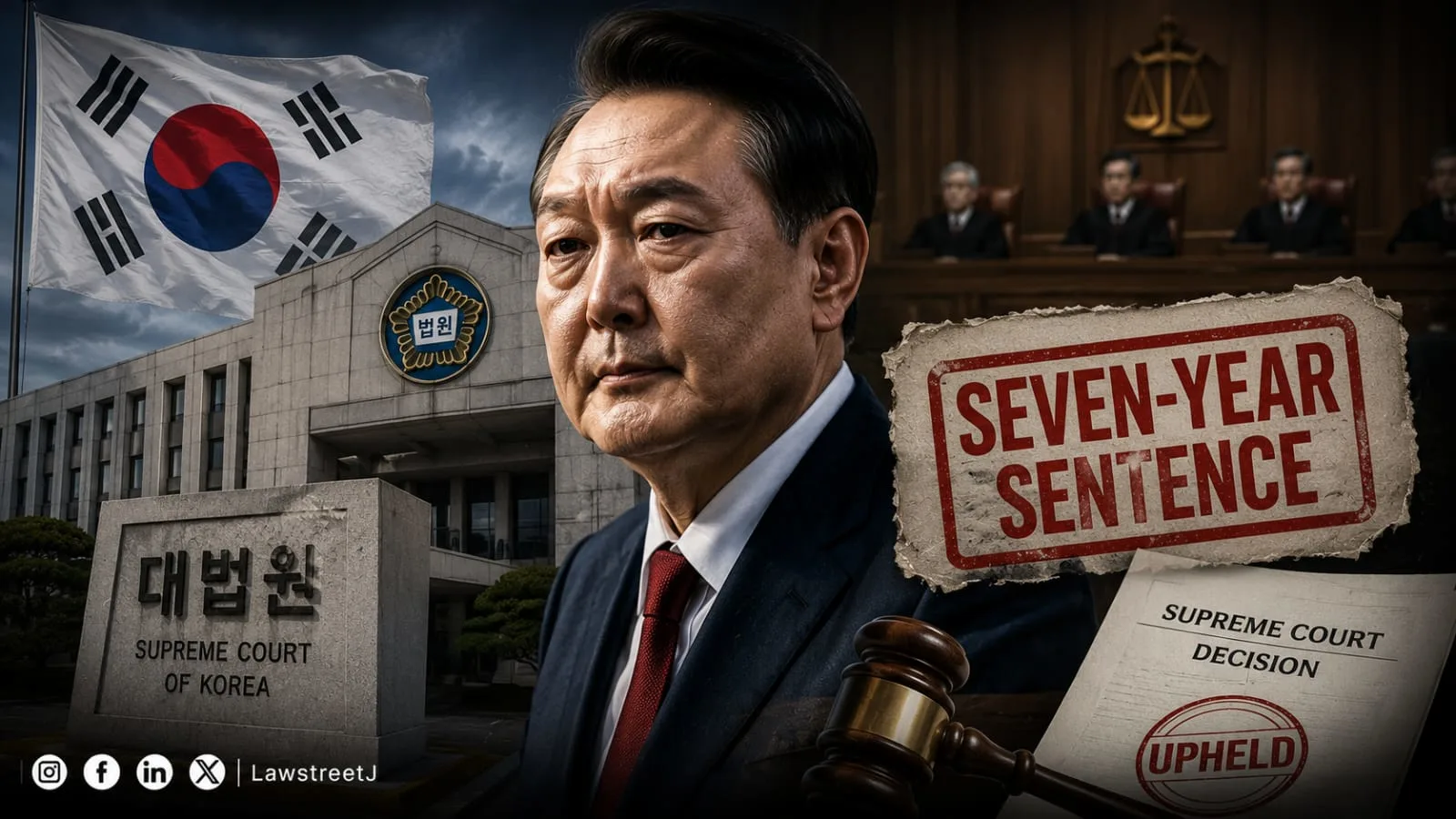
Seoul: South Korea's Supreme Court on Thursday delivered its final and unappealable judgment in the first of several criminal cases against former President Yoon Suk Yeol, upholding a seven-year prison sentence for crimes committed in connection with his declaration of martial law on December 3, 2024 and the chaotic weeks that followed. The ruling, handed down in a televised hearing at which Yoon was not present, is final, South Korea's Supreme Court is the court of last resort, and its judgments cannot be further appealed within the domestic judicial system.
"All appeals are dismissed," a Supreme Court judge said in the televised ruling, adding that the lower court's judgment "contained no errors."
The ruling settles, with legal finality, the obstruction-related charges that have formed one branch of a sprawling legal case against a man who, seven months ago, was the sitting head of state of one of Asia's most advanced democracies. Yoon, 65, was also sentenced to life in prison in February on charges of masterminding an insurrection tied to his martial law declaration. He remains in custody facing seven other criminal trials.
The Night That Changed South Korea: December 3, 2024
To understand the full weight of Thursday's ruling, the sequence of events it concerns must be understood in their entirety.
On the evening of December 3, 2024, Yoon Suk Yeol, who had been facing sustained political pressure from a National Assembly controlled by the opposition Democratic Party of Korea, appeared on national television and declared emergency martial law, the first such declaration in South Korea in over four decades. He accused the opposition of being "anti-state forces" sympathetic to North Korea and announced the suspension of civilian political activity.
The declaration was immediately and dramatically reversed. South Korea's Constitution requires that a martial law declaration be lifted if a majority of the National Assembly votes to revoke it, and 190 lawmakers, a majority, gathered in the early hours of December 4 and voted to do exactly that. Yoon was legally obligated to lift martial law upon that vote, which he did.
What happened in the hours and days between the declaration and its revocation, and in the weeks that followed as investigators sought to arrest Yoon, formed the factual basis of the criminal case the Supreme Court ruled upon on Thursday.
What the Seven Charges Cover: From Forged Signatures to Obstructing Arrest
The case covered accusations that Yoon had obstructed cabinet deliberations and used forged signatures of the prime minister in the lead-up to the declaration, as well as using presidential security agents to block his own arrest after lawmakers had nullified it.
The specific charges on which the Supreme Court affirmed the seven-year sentence are as follows.
On the obstruction of cabinet procedure: Yoon was accused of obstructing deliberations by convening only a select group of ministers for a meeting shortly before he declared martial law. South Korea's Constitution and the laws governing martial law require that it be deliberated upon and approved by the full cabinet before being proclaimed. By convening only a select group, chosen, prosecutors alleged, because they were more likely to support the declaration, Yoon bypassed this mandatory process.
On the fabricated documents: Other charges included allegedly creating and destroying a false martial law decree bearing forged signatures from the prime minister. The creation of official documents bearing fabricated signatures of senior state officials is a serious criminal offence under South Korean law, independent of the political context in which it occurred.
On the false press release: The ruling affirmed the appeals court's finding that Yoon was also guilty of fabricating documents and failing to follow the legal process required to impose martial law, which has to be deliberated by the full cabinet. Prosecutors also established that Yoon directed officials to distribute a misleading press release to foreign media following the declaration, a charge the appeals court added in April when it raised the sentence from five years to seven.
On the obstruction of arrest: The most operationally significant charge concerned Yoon's conduct after the National Assembly voted to revoke martial law and investigators sought to arrest him. Yoon was accused of using presidential security agents to block his own arrest after lawmakers had nullified the declaration. The Corruption Investigation Office for High-ranking Officials, the body mandated to investigate senior state officials, made multiple attempts to execute an arrest warrant. Yoon's presidential protection detail physically resisted those attempts on multiple occasions, with confrontations at the presidential residence that were broadcast live and watched by millions of South Koreans. The Supreme Court affirmed that these events constituted criminal obstruction of public officials in the execution of their lawful duties.
On the deletion of records: Charges also included directing an army commander to delete records from secure military phones, an act that constitutes both destruction of evidence and, in the context of a formal investigation, a standalone criminal offence.
The Sentencing Journey: Five Years to Seven, Now Final
The road to Thursday's final ruling passed through three courts over seven months.
In January 2026, a lower court, the Seoul Central District Court, sentenced Yoon to five years in prison after convicting him on most of the charges. In April, an appeals court upheld the ruling, added a guilty verdict over the misleading press release, and raised the sentence to seven years.
Both prosecutors and Yoon's legal team appealed to the Supreme Court, each from opposite directions. Prosecutors had sought a ten-year sentence, arguing the lower courts had underweighted the severity of a sitting president using his security apparatus to obstruct lawful arrest. Yoon's legal team had sought acquittal. The Supreme Court rejected both appeals, affirming the seven-year sentence as the appropriate and legally sound outcome.
Yoon's legal team expressed "deep regret", accusing the Supreme Court of concluding the case "without sufficient deliberation". The ex-president's lawyers plan to challenge the ruling on constitutional grounds and said they would raise a complaint. A constitutional complaint, if filed, would go before South Korea's Constitutional Court, a separate body from the Supreme Court, though legal analysts noted that challenging a final Supreme Court ruling through the constitutional complaint mechanism is an uphill legal path with very limited precedents for success.
Prosecutors said they respected the top court's decision, adding they would do their "utmost to successfully prosecute the remaining cases related to insurrection."
The Bigger Case: Life in Prison for Insurrection
Thursday's seven-year sentence, while final and significant, is not the most severe legal jeopardy Yoon faces. Yoon, 65, was also sentenced to life in prison in February on charges of masterminding an insurrection tied to his martial law declaration, which he insists was motivated by the public interest.
The insurrection case, tried separately before a different court, carries a different legal standard and a far more serious charge. Under South Korean law, insurrection is one of the gravest offences in the penal code and carries penalties ranging from heavy imprisonment to death. The February life sentence is currently under appeal, meaning it is not yet final. Yoon's legal team has contested the insurrection conviction vigorously, maintaining that the martial law declaration was a legitimate exercise of presidential authority in response to what Yoon characterised as anti-state activity by the opposition.
The distinction between the two cases is legally important. The obstruction case, now closed with finality by the Supreme Court, covers the procedural and post-declaration conduct: the bypassed cabinet process, the forged documents, the false press release, and the physical obstruction of arrest. The insurrection case covers the fundamental question of whether the declaration of martial law itself constituted an unlawful attempt to overturn the constitutional order, a charge of a categorically different magnitude.
Facing seven other trials, Yoon has been in jail since July 2025.
The Constitutional and Historical Significance
Thursday's ruling is the first Supreme Court judgment involving Yoon Suk Yeol since his botched attempt to impose martial law on December 3, 2024. It came 583 days after that declaration. It is also the first time a former South Korean president has received a final, not merely first-instance or appellate, conviction at the country's highest court level for conduct directly tied to a martial law declaration.
South Korea has a troubled history with its presidents and the law. Of the country's six living former presidents at the time of Yoon's indictment, four had faced criminal prosecution: Roh Tae-woo and Chun Doo-hwan were convicted of insurrection and treason related to the 1980 Gwangju Uprising and Chun's coup; Park Geun-hye was sentenced to 20 years for corruption before receiving a presidential pardon; and Lee Myung-bak was convicted of bribery and embezzlement. The addition of Yoon to that list and the speed with which the judicial process has moved, producing a final Supreme Court judgment in under nineteen months of the martial law declaration, is a marker of how seriously South Korea's institutions have treated the events of December 3, 2024.
South Korea's current President Lee Jae-myung, who was elected in the snap presidential election that followed Yoon's impeachment and removal, has not commented publicly on the Supreme Court ruling. The ruling itself carries no direct political consequence for the current administration, it is a criminal matter, not a political one, but it formally closes the chapter that began on that December night when emergency martial law was declared and reversed within hours, setting in motion the most consequential constitutional crisis in South Korea's democratic history.