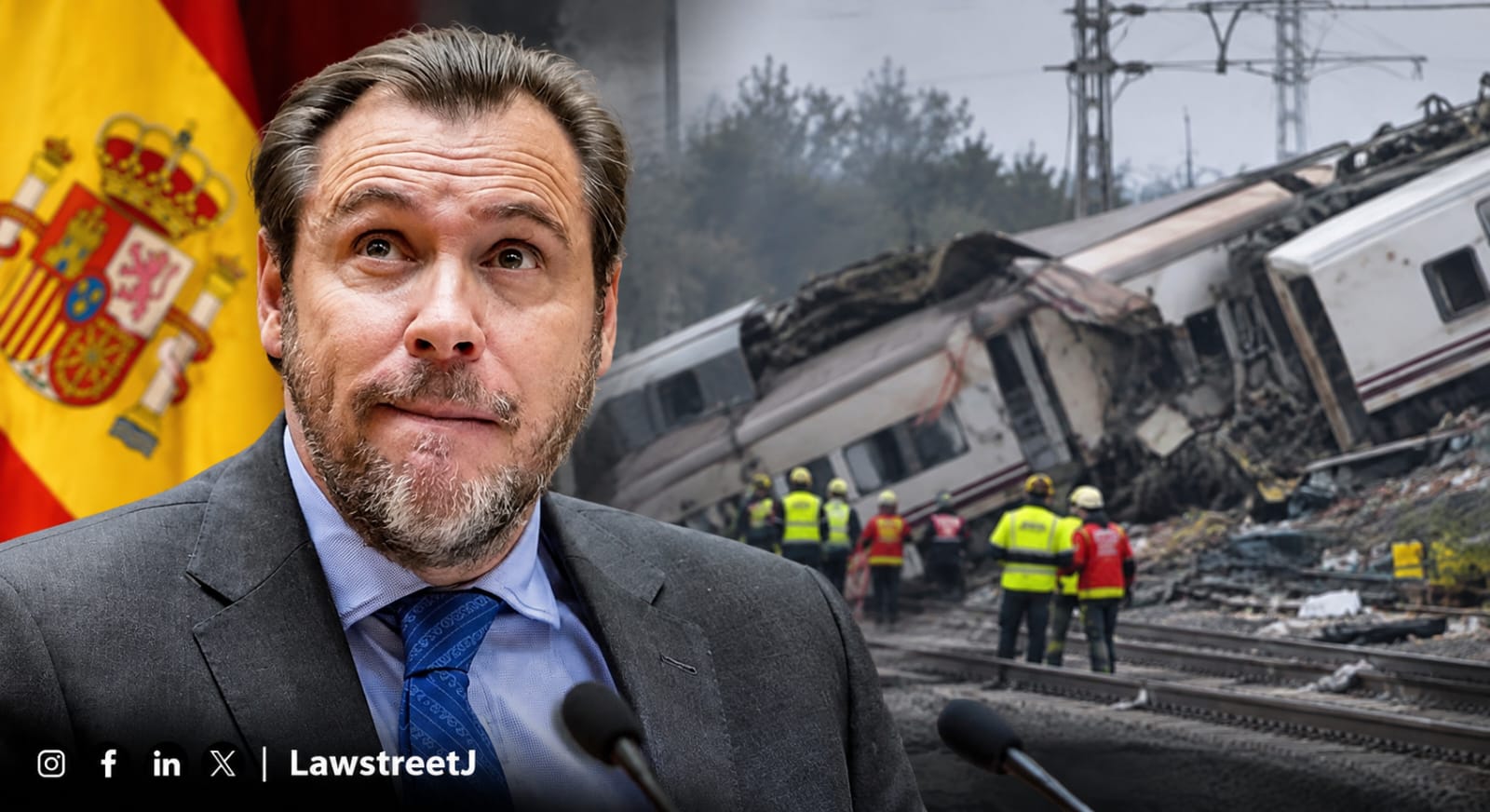
MADRID : Spain’s Transport Minister Óscar Puente announced his resignation on November 3, following a deadly high-speed train collision that claimed 69 lives near Urda in central Spain. His departure came six days after the October 28 disaster and amid growing political pressure over railway safety, following a second major train accident in the country within the same year.
Puente announced his decision while addressing lawmakers in Spain’s Congress, where he faced questions about the circumstances surrounding the collision, the government’s response and the safety of the country’s high-speed railway network.
“A transport minister in a country like Spain cannot remain in office after two accidents of this seriousness in less than a year,” Puente told lawmakers.
The resignation marked a significant development for Prime Minister Pedro Sánchez’s government, which was already facing political pressure ahead of the November 29 general election. The two deadly railway accidents, which together claimed 115 lives, have intensified scrutiny of railway infrastructure, signalling systems and safety procedures.
Puente had initially rejected calls to resign following the October accident, saying his priority was to manage the emergency response and establish what had happened. He later said he had decided to step down shortly after learning about the collision but delayed the announcement until immediate emergency measures and assistance for victims were underway.
The government confirmed that Sánchez accepted the minister’s decision and praised his work, describing the resignation as an act of political responsibility.
October Train Collision Leaves 69 Dead, Raises Questions Over Rail Safety
The accident occurred on October 28 near Urda in Spain’s Toledo province, along the Madrid-Seville high-speed railway corridor. A state-operated Renfe high-speed train collided with a stationary train operated by private company Iryo, killing 69 people and injuring more than 100. The collision became one of Spain’s deadliest railway disasters in recent decades and raised serious questions about the operation of the country’s high-speed rail infrastructure.
According to information presented by Puente to lawmakers, the sequence of events began when a signalling and communications system on the Madrid-Seville line failed. Several trains were automatically stopped as a safety measure, after which railway controllers in Madrid took over traffic management. Controllers subsequently authorised the Renfe train to continue its journey even though the Iryo train was stationary ahead on the track. Investigators are examining the decisions and technical failures that preceded the collision.
Preliminary information indicated that the Renfe train was travelling at an estimated speed of between 160 and 200 kilometres per hour when it struck the stationary train. Investigators have been examining the signalling failure, communications between train drivers and controllers, and whether established safety procedures were followed. The accident has also raised questions about the condition and modernisation of railway safety equipment. The LZB signalling system, which was involved in the sequence of events, has come under scrutiny as authorities examine its reliability and the delayed introduction of a newer European railway signalling system.
Puente defended the broader safety record of Spain’s high-speed railway network but acknowledged that the circumstances surrounding the collision required serious examination. He told lawmakers that the decisions made during the emergency were difficult to explain. The investigation is being conducted by the relevant Spanish authorities, and responsibility for the accident has not been finally established. The government has said that the causes must be determined through the technical investigation rather than premature conclusions about individual responsibility.
The collision also disrupted services on the Madrid-Seville corridor, one of Spain’s major high-speed railway routes. Authorities introduced operational restrictions and began reviewing safety procedures before the full restoration of services.
Second Major Railway Disaster After January Crash That Killed 46
The October tragedy was the second deadly railway accident involving high-speed trains in Spain in 2026. In January, another collision near Adamuz in Córdoba province killed 46 people on the same Madrid-Seville railway corridor. The January accident involved trains operated by Renfe and Iryo, the same two companies involved in the October disaster. The two incidents within a single year have intensified concerns about the maintenance, signalling infrastructure and safety management of Spain’s railway network.
The January collision had already placed the transport ministry under pressure, with opposition politicians and railway workers raising questions about infrastructure maintenance and the government's response to safety concerns.
Following the October accident, criticism intensified. Opposition lawmakers demanded accountability, while railway workers' representatives questioned whether the authorities were placing sufficient emphasis on infrastructure failures and working conditions in railway control centres. Puente initially rejected demands for his resignation. On October 30, he argued that his responsibility was to address the problems, determine what had happened and provide explanations. However, his position changed after the second disaster and the subsequent questioning in Congress.
During his November 3 appearance, Puente also outlined a series of measures intended to improve railway safety. These included strengthening operating procedures when signalling systems fail, improving conditions in railway control centres, increasing staffing and accelerating the introduction of the European Rail Traffic Management System (ERTMS). The government also announced measures to increase compensation for victims and accelerate payments to affected families.
Puente additionally announced plans to introduce technology to monitor communications between train drivers and controllers in order to identify irregularities and reduce the possibility of human error.
The government said these measures were intended to strengthen the safety framework across the railway network. However, the effectiveness of the changes will depend on their implementation and the findings of the ongoing investigations.
Political Fallout Ahead of Spain’s November 29 Election
Puente’s resignation comes at a politically sensitive time for Spain. Prime Minister Pedro Sánchez had called an early general election for November 29, and the railway disasters have become an important issue in the political campaign. The opposition has questioned the government’s handling of railway infrastructure and demanded accountability for the accidents. The government, meanwhile, has defended its response and promised improvements to safety systems and emergency procedures.
Sánchez praised Puente following his resignation, saying the outgoing minister had acted out of respect for the victims and their families. The government must now manage the political consequences of the accidents while ensuring that the investigations proceed.
Spain operates the world's second-largest high-speed rail network after China, making the two deadly accidents particularly significant for public confidence in its transport infrastructure. Before the disasters in 2026, the country's high-speed railway network had not experienced a fatal accident since entering service more than three decades ago, according to the Associated Press.
The resignation does not, by itself, establish responsibility for either collision. Investigators still need to determine the precise technical and operational failures behind the accidents and whether existing safety procedures were properly followed.
With 115 people killed in the two disasters, railway safety has become a central issue for the government and political parties ahead of the election. Puente's departure represents a major political consequence of the October collision, while the investigations and proposed reforms will determine what further accountability and changes follow.