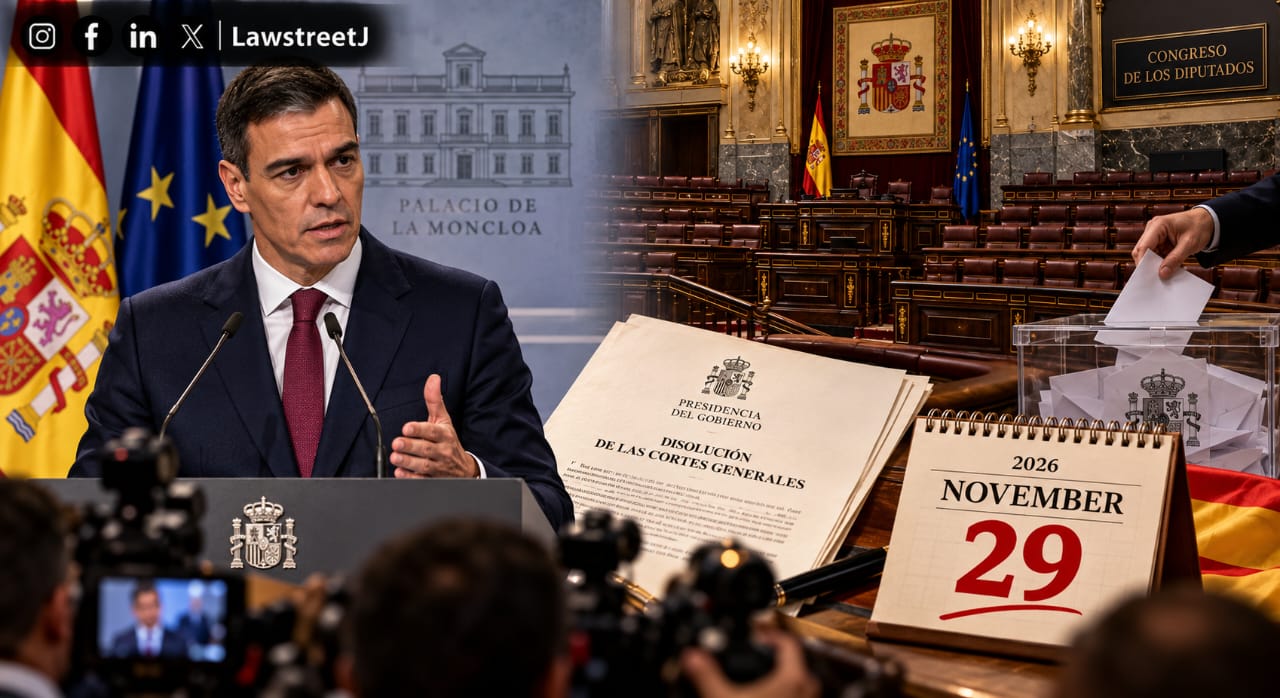
Madrid — Spanish Prime Minister Pedro Sánchez announced on Monday, October 5, 2026, that he has dissolved the Cortes Generales, Spain's national parliament, and called a general election for Sunday, November 29, 2026, following the defeat of his government's emergency housing relief measures in the Congress of Deputies. The announcement brings Spain's current parliamentary term to an end more than six months ahead of its scheduled expiry.
Sánchez made the announcement in a televised institutional address from the Moncloa Palace, the official residence of the Spanish Prime Minister, after first informing King Felipe VI of his decision. He said he had decided to convene an extraordinary meeting of the Council of Ministers to formally dissolve parliament and call the election, stating that the government needed to renew the public's support. The dissolution decree is due to be published in Spain's Official State Gazette, the Boletín Oficial del Estado, on October 6, 2026, which formally triggers the campaign and election timeline.
Immediate Trigger: Rejection of Housing Decrees
The decision followed the rejection, on October 2, 2026, of two emergency housing decrees that Sánchez's minority government had put before the Congress of Deputies. The decrees were aimed at addressing Spain's housing crisis, including measures intended to curb tenant evictions and cap rapidly rising rents.
According to reporting on the vote, the decrees had been approved by the Council of Ministers only three days prior to the parliamentary vote, without securing the parliamentary arithmetic needed for them to survive, and consequently remained in force for barely a day before being struck down.
The measures were voted down by a combination of opposition parties, including the centre-right People's Party, the far-right Vox party, and the pro-Catalan-independence party Junts per Catalunya (Together for Catalonia). The defeat of the decrees came amid a backdrop of mass public protests over housing costs, with tens of thousands of people demonstrating in Madrid and other major Spanish cities. According to reporting, the wave of public anger over the housing crisis had been intensified by the eviction of an 87-year-old woman, an incident that drew significant public attention and fuelled the broader protest movement.
Political and Fiscal Context
Sánchez's decision to call elections came after his own Socialist Workers' Party leadership and cabinet ministers had reportedly been pressing him since the preceding Friday to go to the polls while the tenants' protest movement was still active and visible in Spain's city squares. The outgoing legislature ends without the government having passed a budget of its own since 2023; the 2023 budget has been rolled over on three separate occasions, making it, according to reporting, the longest-serving budget rollover in the history of Spain's current democratic period. The government's deficit targets were also voted down twice during the course of the year.
Sánchez has served as Prime Minister for more than eight years. Spanish electoral law required that a general election be held no later than August 2027, meaning analysts had anticipated that an early election call was likely at some point before that deadline, given the fragility of Sánchez's minority coalition government in parliament.
Constitutional and Legal Framework
The Prime Minister's power to dissolve the Cortes Generales and call elections is governed by Article 115 of the Spanish Constitution of 1978, which empowers the President of the Government, under his own responsibility and after deliberation by the Council of Ministers, to propose the dissolution of the Congress of Deputies, the Senate, or the full Cortes Generales.
Under this provision, the dissolution is formalised through a royal decree, which must set the date of the election and is countersigned by the Prime Minister, reflecting Spain's constitutional structure as a parliamentary monarchy in which the King serves as head of state without exercising independent executive authority over such decisions. Article 115 also provides that a dissolution decree cannot be issued while a motion of no confidence against the government is pending, and that a fresh dissolution may not ordinarily be proposed again within one year of a previous one, except in specific constitutionally defined circumstances.
Spain's Organic Law on the General Electoral Regime, commonly known by its Spanish acronym LOREG, governs the procedural timeline that follows a dissolution decree. Under this law, a general election must be held no later than 54 days after the publication of the dissolution decree in the Official State Gazette, which places the legally mandated outer boundary for the vote in line with the announced date of November 29, 2026, following the decree's publication on October 6.
King Felipe VI, Spain's constitutional monarch, was informed of the dissolution decision by Sánchez prior to the public announcement, consistent with the Constitution's requirement that the Prime Minister communicate such decisions to the head of state. The King left Spain on the same day for a previously scheduled state visit to Finland, a detail that has been reported alongside the dissolution announcement but which does not affect the constitutional validity or legal timeline of the election process, since the King's role in the dissolution process under Article 115 is to issue the royal decree on the Prime Minister's proposal rather than to exercise independent discretion over the decision itself.
Sánchez has indicated that he intends to make housing policy a central theme of his campaign for the November election, framing the vote as a choice between the continuation of his government's progressive policy agenda and the prospect of power passing to a right-leaning parliamentary bloc.
Analysts cited in reporting on the announcement have suggested that Sánchez may be seeking to use the public anger generated by the rejection of the housing decrees, and the accompanying protest movement, to mobilise electoral support, given that the opposition parties that voted down the decrees, including the People's Party and Vox, now bear part of the political responsibility for the measures' defeat in the eyes of protesting tenants.
Composition of the Outgoing Government
Sánchez has governed Spain as the leader of a minority coalition government built around his Socialist Workers' Party, commonly known by its Spanish acronym PSOE, relying on the parliamentary support of various smaller regional and left-leaning parties to pass legislation during the current term. The repeated defeat of the government's deficit targets, the multi-year rollover of the 2023 budget, and the final defeat of the emergency housing decrees reflect the persistent difficulty the government faced in securing stable parliamentary majorities for its legislative agenda throughout the term now coming to an end.
Under the legal timeline triggered by Monday's announcement and the decree's scheduled publication on October 6, Spain now enters a 54-day campaign period, culminating in the general election on November 29, 2026.
Spanish voters will elect members of the Congress of Deputies and the Senate, the two chambers that together constitute the Cortes Generales, with the resulting composition of the Congress of Deputies determining which party or coalition is best positioned to put forward a candidate for Prime Minister in the subsequent government-formation process, which under the Spanish constitutional system requires the successful candidate to secure the confidence of the Congress of Deputies through an investiture vote.