Paris — A wave of protests by secondary school students over inadequate staffing and deteriorating conditions in French lycées has spread nationwide since mid-September, with authorities reporting more than 5,000 arrests, hundreds of injuries among students, staff and police, and dozens of schools damaged, burned or ransacked. The unrest, now in its third week, has become one of the most significant domestic challenges facing President Emmanuel Macron's government.
How the Protests Began
The movement originated in mid-September at a lycée in Créteil, in the southeastern suburbs of Paris, where teachers and students mobilised to protest a shortage of staff and resources. In the days that followed, demonstrations spread throughout the Île-de-France region, which includes Paris and its surrounding metropolitan area, before expanding nationwide as students in towns and cities across the country organised class strikes, blockades and demonstrations.
According to France's Union Syndicale des Lycéens, approximately 400 of the country's roughly 3,700 high schools were blockaded as the movement gathered pace.
Students have raised a range of grievances, including overcrowded classrooms, deteriorating school buildings, long school schedules and repeated, unfilled teacher absences. According to figures released by French Justice Minister Gérald Darmanin, the protests had affected 735 of France's schools "in one way or another" as of early October.
Scale of Arrests and the Treatment of Minors
France's Interior Ministry and Justice Ministry have released arrest figures on a rolling basis as the protests have continued. According to the Justice Ministry, more than 5,060 people have been arrested since the protests began, with 87 percent of those detained being minors. Separate Interior Ministry figures, cited by the Washington Post, put the arrest total for a single week at more than 5,000, with 85 percent minors. Le Figaro, citing the Justice Ministry, separately reported that 1,793 people had been placed in custody in a shorter period, with about 90 percent being minors, and that more than 1,800 individuals are now facing prosecution in connection with the unrest.
Education Minister Édouard Geffray has said that more than 170 students and 78 school staff members have been injured in connection with the protests. According to the European broadcaster Euronews, citing French authorities, more than 600 police officers have also been injured during the unrest. In one incident in Tours, in central France, a young man was reported by the local prosecutor to have lost sight in his right eye, with his injuries suggesting he may have been struck by a police rubber bullet. In another serious incident, in La Ciotat in the Provence region, a 59-year-old teacher was doused with petrol and beaten during a student demonstration.
As the protests entered their third week, between 400 and 500 secondary schools were expected to remain fully or partially closed on a single Monday, according to French authorities. Of the schools affected by the unrest, 24 have been set on fire or ransacked, according to Education Minister Geffray.
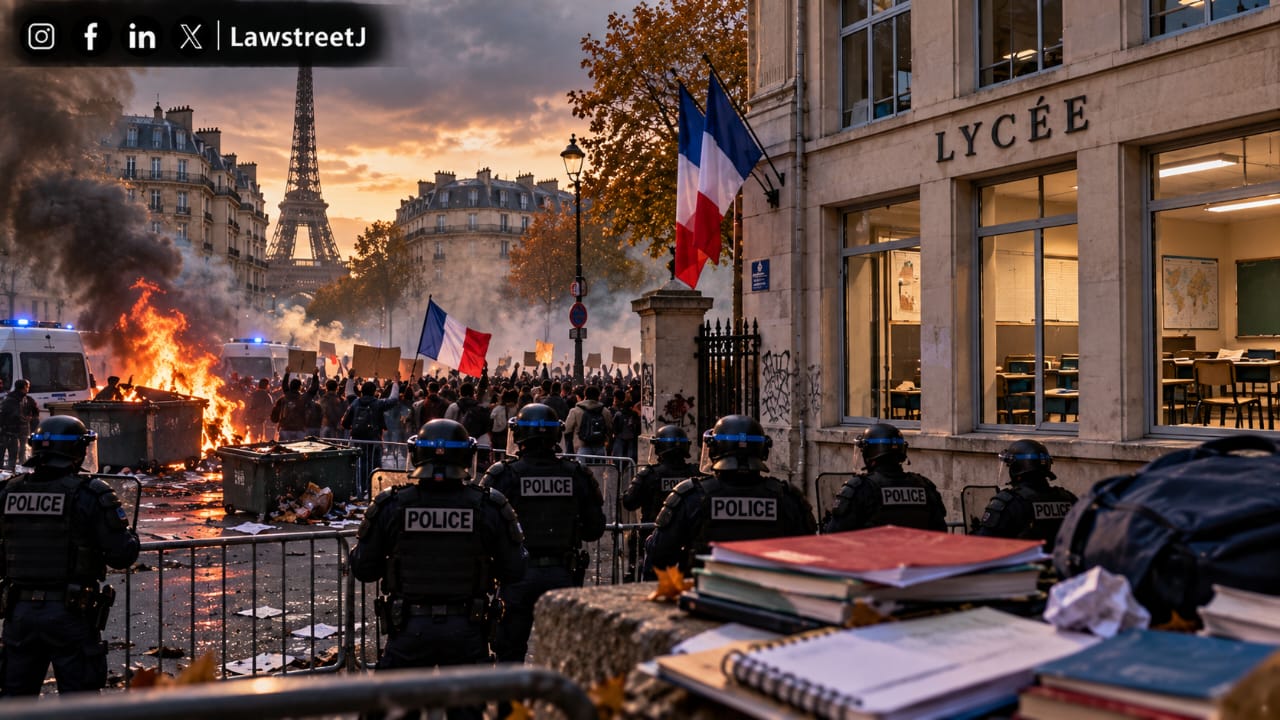
Visuals from cities including Paris, Lille, Strasbourg, Marseille, Rennes and Lyon have shown masked protesters setting rubbish bins and barricades alight, throwing projectiles, and confronting riot police, who have responded with tear gas, batons and other crowd-control measures.
Government Response
Prime Minister Sébastien Lecornu chaired an inter-ministerial crisis meeting on October 1, 2026, after which the government characterised the escalating unrest as "urban violence." Interior Minister Laurent Nuñez has defended the conduct of police operations, stating that security forces are working to protect students who wish to protest peacefully while intervening against vandalism and violence that has occurred on the margins of the demonstrations. The Interior Ministry has denied that its response to the unrest has been disproportionate.
President Macron addressed the unrest while speaking in Madrid, stating that he understood the anxieties and anger that young people in France may be feeling. Education Minister Geffray has said that those responsible for violent acts during the protests must be identified, prosecuted and punished, while also cautioning about the dangers posed to students by the increasingly violent character some of the demonstrations have taken on.
The government has separately alleged that far-left activists have infiltrated and intensified parts of the protest movement, an allegation disputed by opposition politicians. Socialist Party leader Olivier Faure has criticised the conduct of security operations in earlier phases of related unrest, stating that no wrongdoing by students could justify what he described as the filmed humiliation of minors during mass detentions.
Teachers' unions have thrown their support behind the protesting students, while criticising what they describe as a government response limited largely to the deployment of security forces, rather than substantive measures addressing the underlying shortages of staff and resources in French schools. Student organisations and rights groups have separately accused police of using excessive force against teenage protesters during the course of the demonstrations.
Legal and Constitutional Framework
The right to protest in France derives from Article 11 of the Declaration of the Rights of Man and of the Citizen of 1789, which forms part of the constitutional bloc under the Constitution of the Fifth Republic of 1958, and which protects the free communication of thoughts and opinions, subject to accountability for abuses of that freedom as defined by law. Freedom of assembly in France is further governed by the Code de la sécurité intérieure, France's Code of Internal Security, which sets out the legal framework within which prefects, France's departmental administrative authorities, may regulate, restrict or, in specified circumstances, prohibit public demonstrations on grounds of public order, while demonstrators retain the right to challenge such restrictions before administrative courts.
The processing of detained minors in connection with the protests falls under the Code de la justice pénale des mineurs, France's Juvenile Criminal Justice Code, which came into force in 2021 and governs the specific procedural protections applicable to minors in police custody and criminal proceedings.
These protections include requirements for parental or legal guardian notification upon a minor's detention, restrictions on the permissible duration of police custody (garde à vue) based on the age of the detained minor, and the mandatory presence of legal counsel during certain stages of questioning, reflecting the code's broader principle that the criminal justice system's response to minors must prioritise education and rehabilitation alongside accountability.
Decisions regarding school closures fall within the administrative authority of regional education authorities, known as académies, operating under the Ministry of National Education, in coordination with departmental prefects where public order or safety considerations are implicated. The Île-de-France regional education authority has reported that a number of lycées in the region were, in its own description, the scene of violence, clashes and damage during the unrest.