Jizan / Yanbu / Sanaa | Yemen's Iran-backed Houthi rebels claimed responsibility for attacks on Saudi oil facilities on Saturday, in the first such strikes since 2022. Houthi military spokesperson Yahya Saree said the group fired ballistic missiles and drones at facilities belonging to Saudi state oil company Aramco in the Red Sea cities of Yanbu and Jizan, in what it called retaliation for Saudi airstrikes on the port city of Hodeidah and Kamaran Island.

The attacks were not merely the latest episode in a conflict that has been escalating for months. They were something structurally different, a strike on the specific piece of infrastructure that the global energy market had constructed as its emergency alternative to the Strait of Hormuz, at precisely the moment that alternative was carrying the world's most critical oil flows. The architects of the attack understood exactly what they were targeting. And the market understood immediately what it meant.
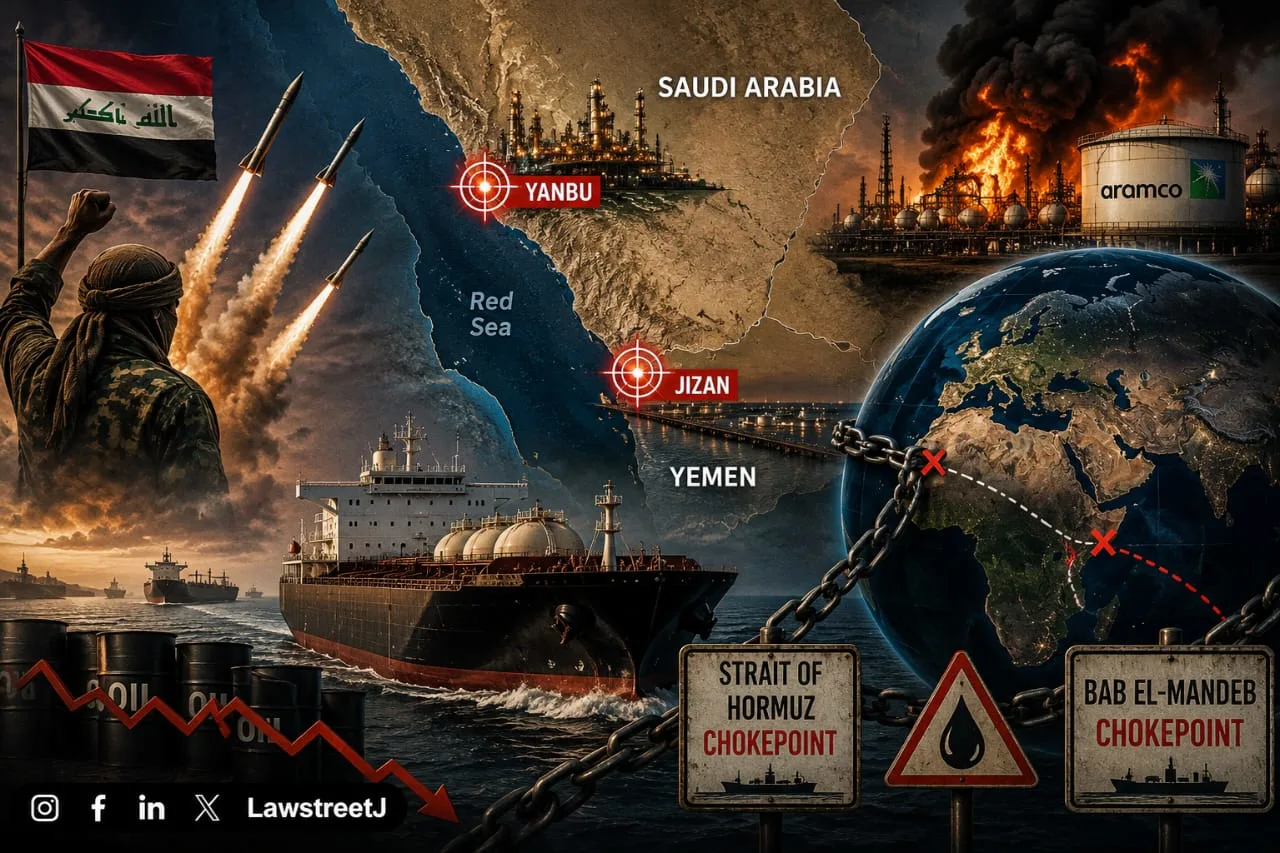
Saudi Aramco's Houthi attack on July 25, 2026 set the Jizan refinery ablaze and targeted Yanbu, Saudi Arabia's only crude-export corridor after Hormuz closed, pushing Brent crude back above $100 and completing a dual-chokepoint trap.
Why Yanbu Matters: The Emergency Pipeline That Became the World's Lifeline
To understand what the Houthis struck, the history of the Petroline must be understood.
The Petroline runs 1,201 kilometres from the Abqaiq oil processing complex in Saudi Arabia's Eastern Province to Yanbu on the Red Sea coast. For four decades, the pipeline sat largely dormant as a contingency. In 2026 it became the world's most important piece of energy infrastructure.

When Iran effectively shuttered the Strait of Hormuz following the outbreak of the US-Iran war in February 2026, Saudi Arabia faced an acute strategic problem. Its primary export infrastructure, the massive crude loading terminals at Ras Tanura and Ju'aymah on the Arabian Gulf coast, feeds directly into Hormuz. With the strait closed or contested, Saudi Arabia had to find another way to get oil to market.
Saudi Arabia pushed its East-West Pipeline, the Petroline to an all-time throughput record of 7 million barrels per day in March 2026, after Iran effectively shuttered the Strait of Hormuz. Aramco pushed it to 7 million by converting parallel natural gas liquids pipelines to crude service, an emergency adaptation that sacrificed NGL export revenue for raw throughput.
Out of concerns for security, Saudi Aramco halted production at the Ras Tanura refinery and planned on keeping the plant shut down and exports cut off for a few weeks while they were rerouted to different parts of the country. With Iran declaring the Persian Gulf restricted, Saudi Arabia planned on using the Red Sea to export oil products through Yanbu.
Yanbu thus became the single most strategically important port on earth for global oil supply, the funnel through which Saudi Arabia's output reached a world that had lost access to Hormuz. Every barrel of oil Saudi Arabia exported from March 2026 onward passed through Yanbu. Every tanker loading Saudi crude sailed from Yanbu into the Red Sea and through the Bab al-Mandeb Strait at the southern tip of the Arabian Peninsula.
This is the architecture the Houthis struck on July 25.
The Attack: What Happened at Jizan and Yanbu
The Houthi-run Yemeni Armed Forces said in a statement: "The first targeted sensitive Aramco-affiliated facilities in Jizan with dozens of ballistic missiles and drones. And the second operation targeted sensitive Aramco-affiliated facilities in Yanbu with a number of ballistic and cruise missiles and drones."
Videos shared on social media showed black smoke rising from the Aramco refinery in Jizan, indicating a possible hit on the facility. At least five explosions were reported in Jizan according to regional media, with commercial flights to the area diverting or entering holding patterns.
The Jizan refinery, commissioned commercially in 2021 and operating at full throughput since around 2023, processes 400,000 barrels per day of crude oil.
At Yanbu, the attack was partially defeated. Two ballistic missiles aimed at oil installations were intercepted by a Patriot battery operated in Saudi Arabia by the Greek military under an agreement with Riyadh. Saudi Arabia's Civil Defense issued warnings early Saturday for residents of Yanbu governorate and Jazan province about a potential danger, without specifying the nature of the threat. The warnings were lifted shortly afterward, with Civil Defense announcing the danger had passed in both areas. There were no immediate reports of casualties.
The Jizan refinery fire was more consequential. While Jizan is downstream infrastructure rather than the strategic centre of gravity, its 400,000-barrel-per-day processing capacity is not trivial and its burning sent the most powerful possible signal about the Houthis' targeting ambitions and precision.
The Dual-Chokepoint Architecture: Hormuz and Bab al-Mandeb
The strategic significance of the Yanbu and Jizan attacks cannot be understood without mapping the geography that the Houthis are exploiting.
Here is the architectural problem the Houthis have exploited: every barrel that arrives at Yanbu via the Petroline must then exit through the Bab al-Mandeb, the 29-kilometre-wide strait at the southern end of the Red Sea connecting it to the Gulf of Aden.
The Strait of Hormuz and the Bab al-Mandeb are the two maritime chokepoints through which the Arabian Peninsula's oil must pass to reach the world. Hormuz, in the northeast, connects the Arabian Gulf to the Indian Ocean. Bab al-Mandeb, in the southwest, connects the Red Sea to the Gulf of Aden and onward to the Indian Ocean via different routes.
Before February 2026, most Saudi oil went through Hormuz. After February 2026, it was rerouted through the Petroline to Yanbu and out through Bab al-Mandeb. The world's energy infrastructure pivoted from one chokepoint to the other.
The Houthis control the coastline on the western side of Bab al-Mandeb, the Yemeni coast. They have been attacking shipping in the Red Sea and Bab al-Mandeb since November 2023. They possess ballistic missiles capable of reaching Yanbu. They now, as their July 25 attacks demonstrated, possess both the intent and the operational capability to strike Aramco infrastructure directly.
The rising tension in the Red Sea has threatened to further choke global shipping, because the rebels have said they would close the Bab al-Mandeb strait to Saudi-linked shipping.
If Hormuz remains contested and Bab al-Mandeb becomes effectively blocked to Saudi exports, the world is left with no safe maritime route for Arabian Peninsula oil. That is the dual-chokepoint trap and July 25 was the day the Houthis demonstrated they have the tools to spring it.
What Triggered the Attack: The Saudi-Houthi Escalation
The Houthis said their attack was launched after Saudi Arabia struck the Yemeni port city of Hodeidah on Friday. Houthi spokesman Brig Gen Yahya Saree said the strikes showed Saudi Arabia's determination to continue its siege of their people and its violation of their country's sovereignty, vowing to respond to escalation with escalation.
A Saudi ship, NCC Masa, sustained minor hull damage after it was attacked while sailing in the Red Sea on Friday. The vessel continued to its destination after checks confirmed it and its crew were safe.
The escalation sequence is a familiar one in the five-year Saudi-Houthi conflict: Houthis attack Saudi-linked vessels or territory, Saudi coalition strikes Hodeidah or other Houthi-controlled areas, Houthis retaliate against Saudi infrastructure. What is new in July 2026 is the strategic consequence of each escalation, because Yanbu's role as the global oil market's emergency alternative to Hormuz makes every attack on Saudi Red Sea infrastructure an attack on global energy supply rather than merely a bilateral conflict development.
Saudi Arabia has sought to avoid renewed conflict in Yemen since it agreed to a ceasefire with the Houthis in 2022. That ceasefire has now effectively broken down, a development that, combined with the ongoing US-Iran conflict and the contested status of Hormuz, places the global energy system under simultaneous pressure from two directions simultaneously for the first time in its modern history.
Market Impact: Brent Above $100, India's Exposure
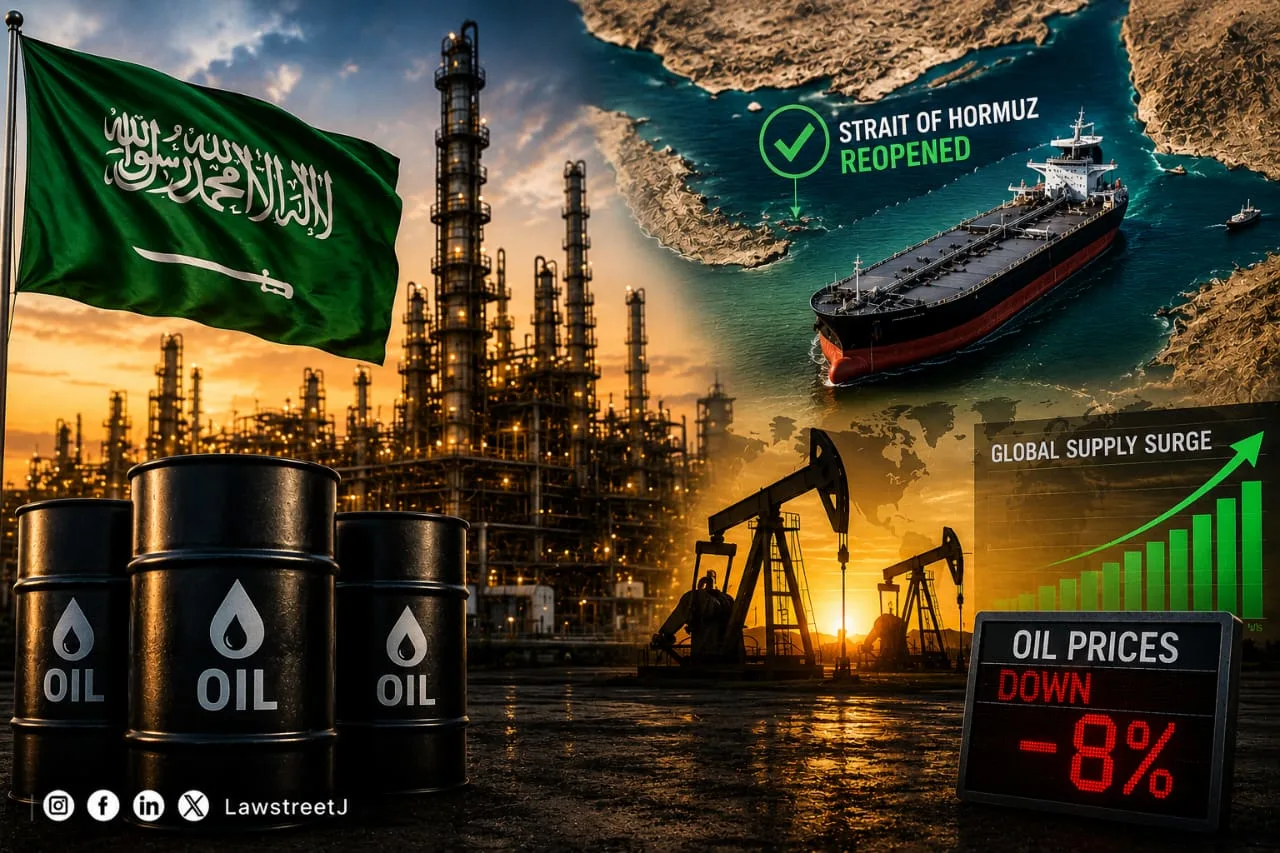
The Houthi strikes pushed Brent crude back above $100 per barrel, reversing much of the price decline that had followed the June 18 Versailles peace agreement and the temporary reopening of Hormuz. The market's reaction reflects the dual-chokepoint calculus with mathematical precision: if both Hormuz and Bab al-Mandeb are under threat simultaneously, the risk premium on global oil supply jumps sharply regardless of the diplomatic situation at either strait individually.
For India, the world's third-largest oil importer, the implications are direct and severe. India's energy security depends on reliable access to Arabian Gulf crude. The disruption of Hormuz since February had already forced Indian refiners to pay premium prices for alternative supply routed through longer voyages. The threat to Yanbu and Bab al-Mandeb now complicates even those alternatives.
The Indian government's immediate focus in this context has been its seafarers, five of whom have died in attacks on commercial vessels since April, with two more missing following the Odesa attack on July 25. The broader energy security implications of the dual-chokepoint situation will fall to the Ministry of Petroleum and the Ministry of External Affairs to manage through supply diversification, strategic reserve drawdowns, and diplomatic engagement with both the Saudi government and the parties to the US-Iran conflict.
The Houthis in the Wider War: From Gaza to Iran
The Houthi attacks on Saudi Arabia represent a widening of what began as an Iran-aligned response to the conflict in Gaza. The Houthis first began attacking Red Sea shipping in November 2023, framing their campaign as solidarity with Palestinians under Israeli bombardment in Gaza. That campaign, which drew US and UK military responses in early 2024, was largely suppressed but never fully eliminated.
The outbreak of the US-Iran war in February 2026 gave the Houthis a new strategic framework and a new set of targets. Operating as an Iranian proxy, they have used the regional conflict to expand their campaign from commercial shipping generally to Saudi infrastructure specifically, exploiting Riyadh's new dependence on the Red Sea route to inflict maximum strategic damage on the world's largest oil exporter.
Fears of a renewed war in Yemen have escalated. The Saudi-Houthi ceasefire of 2022, which had been one of the more durable diplomatic achievements of the Omani and UN mediation efforts, is now under severe strain. Whether Saudi Arabia responds to the Jizan and Yanbu attacks with a full military campaign in Yemen, whether it seeks diplomatic de-escalation, or whether it absorbs the attacks and focuses on air defence reinforcement will determine whether the dual-chokepoint threat becomes permanent.
The world's energy system has survived Hormuz crises before. It has survived Red Sea crises before. It has never faced both simultaneously. July 25, 2026 was the day the Houthis made clear they intend to keep it that way.