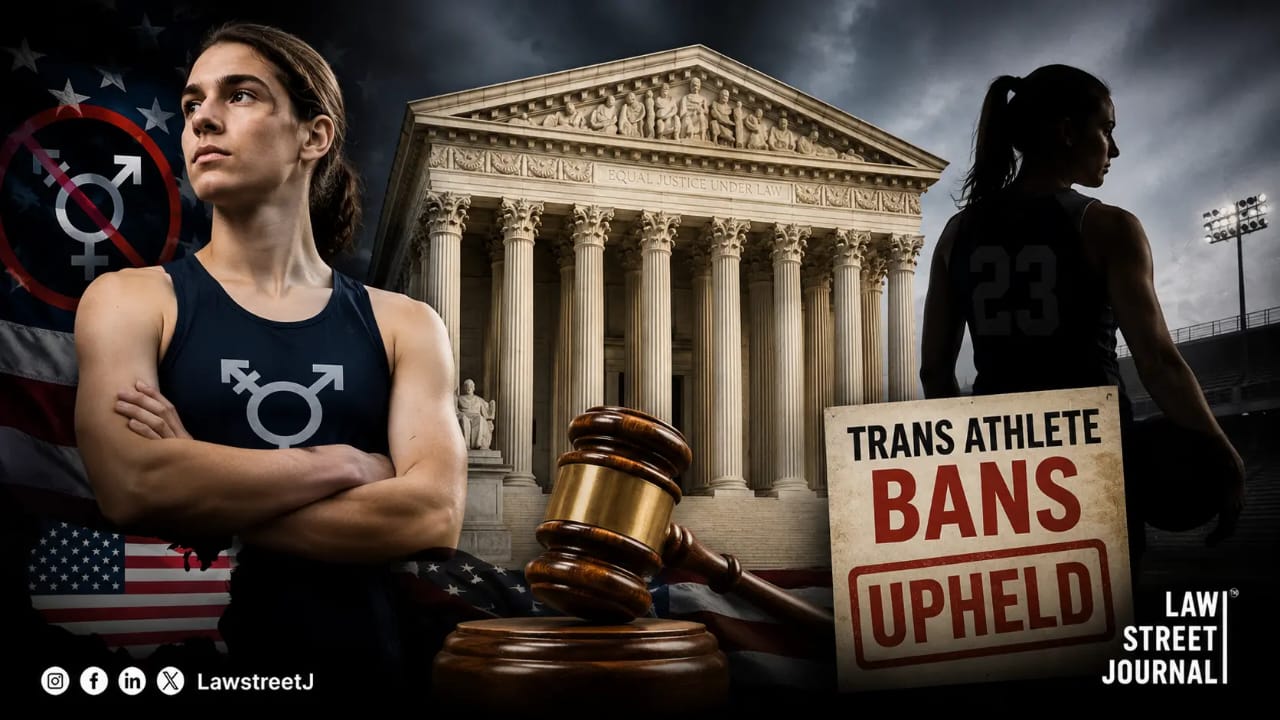
The United States Supreme Court on Tuesday delivered one of the most consequential rulings in the history of American sports law, holding that states may ban transgender girls and women from competing in girls' and women's sports teams at publicly funded schools. The decision, authored by Justice Brett Kavanaugh and decided along the court's 6-3 conservative-liberal divide, upholds laws in Idaho and West Virginia and is likely to affect 25 other states that have passed similar restrictions.

"BIG WIN: The United States Supreme Court just RULED AGAINST MEN PLAYING IN WOMEN'S SPORTS. Wow! That takes that ridiculous situation off the table!!!"
The ruling is the latest in a series of decisions by the court's conservative supermajority that have progressively narrowed legal protections for transgender Americans and it arrives at a moment when the legal, medical, and political debate over transgender rights has reached an intensity not seen in recent decades.
The Two Cases Before the Court
The ruling addressed two consolidated cases that had produced different outcomes in lower courts, creating the kind of circuit split that typically draws Supreme Court intervention.
The first case, Bradley Little et al. v. Lindsay Hecox et al., centred on Idaho's Fairness in Women's Sports Act, the first state law in the country to restrict transgender athlete eligibility. The law justifies the ban based on what it describes as "longstanding government policies preserving women's and girls' sports due to the average real differences between the sexes." Lindsay Hecox, a 25-year-old transgender college student, had been barred under that law from trying out for the Boise State University varsity women's track team. She had received testosterone suppression and estrogen treatments, and had competed in running and club soccer. The US Court of Appeals for the 9th Circuit had disagreed with Idaho's law, concluding it discriminates on the basis of sex because it treats athletes on girls' and boys' teams differently, subjecting girls' teams to sex verification procedures.
The second case, State of West Virginia et al. v. B.P.J. & Heather Jackson, involved Becky Pepper-Jackson, a 16-year-old high school student who was assigned male at birth, has taken puberty-blocking medication and estrogen, and competed in girls' cross-country, shot put, and discus. She says she knew from a very young age that she was a girl and by third grade was presenting as a girl and had joined the girls' running team at school. The US Court of Appeals for the 4th Circuit had held that gender discrimination based on gender identity violates Title IX. In that case, the student had a new birth certificate identifying her as female.
What the Majority Held and Why
Justice Kavanaugh, writing for the six-justice majority, rooted the decision in Title IX, the landmark 1972 federal civil rights law that bars sex-based discrimination in educational programmes receiving federal funding. Title IX explicitly permits the separation of sports teams by sex, and Kavanaugh concluded that since it allows sex-segregated athletic teams, states are legally free to limit team membership to athletes' sex at birth.
"The Constitution and Title IX do not require an overhaul of women's and girls' sports throughout America," Kavanaugh wrote. He also stated that the Equal Protection Clause "allows schools to maintain separate teams for female and male athletes," and that schools can turn to biological sex as an eligibility factor given "vitally important interests in safety and competitive fairness so as to provide equal opportunities for women and girls to participate in sports."
The majority also noted that most states, along with the NCAA, the International Olympic Committee, and the US Olympic and Paralympic Committee, have acted on the basis that at least some biological males who have taken puberty blockers or hormones still retain physical advantages over females. According to a June 2025 Gallup survey, 69 percent of Americans believe transgender girls should be allowed to play only on boys' teams.
In a concurring opinion, Justice Clarence Thomas wrote that a man does not have a legal right to compete against women just because he believes that he is a woman, adding that "sex is an immutable biological characteristic" and that "man" and "woman" constitute a binary classification.
Notably, Kavanaugh expressed sympathy for transgender girls and women who desire to play sports, writing that "their desire to compete warrants respect" and that they should not be "ostracised or vilified."
The Dissent: What the Three Liberal Justices Said
The court's three liberal justices dissented. Justice Sonia Sotomayor wrote that the court "inflicts a hardship on those it disfavours without giving them the fair and full opportunity the Constitution requires to litigate their contentions." She argued that Becky Pepper-Jackson's case should have been returned to a lower court for further litigation and that there was not sufficient evidence to show that transgender girls and women had an "inherent physical advantage" across the board.
LGBTQ activists decried the ruling, saying that while it was claiming to ensure fairness, the court was doing the exact opposite. ACLU senior counsel Joshua Block noted that the court issued what he described as a narrow decision focused specifically on the unique context of sports, and said it did not issue a broader ruling under the Constitution that it is acceptable to discriminate based on transgender status, nor did it prevent states from making their own policy choice to allow transgender girls to participate with cisgender girls. Tennis greats Billie Jean King and Martina Navratilova found themselves on opposing sides of the issue, along with hundreds of other high-profile athletes.
What the Ruling Does and Does Not Do
The ruling has a precise and limited legal scope that is important to understand accurately.
It upholds the specific laws in Idaho and West Virginia and is likely to affect the 25 other states with similar bans. However, it does not require states that currently allow transgender athletes to compete in accordance with their gender identity to change their policies. In 21 states, including California and Massachusetts, transgender athletes were eligible to play school sports before the ruling and remain eligible after it.
The ruling applies only to publicly funded educational institutions. Title IX applies only to educational institutions, and the Equal Protection Clause generally applies only to state and government actors. Leagues outside of school settings, including youth and adult recreational leagues and professional sports are typically private, nonprofit entities and do not fall under those provisions. The ruling therefore has no direct legal effect on professional sports or private recreational leagues.
Several significant questions were left unresolved. The court did not address whether states can ban transgender children from playing sports in primary school, where boys and girls routinely play on the same teams. The ruling also did not address club sports or recreational leagues at the school level, as distinct from varsity competition.
The Broader Legal Trajectory
Tuesday's decision is the latest in a sequence of rulings by the court's conservative majority that have progressively narrowed legal protections for transgender Americans across multiple areas of life.
Last year, the court upheld a Tennessee law that bars medical professionals from providing gender-affirming care for minors. Since then, 25 states have criminalised or banned such treatments for minors, and several states have also restricted public funds from being used for transition-related care in adults. The court this year also ruled in favour of parents who object to California policies aimed at protecting transgender students, and in two decisions last year allowed Trump administration policies that bar transgender people from the military and prevent them from including their gender identities on passports.
In a ruling in 2020 that increasingly appears to represent a different era, the court ruled that Title VII of the Civil Rights Act of 1964 applies to gender identity as well as sexual orientation in the employment context. The trajectory of the court's decisions since then suggests that ruling is now an outlier.
Idaho's HB 500, the first state law of this kind, transformed the landscape beyond school sports when it was passed. Since then, 26 additional states passed similar legislation. The Supreme Court's ruling on Tuesday has now placed all of those laws on firm constitutional ground. Tuesday's decision is unlikely to be the last involving the rights of transgender minors, or for that matter, the rights of transgender adults.

![Madras HC Seeks Explanation From Centre On Exclusion Of Transgender Persons From Adoption Under CARA Guidelines [Read Order]](/secure/uploads/2025/11/lj_9166_Madras_HC_Seeks_Explanation.webp)